
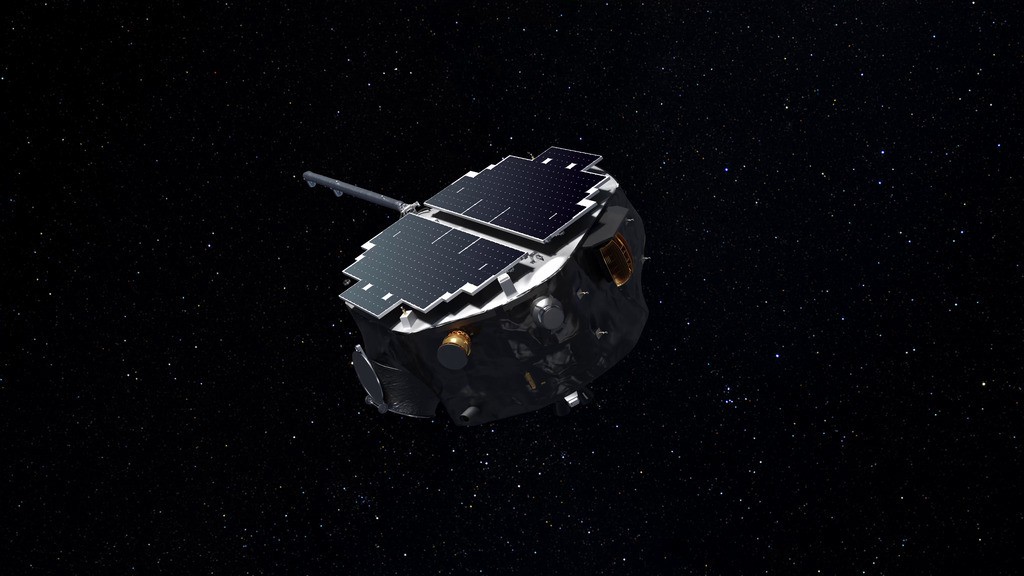
NASA’s IMAP (Interstellar Mapping and Acceleration Probe) began its two-year primary science mission on Feb. 1 to explore and map the boundaries of our heliosphere — the protective bubble created by the solar wind that encapsulates our solar system.
The mission, which launched on Sept. 24, 2025, relies on 10 scientific instruments to chart a comprehensive picture of what’s roiling in space, from high-energy particles originating at the Sun, to magnetic fields in interplanetary space, to dust left from exploded stars in interstellar space.
NASA’s IMAP (Interstellar Mapping and Acceleration Probe) is mapping the boundaries of our heliosphere — a giant protective bubble created by the Sun that encapsulates our solar system. The spacecraft studies the Sun’s activity and how the heliosphere’s boundary interacts with the local galactic neighborhood beyond.
Credit: NASA/Joy Ng
Through studying this vast range of particles and the magnetic fields that guide them, IMAP will investigate two of the most important overarching issues in heliophysics, namely the energization of charged particles from the Sun and the interaction of the solar wind at its boundary with interstellar space.
With the start of its primary science mission, some of IMAP’s data is now being fed into the IMAP Active Link for Real-Time (I-ALiRT) system, which broadcasts near–real-time observations of the space weather conditions, such as the solar wind and energetic particles, headed toward Earth. This data can be used to inform forecasters, who issue advanced warnings and alerts of potential adverse space weather effects on the health and safety of spacecraft and astronauts.
Principal investigator and Princeton University professor David McComas leads the IMAP mission, which has an international team of 27 partner institutions. The Johns Hopkins Applied Physics Laboratory (APL) in Laurel, Maryland, managed the development phase, built the spacecraft, and operates the mission, which is the fifth in NASA’s Solar Terrestrial Probes Program portfolio. The Explorers and Heliophysics Projects Division at NASA’s Goddard Space Flight Center in Greenbelt, Maryland, manages the Solar Terrestrial Probes Program for the agency’s Heliophysics Division of NASA’s Science Mission Directorate.
Learn more about IMAP’s science mission here: https://science.nasa.gov/missions/nasas-imap-mission-to-study-boundaries-of-our-home-in-space/
By Mara Johnson-Groh
NASA’s Goddard Space Flight Center, Greenbelt, Md.
February 2, 2026
More from IMAP (Interstellar Mapping and Acceleration Probe)