
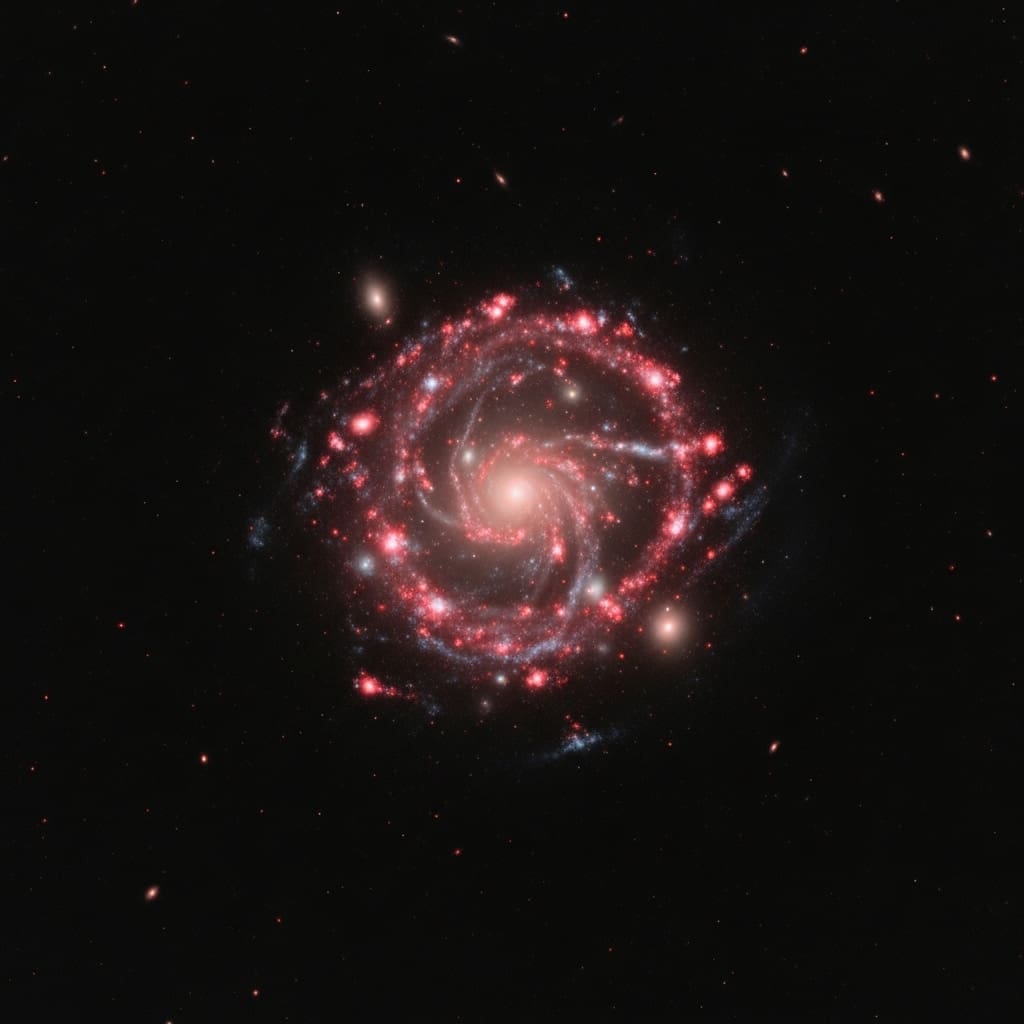
Scientists are probing the early universe with new observations from the James Webb Space Telescope, revealing a surprisingly complex picture of galaxy formation. Yuichi Harikane, from the Institute for Cosmic Ray Research, The University of Tokyo, alongside Pablo G. Perez-Gonzalez and Javier Alvarez-Marquez from Centro de Astrobiologıa (CAB), CSIC-INTA, and et al., report the discovery of CEERS2-588, a UV-luminous galaxy existing just 400 million years after the Big Bang. This galaxy challenges current theoretical models, exhibiting a prominent Balmer break and a surprisingly high stellar mass, making it the most massive galaxy securely confirmed at such an early epoch. Crucially, despite its brightness, CEERS2-588 shows remarkably weak star formation activity and near-solar metallicity, suggesting that rapid quenching may have been a common process in the early universe and offering new insights into the abundance of luminous galaxies observed by JWST.
This contrasts sharply with other galaxies observed at similar redshifts, which typically exhibit ongoing star formation. The absence of detected Hα or [OIII] emission lines in the MIRI Spectroscopy, despite long integration times of 9.5 and 17.8 hours respectively, further supports this quenching scenario and suggests the observed MIRI fluxes are dominated by rest-frame optical stellar continuum emission. Furthermore, the research unveils a galaxy with an effective radius of approximately 450 parsecs and no evidence of strong active galactic nucleus (AGN) activity, classifying it as a typical extended system. The MIRI observations provide crucial rest-frame optical diagnostics, previously unavailable, allowing scientists to constrain key properties like stellar mass and metallicity with unprecedented accuracy. These findings not only challenge existing theoretical frameworks but also highlight the power of JWST’s MIRI instrument in probing the early universe and uncovering the secrets of the first galaxies0.5 and 17.8 hours respectively, to probe rest-frame optical light from this distant galaxy. Crucially, the study pioneered MIRI/MRS spectroscopy, integrating spectra over ±100km s−1, to search for key emission lines like Hα and [OIII]λ5007, but detected neither, indicating that the observed MIRI fluxes primarily originate from stellar continuum emission. Prior stellar mass estimates, ranging from 8.1 ≲log(M∗/M⊙) ≲9.59, were previously limited by reliance on rest-frame ultraviolet wavelengths. The team harnessed multi-epoch observations to constrain the equivalent widths of Hα and [OIII], finding values ≲200, 400Å, substantially lower than those observed in comparably luminous high-Redshift galaxies.
Furthermore, the study employed multiple strong-line diagnostics to infer a gas-phase metallicity near solar, with 12 + log(O/H) ≃8.6, exceeding predictions from current theoretical models. The SED fitting process demonstrated good agreement between observed and model-predicted emission-line fluxes for Hα, [O iii]λ5007, and [O ii]λ3727, validating the accuracy of the derived parameters. This methodological combination, deep MIRI imaging and spectroscopy coupled with sophisticated SED fitting, revealed a galaxy undergoing rapid quenching, a previously unobserved phase at z > 10.
Mature Galaxy CEERS2-588 at Redshift 11
Remarkably, measurements confirm a near-solar gas-phase metallicity, with a value of 12 + log(O/H) ≃8.6, exceeding predictions from existing theoretical models. Tests prove the detection of a Balmer break in CEERS2-588’s spectrum, a key indicator of stellar populations and galaxy maturity at this early epoch. Data shows the inferred star formation rate, based on UV continuum and Hα upper limits, is consistent with the observed decline in star formation. Results demonstrate that despite its large stellar mass, the Hα-based star formation rate is lower than that of other galaxies at similar redshifts, falling significantly below established star formation rate-stellar mass relations at redshifts between 7 and 10.
CEERS2-588’s Balmer Break and Star Formation History reveal
This detection represents the first instance of such a feature observed at this extreme redshift, offering crucial insight into the galaxy’s stellar populations. Spectral analysis indicates an extended period of star formation, potentially spanning several hundred million years, followed by a rapid cessation of star formation within the last few million years, a pattern differing from other known galaxies at similar epochs. Remarkably, the inferred gas-phase metallicity is near solar, exceeding expectations based on prevailing theoretical predictions for galaxies at this redshift. The authors acknowledge limitations in constraining the star formation history due to the relatively short duration of the observations and the challenges of modelling dust extinction at these redshifts. Future research could focus on obtaining deeper spectroscopic data to refine the star formation history and metallicity measurements, as well as expanding the sample of similarly high-redshift galaxies to test the generality of these findings.