
When four astronauts blast off towards the moon on board Nasa’s Artemis II mission, employees at the Slough headquarters of a British engineering firm will be watching particularly closely.
Making the 500,000-mile round trip to orbit the moon and return to Earth will be 32 crucial pieces of hardware.
These filtration sieves are designed to keep gas bubbles out of the propellant tanks that will manoeuvre the Orion spacecraft on its historic mission, humanity’s the first trip to the moon in more than 53 years.

Filters to prevent gas bubbles going into the liquid propellant have been made by a company based in Slough

The square devices are about 15cm wide, made of titanium and a steel mesh with holes measuring just 15 microns, less than a sixtieth of a millimetre. They were designed and manufactured by John Crane, a company that has been headquartered in Slough since 1923, as a collaboration between its scientists based in Britain and its filtration experts in Germany.
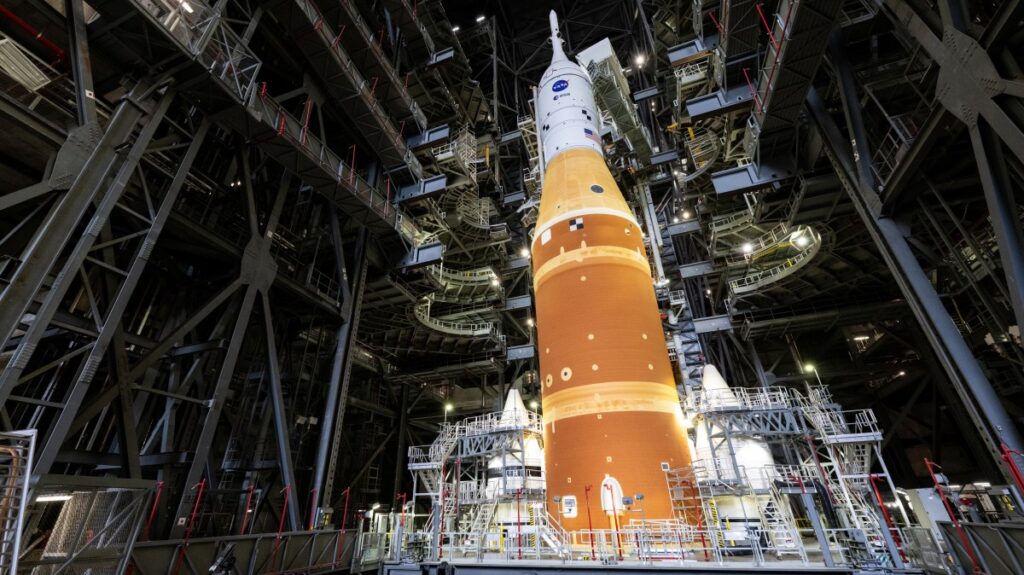
Nasa is set to conduct a “wet dress rehearsal” for the Artemis II mission in the early hours of Tuesday morning UK time, when countdown systems will be tested and fuel will be pumped into the giant Space Launch System rocket as it sits on the launchpad at the Kennedy Space Centre in Florida.
If there are no technical glitches, Nasa could make its first attempt to launch three Americans and a Canadian — Reid Wiseman, Christina Koch, Victor Glover and Jeremy Hansen — towards the moon next Sunday. There will be more windows to launch on February 10 and 11, and another batch of possible dates in March and April.
Jeroen Huizinga, a senior director at John Crane, said: “It’s exciting to [play] a tiny part in this kind of a mission. It’s just a tiny part, it looks very simple and very small, but it is going up to the moon.”
The company was approached for the project in 2010 thanks to its expertise in making precise filtration devices for use in the pharmaceutical and oil and gas industries.
• Why go back to the moon? Read The Times’s visual interactive guide to the Artemis II mission
Beneath the crew module for the Artemis II mission sits the cylindrical service module, which was built by the European Space Agency. This module supplies air and water for the astronauts and also contains 33 engines and 8.6 tonnes of fuel in four 2,000-litre propellant tanks, each of which have eight filters created by John Crane.
“It is within the propellant tanks where our special sieves are installed,” Huizinga said. “They are separators. In the tanks, what is very important is … to prevent gas bubbles going into the liquid propellant.”
Such bubbles could lead to a phenomenon called cavitation, where the bubbles implode violently, hindering the flow of fuel and possibly causing serious damage.
And it only takes a tiny fault to cause a catastrophe. The explosion that tore apart the service module on Apollo 13 in 1970, nearly leading to the deaths of three astronauts, was caused by damaged insulation on a single piece of wire in an oxygen tank.

The astronauts on the Artemis II mission: Christina Koch, Reid Wiseman, Victor Glover and Jeremy Hansen
NASA/PA
Materials scientists at John Crane had to devise a special process to weld the stainless steel mesh to the titanium for the sieves, which were manufactured in Bremen before being delivered in 2014 for rigorous testing by the Ariane Group, which worked on the service module.
John Crane was founded in Chicago in 1917, named for the engineer who used lead foil from tobacco packages to repair leaky radiator pumps. For 103 years, its global operations have been headquartered in Berkshire.
The company’s filters have already travelled to the moon and back on the uncrewed Artemis I mission in 2022, but the stakes will now be higher for Artemis II with four people on board.
Asked if he was nervous, Huizinga said: “We are absolutely excited. Not nervous, per se. We were on Artemis I and this is a continuation. And it has gone through such enormous rigorous testing.”