
Michael Shermer is the publisher of Skeptic magazine and author of the newly published book “Truth: What It Is, How to Find It, and Why It Still Matters.”
On Jan. 13, Vermont legislator Troy Headrick (I) proposed creating a state task force that would get to the bottom of “unidentified anomalous phenomena,” or UAPs, that appeared to be buzzing about U.S. military air bases. Days later, Helen McCaw, a former senior analyst in financial security at the Bank of England, urged the bank’s governor to prepare for possible financial collapse should the White House disclose the existence of alien intelligence.
I have been following and writing about UFO phenomena and the people who believe they represent alien visitation since the 1990s, and until recently the topic was always largely treated by the public and media as fringe and beneath serious consideration. That began to change in 2017, when The New York Times published a front-page story about the Pentagon having established the secret Advanced Aerospace Threat Identification Program to learn what was really going on with all these sightings, many of which happened over military facilities.
Since then there have been Congressional hearings involving, not tinfoil-hat-wearing kooks, but — for example — former Navy pilots David Fravor and Ryan Graves and government intelligence employees Luis Elizondo and David Grusch, who told Congress and millions of online viewers that the U.S. government was covering up evidence of alien visitation. The UAP acronym, gradually adopted by the Pentagon around 2020, signifies the subject’s transformation into the official conversation.
All of this was packaged into a documentary released last year by the noted filmmaker Dan Farah, “The Age of Disclosure,” which has been widely reviewed in mainstream media and discussed not only on popular podcasts with UFO enthusiasts but at the highest levels of government, including by Secretary of State Marco Rubio.
Before we consider how this happened, let me address the claims themselves.
First, even some ufologists admit sightings are overreported. In her 2010 book “UFOs: Generals, Pilots, and Government Officials Go on the Record,” Leslie Kean wrote that “roughly 90 to 95 percent of UFO sightings can be explained” as such prosaic phenomena as weather balloons, blimps, planes flying in formation, secret military aircraft, the planet Venus, meteors or meteorites, satellites, lights on the ground and the like. So only a small number of sightings even qualify as unidentified.
What about the reports of unexplained phenomena by pilots and astronauts? According to Scott Kelly, who has logged more than 15,000 hours over 30 years in planes and in space, “the environment that we fly in is very conducive to optical illusions.” At a NASA news conference on UAPs, he recalled his co-pilot seeing a mysterious object that turned out to be “a Bart Simpson balloon.” Kelly added that his brother Mark, a former NASA astronaut and now a U.S. senator, told about being on the space shuttle when someone spotted a dropped tool apparently floating near their ship, only to discover the object was the International Space Station, 80 miles away.
In my own classification system, I put reported UFO and UAP sightings in three categories: 1. ordinary terrestrial (balloons, camera/lens effects, visual illusions, etc.), 2. extraordinary terrestrial (Russian or Chinese spy planes or drones capable of feats unheard of in the U.S.) and 3. extraordinary extraterrestrial (alien presence).
I strongly suspect that all UAP sightings fall into the first category, but other commentators suggest the second, noting that they could represent Russian or Chinese assets using technology as yet unknown to American scientists, capable of speeds and turns that seemingly defy all their physics and aerodynamics.
That hypothesis is highly unlikely. It is simply not possible that some nation, corporation or lone individual — no matter how smart and creative — could have created an aircraft of any sort that would be centuries ahead of the West’s present technologies. It would be as if the United States were flying biplanes while the Russians or Chinese were flying Stealth fighter jets, or we were still experimenting with captured German V-2 rockets while they were testing SpaceX-level rocketry. Impossible. We would know about all the steps leading to such technological wizardry.
Finally, could UAPs really be space aliens? It’s not impossible, but it is highly improbable. While intelligent life is probably out there somewhere, the distances between the stars are so vast that it is extremely unlikely that any have come here, and what little evidence is offered by UAP believers comes in the form of highly questionable grainy photographs, blurry videos and stories about strange lights in the night sky.
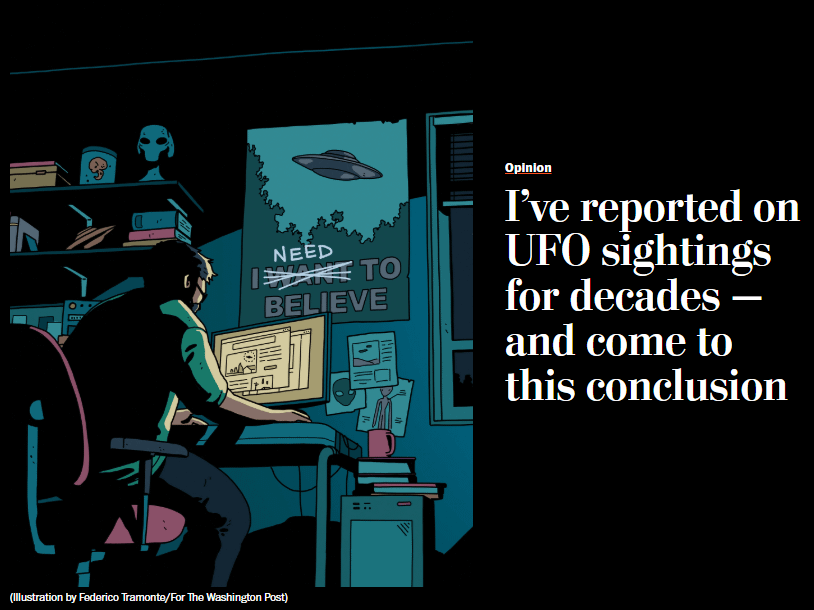
What I think is actually going on is a deep, religious-like impulse to believe that there is a godlike, omnipotent intelligence out there who 1. knows we’re here, 2. is monitoring us and is concerned for our well-being and 3. will save us if we’re good. Researchers have found, for example, an inverse relationship between religiosity, meaning and belief in aliens; that is, those who report low levels of religious belief but high desire for meaning show greater belief in extraterrestrials. They also found that people who self-identified as either atheist or agnostic were more likely to report believing in ETIs than those who reported being religious (primarily Christian).
From this research, and my own on the existential function served by belief in aliens, I have come to the conclusion that aliens are sky gods for skeptics, deities for atheists and a secular alternative to replace the rapidly declining religiosity in the West — particularly the United States and the United Kingdom, where, not coincidentally, most UAP sightings are made.
by Rafaelis75