
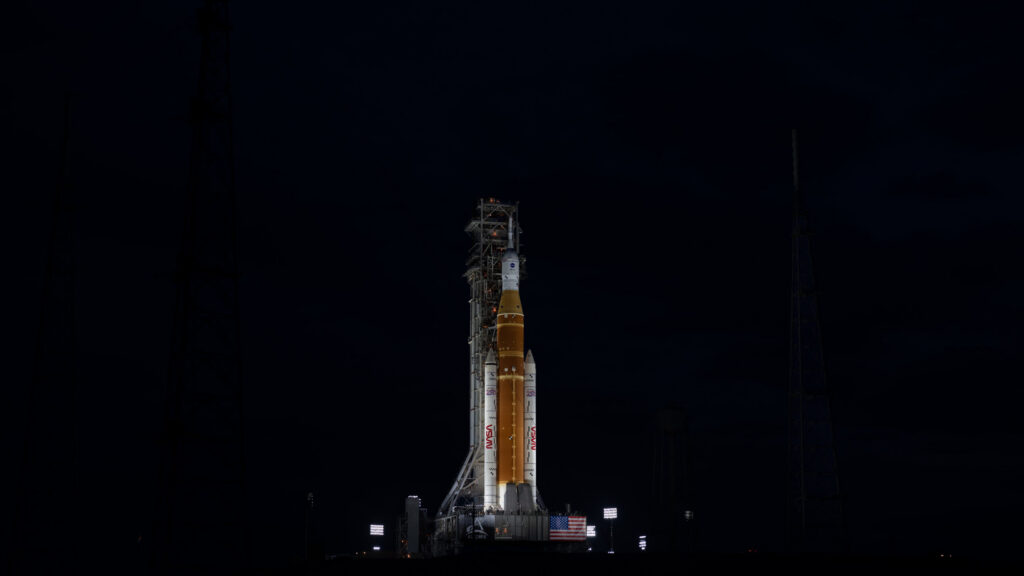
When NASA’s Space Launch System fires its engines for the second time in history, it will be flying because of more than 14,000 Coloradans. It will carry four astronauts, three Americans and one Canadian, on a course around the moon in what may be the most consequential NASA mission in more than 50 years.
The mission will be humanity’s first crewed mission to our celestial companion since 1972. And Artemis, so named as the twin sister of Apollo, is set to take NASA back with the first window to launch opening on Feb. 8. Because of orbital dynamics and rocket science, NASA has to plan launches in a range of dates, or windows, to ensure the maximum chance of success.
While Artemis II won’t land on the moon — the landers are still under development — its mission will be the closest humans have come to touching lunar dust since 1972.
And Colorado companies big and small from up and down the Front Range are working to ensure the mission is perfect. It’s not as simple as imitating the Artemis I mission, which launched two years ago.
Artemis II echoes missions from nearly 60 years ago.
“If you look at Artemis II and Apollo 8, you know, they’re both from the same mold where you’re testing out that you know it’s going to work the way you think,” said NASA’s Chief Historian Brian Odom. “There’s so much that can go wrong with new experience, new information that you’re getting … There is always a lesson to be learned. You just hope you get to learn that in a situation where you can recover.”
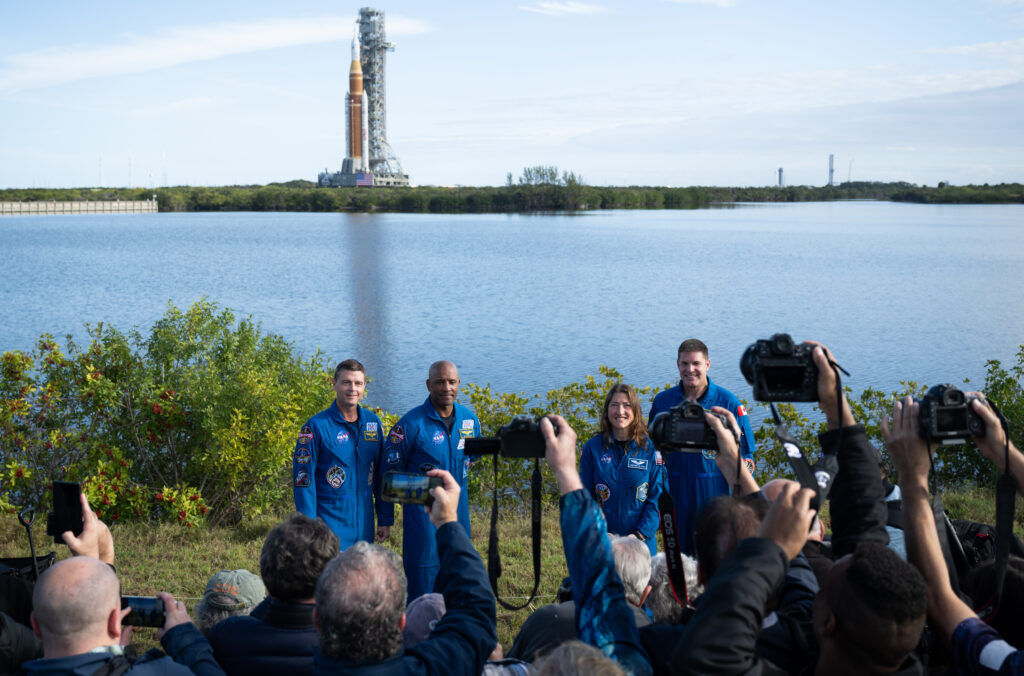 NASA astronauts Reid Wiseman, Artemis II commander, Victor Glover, Artemis II pilot, left, Christina Koch, Artemis II mission specialist, and CSA (Canadian Space Agency) astronaut Jeremy Hansen, Artemis II mission specialist, pose for a picture after speaking to members of the media during NASA’s Artemis II SLS (Space Launch System) rocket and Orion spacecraft rollout to Launch Complex 39B at NASA’s Kennedy Space Center in Florida on Jan. 17, 2026. In the coming weeks, engineers will prepare for the wet dress rehearsal, a two-day test that simulates launch day. The Artemis II test flight will take Wiseman, Glover, Koch, and Hansen around the Moon and back to Earth no later than April 2026. Photo Credit: (NASA/Joel Kowsky)
And if NASA wants to win the new space race to land on Mars, the agency will have to rediscover the balance of risk and safety it struck when it first traveled to the moon.
NASA Administrator Jared Isaacman told the agency, “America will lead in the peaceful exploration of space,” pledging to double down on its efforts to return Americans to the moon. As the new space race between the U.S. and China builds, Artemis is a planned step for NASA before it attempts a giant leap to Mars.
And Colorado’s aerospace sector is getting it there. The industry employs 55,000 people directly, according to the state. More than half, 26,000 people, work on programs directly linked to NASA, said Lesley Conn, director of strategic engagement at the Space Foundation, a space advocacy non-profit headquartered in Colorado Springs.
There are 26 companies directly tied to Artemis in Colorado Springs, and statewide, Artemis supports 14,000 jobs, she said.
Colorado has the third most companies, 264, contributing to the Artemis program, behind only California (790) and Florida (399). It has more than twice the number of companies located in Alabama (109), according to NASA’s list of suppliers for the program.
“The Artemis mission is powered by the Colorado aerospace economy,” said Parker White, director the Colorado Competitive Council. “If you don’t have the Colorado aerospace footprint, you wouldn’t have an Artemis mission.”
 NASA’s Space Launch System rocket is seen inside high bay 3 of the Vehicle Assembly Building as teams await the arrival of Artemis II crewmembers NASA astronauts Reid Wiseman, commander; Victor Glover, pilot; Christina Koch, mission specialist; and CSA (Canadian Space Agency) astronaut Jeremy Hansen, mission specialist; to board their Orion spacecraft atop the rocket as part of the Artemis II countdown demonstration test on Dec. 20 at NASA’s Kennedy Space Center in Florida. For this operation, the Artemis II crew and launch teams are simulating the launch day timeline including suit-up, walkout, and spacecraft ingress and egress. Through the Artemis campaign, NASA will send astronauts to explore the Moon for scientific discovery, economic benefits, and to build the foundation for the first crewed missions to Mars, for the benefit of all. (Joel Kowsky, NASA)
Getting to the moon is no easy feat and requires an exceptional vehicle.
The Lockheed Martin-built Orion spacecraft, which was designed in Colorado, is the only vehicle for the job, according to staff at the company.
“There’s never been anything like Orion,” said Blaine Brown, Lockheed’s director for Orion spacecraft mechanical systems . “We are the only ship that can take humans to deep space and back. Others are just designed for low earth orbit.”
The company views its Orion space capsule as an exploration class vessel, he said.
‘It’s very emotional for everyone’
During NASA’s initial attempts to relaunch a moon landing campaign, what eventually became Orion looked very different from the Apollo-like capsule of today.
“Our original design was a lifting body,” Brown said.
A lifting body is a type of air or spacecraft where the fuselage, and not just the wings, produce lift, helping it fly.
“(Ultimately) we used an Apollo-like capsule, mainly because it made sense. It leveraged the technology and all of the work done on Apollo, it is stable and it’s the most robust body to return to earth’s atmosphere.”
Conceived as part of the Constellation Program, the Orion Capsule first flew in 2014. Lockheed Martin purchased a Delta IV Heavy, which was, for a time, the most powerful launch vehicle available, sending Orion on a four-hour, two-orbit test flight.
It was a resounding success. And now, Orion is flying four astronauts to the moon.
“I’ve been wanting to do this my entire career,” Brown said. “It is very emotional for everyone. There’s been so much effort … It takes lots of hard work to build a human-rated space ship.”
Orion flew again during the Artemis I mission. While another success, the craft spent 25 days in space before splashing down, there were some kinks that needed to get ironed out before the crewed flight.
Of particular note was some unexpected material loss on the Orion heat shield.
“We did see unexplained losses of char material,” Brown said of a substance that is designed to partially burn and slowly vaporize. It takes heat away from the space craft and keeps its occupants comfortable and alive.
“We figured it out and we know why it happened. … We will use a revised set of blocks for Artemis III, but with Artemis II we’re using the same blocks just using a different reentry trajectory.”
 Technicians with NASA’s Exploration Ground Systems team prepare for integration to attach the agency’s Orion spacecraft on top of the SLS (Space Launch System) rocket in High Bay 3 of the Vehicle Assembly Building at NASA’s Kennedy Space Center in Florida on Friday, Oct. 17, 2025, for the agency’s Artemis II mission. Set to launch in 2026, the spacecraft will carry NASA astronauts Reid Wiseman, Victor Glover, Christina Koch, and CSA (Canadian Space Agency) astronaut Jeremy Hansen on a 10-day mission around the Moon and back. Once stacked, teams will begin conducting a series of verification tests ahead of rolling out to Launch Complex 39B for the wet dress rehearsal at NASA Kennedy.
When Artemis I came back to earth, it skipped across the atmosphere for more than 3,100 miles. This prevented the heat shield from venting and shedding gasses, which ultimately popped, resulting in the unexpected losses.
However, astronauts onboard would have stayed cool, according to Brown and NASA. Temperatures hovered in the mid 70s.
In order to prevent this from happening on Artemis II, NASA is going with a shorter, more aggressive reentry trajectory. This will ensure the char layer vaporizes at the correct rates.
The adjusted trajectory limits how long Orion “spends in the temperature range” where the first mission’s issues were observed, NASA said.
With the Space Launch System fully stacked, Orion integrated and all the final checks being completed, Brown suddenly became very aware of the moment in history that he was a part of.
“We’re about to start a lunar exploration campaign that will change humanity,” he said. “We’re going to build a base on the moon and there will be people living on the moon.”
Colorado Springs company ensures mission success
Not all of the companies working on Artemis are in the rocket industry, per se. One company in Colorado Springs, Frontgrade Technologies, specializes in high reliability electronics.
Where a smartphone might begin to display error messages if the temperature gets too high, Frontgrade’s computer chips have to operate in an unforgiving environment.
“Our capability, our bread and butter historically, has always been to design, develop and field either radiation hardened or radiation tolerant microelectronics,” said David Meyouhas, Frontgrade’s president of microelectronics and mission processing. “We’re also leveraging those base building blocks and integrating them into higher level systems” such as the Orion capsule and Space Launch System.
The company, which was formerly known as CAES before rebranding in 2023, employs about 200 people at its Colorado Springs manufacturing hub and headquarters. More than 100 of those employees are working on the Artemis missions, Meyouhas said.
While they are excited to see the rocket launch, possibly as soon as Feb. 6, but no later than April, nobody at Frontgrade is ignorant of the risks posed by spaceflight.
Forty years ago, the Challenger Space Shuttle exploded 73 seconds after launch, killing all seven astronauts on board. On Feb. 1, 2003, the Columbia Space Shuttle disintegrated while returning to Earth, killing all seven astronauts onboard.
On Jan. 27, 1967, a fire broke out in the Apollo 1 capsule, killing the three occupants.
“We’re dealing with human lives here, and so failure, failure is not an option,” Meyouhas said, echoing the famous words of Gene Kranz. “There’s no room for error.”
Frontgrade’s technology can be found in various computer components onboard both Artemis and Orion. But the company is positioning itself to remain a preferred supplier of electrical components for Department of Defense, civilian and commercial space uses.
It offers everything from field programmable grid arrays, which are computers that can be reconfigured to different tasks on the fly as conditions change, to radiation resistant communications devices.
 The Apollo 8 (Spacecraft 103/Saturn 503) space vehicle is launched from Pad A, Launch Complex 39, at the Kennedy Space Center, at 7:51 a.m. (EST) on Dec. 21, 1968. The crew of the Apollo 8 lunar orbit mission included astronauts Frank Borman, commander; James A. Lovell Jr., command module pilot; and William A. Anders, lunar module pilot. Apollo 8 was the first manned Saturn V launch. (NASA file photo)
“We’ve got technology that’s able to sweep the entire spectrum of what the new space ecosystem is,” Meyouhas said. “We’ve made, and we continue to make, significant research and development expenditures to help provide cutting edge, bleeding edge technology (for future missions).”
Not every company is providing hardware for the launch. One company with local ties, Amentum, is working with NASA to ensure all the infrastructure is in place for a smooth launch.
The company is involved in every step of the launch, from rocket stacking, rolling it out to the launch pad to the capsule recovery operations that will happen a continent away. It employs more than 1.300 people in Colorado Springs.
“We’re not an OEM. We’re not an original equipment manufacturer. We’re the integration contractor,” said Brad McCain, the vice president and program manager for Amentum’s space operations division. “The ground support equipment, the infrastructure, is all Amentum’s to maintain.”
The company receives all the major subassemblies and puts them together in the Vehicle Assembly Building (VAB) like the world’s largest model kit.
‘Ready to have our Apollo 8 moment’
Inside the cavernous VAB, one’s sense of scale is lost. It is one of the largest buildings in the world by volume and has enough space to hold four fully assembled Saturn V rockets, according to NASA. The Saturn V was 363 feet tall and 33 feet wide when fully assembled. The Space Launch System is just slightly shorter at 322 feet.
“You don’t realize how big it is and what kind of spaceship you’re actually working on. But as the platforms move away and it starts to appear, you realize, ‘hey, we’re getting close,’” McCain said. “And then that last day and a half, the (platforms are) all gone, and you got a big, giant, most powerful rocket NASA has ever built. … It’s exciting.”
 NASA’s Artemis II Orion spacecraft with its launch abort system is stacked atop the agency’s SLS (Space Launch System) rocket in High Bay 3 of the Vehicle Assembly Building at NASA’s Kennedy Space Center in Florida on Oct. 20. The spacecraft will carry NASA astronauts Reid Wiseman, Victor Glover, Christina Koch, and CSA (Canadian Space Agency) astronaut Jeremy Hansen on a 10-day mission around the Moon and back early this year. Teams will begin conducting a series of verification tests ahead of rolling out the integrated SLS rocket to NASA Kennedy’s Launch Complex 39B for the wet dress rehearsal.
During his interview with The Gazette, McCain had LEGO models of SLS and the Space Shuttle on display behind him.
It’s fitting. The Space Launch System is using the same crawler transporter that carried the shuttle and Saturn V rocket to the launch pads. And the rocket is using the same engines that powered the shuttle fleet.
Artemis is carrying on the legacy begun by the Apollo missions, and the noble tradition carried on by NASA’s Space Shuttle astronauts. The mission II is following in the footsteps of Apollo 8.
That mission, launched in 1968 during a time of social upheaval and world tension, is among one of NASA’s finest moments. Rather than a lunar landing mission, or a dress rehearsal for it like Apollo 10, Apollo 8 was a voyage around the dark side of the moon.
As their ship emerged, they saw the Earth rising above the lunar horizon. Astronaut William Anders, struck by the moment grabbed a camera.
“Oh my God, look at that picture over there! There’s the Earth comin’ up. Wow, is that pretty!” he said to his crew mates. In one moment, Anders photographed every living being on the planet at the time, minus three.
The picture, dubbed “Earthrise” held a mirror up to humnaity, showing people where they lived in a completely different context. Galen Rowell, a nature and adventure photographer who died in 2002, called it the most influential environmental photograph ever taken, according to various reports.
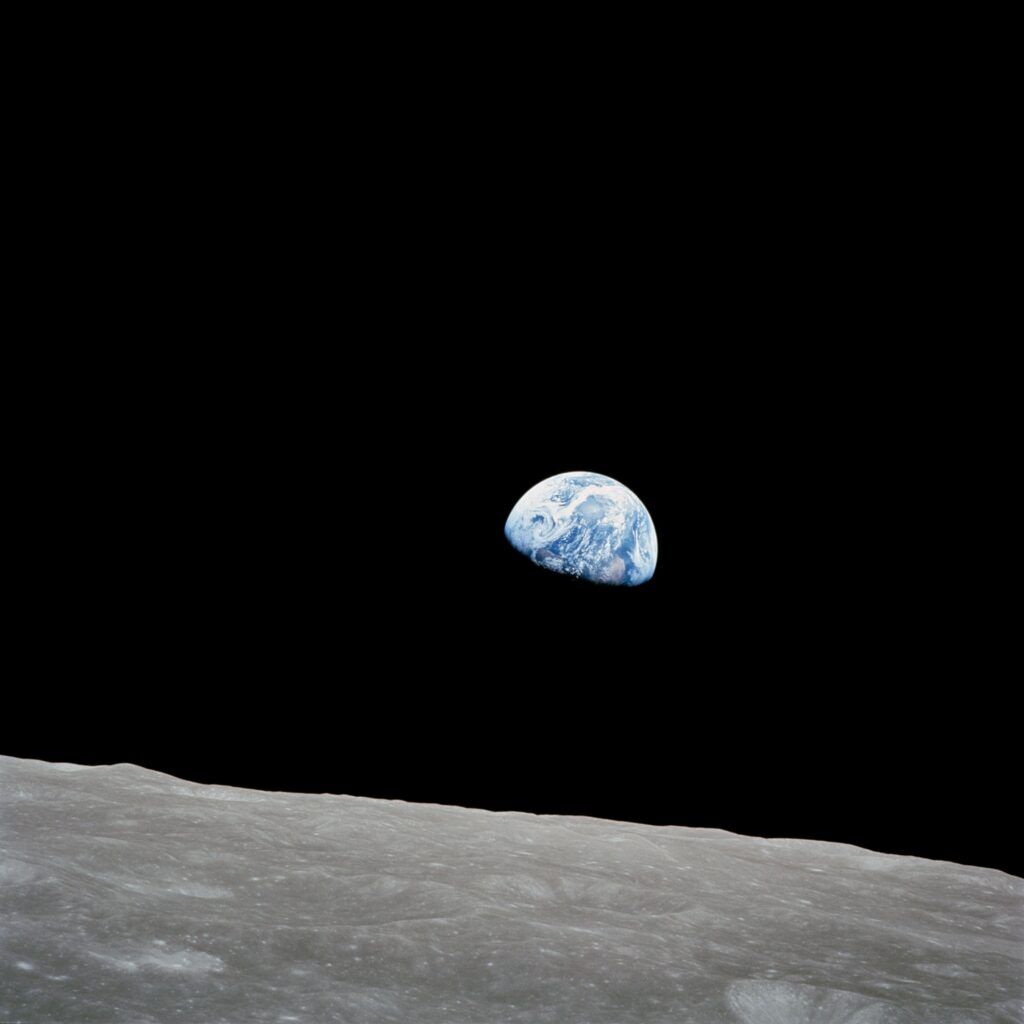 The rising Earth is about five degrees above the lunar horizon in this telephoto view taken from the Apollo 8 spacecraft near 110 degrees east longitude. The horizon, about 570 kilometers (350 statute miles) from the spacecraft, is near the eastern limb of the moon as viewed from Earth. Width of the view at the horizon is about 150 kilometers (95 statute miles). On Earth 240,000 statute miles away the sunset terminator crosses Africa. The crew took the photo around 10:40 a.m. Houston time on the morning of Dec. 24, and that would make it 15:40 GMT on the same day. The South Pole is in the white area near the left end of the terminator. North and South America are under the clouds. (NASA)
And, recognizing the parallels, Colorado’s businesses are ready to deliver success.
“We are ready to have our Apollo 8 moment,” said Lockheed Martin’s Brown. “We’re about to write some records in the history books. It’s time to go.”