
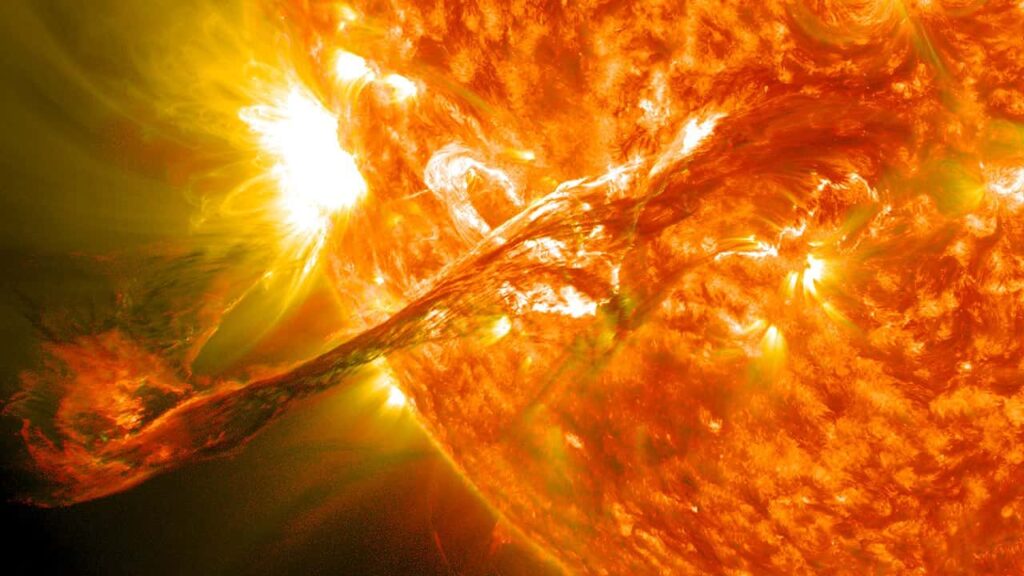
 On August 31, 2012, a long filament of solar material that had been hovering in the sun’s atmosphere, the corona, erupted out into space at 4:36 p.m. EDT. The coronal mass ejection, or CME, traveled at over 900 miles per second. Credit: Wikimedia Commons
Imagine standing on a snowy mountain ridge. A single fracture forms in the ice crust, or a small patch of heavy snow shifts just an inch. That tiny movement destabilizes the snowpack below, which pushes against the next layer. Within moments, the entire mountainside is a cascading white sheet of destruction. We call this phenomenon an avalanche.
Now, thanks to the European Space Agency’s Solar Orbiter spacecraft, we know that our Sun—a churning ball of million-degree plasma—operates by the same terrifying logic.
On Sept. 30, 2024, the Sun released a solar flare that, at first glance, followed the usual script: a sudden brightening in its outer atmosphere, a sharp rise in X-rays, and a burst of high-energy particles. Flares of this kind can disturb the space environment around Earth and, in stronger cases, contribute to geomagnetic storms that disrupt radio communication and stress power grids.
While nothing special happened this time, not a lot is known about how exactly this phenomenon unfolds. Scientists know flares draw their power from magnetic fields that twist, tangle, and sometimes snap into new shapes. What has been hard to catch is the first shove—the moment the system tips from tense to explosive.
During a close approach to the Sun, the European Space Agency’s Solar Orbiter watched that tipping point unfold in unusually fine detail. The spacecraft observed the M7.7-class flare—strong but still far below the most extreme X-class flares—and tracked the buildup for roughly 40 minutes before the main outburst.
“It’s the first time we see this at this level of spatial and temporal detail in the solar corona,” said Pradeep Chitta of the Max Planck Institute for Solar System Research, in a statement carried by ESA.
What the team reports in the journal Astronomy & Astrophysics is like a slope giving way, with small slips that stack into a “magnetic avalanche.”
Magnetic Cascade
Solar Orbiter’s most detailed view yet of a large solar flare, with filaments, raining plasma blobs, magnetic reconnection events and X-ray emission labeled. Credit: ESA & NASA/Solar Orbiter/EUI Team
Solar Orbiter’s Extreme Ultraviolet Imager took pictures every two seconds, resolving features down to a few hundred kilometers across. That’s fine enough to watch magnetic structures change frame by frame.
×
Thank you! One more thing…
Please check your inbox and confirm your subscription.
When the spacecraft began staring at the region around 23:06 UT, it saw a dark, arch-like filament—cooler, denser material suspended in the hot corona—connected to a bright, cross-shaped tangle of loops.
Then came the key behavior: repeated, rapid rearrangements at the crossing point of the loops, where the magnetic field geometry suggested the fields were repeatedly breaking and reconnecting on very short timescales.
Solar Orbiter’s high-resolution images reveal the fine-grained detail of the ‘magnetic avalanche’ process that led up to the major solar flare of 30 September 2024. Credit: ESA & NASA/Solar Orbiter/EUI Team
“We were really very lucky to witness the precursor events of this large flare in such beautiful detail,” Chitta said. “Such detailed high-cadence observations of a flare are not possible all the time because of the limited observational windows and because data like these take up so much memory space on the spacecraft’s onboard computer.”
Motions along the magnetic loops accelerated, sections of the filament broke free, and the structure began to unwind quickly as the flare drew closer. In the final minutes before the eruption, the researchers saw streams of material moving in opposite directions and sudden jolts that signaled increasingly powerful magnetic rearrangements.
Plasma Rain
Solar Orbiter saw that, in the lead-up to a solar flare, twisted magnetic fields break and reconnect, creating an outflow of energy that subsequently rains down through the Sun’s atmosphere in ribbon-like streams. Credit: ESA & NASA/Solar Orbiter/EUI Team=
As the flare peaked around 23:47 UT, Solar Orbiter recorded a sudden jump in X-rays, a clear sign that particles were being flung to high speeds and crashing into denser layers of the Sun.
The most striking visual signature came not as a single blast outward, but as motion downward: bright, ribbon-like streaks in the corona, threaded with short-lived blobs that looked like plasma “rain.”
“We saw ribbon-like features moving extremely quickly down through the Sun’s atmosphere, even before the main episode of the flare,” Chitta added. “These streams of ‘raining plasma blobs’ are signatures of energy deposition, which get stronger and stronger as the flare progresses. Even after the flare subsides, the rain continues for some time.”
The team reports that individual ribbon threads lit up for only about 10 to 20 seconds, while the embedded blobs lasted just a few seconds. The rain began minutes before the strongest X-ray pulse and persisted minutes afterward, revealing that the flare unfolded in bursts rather than a single, clean release.
Space Weather
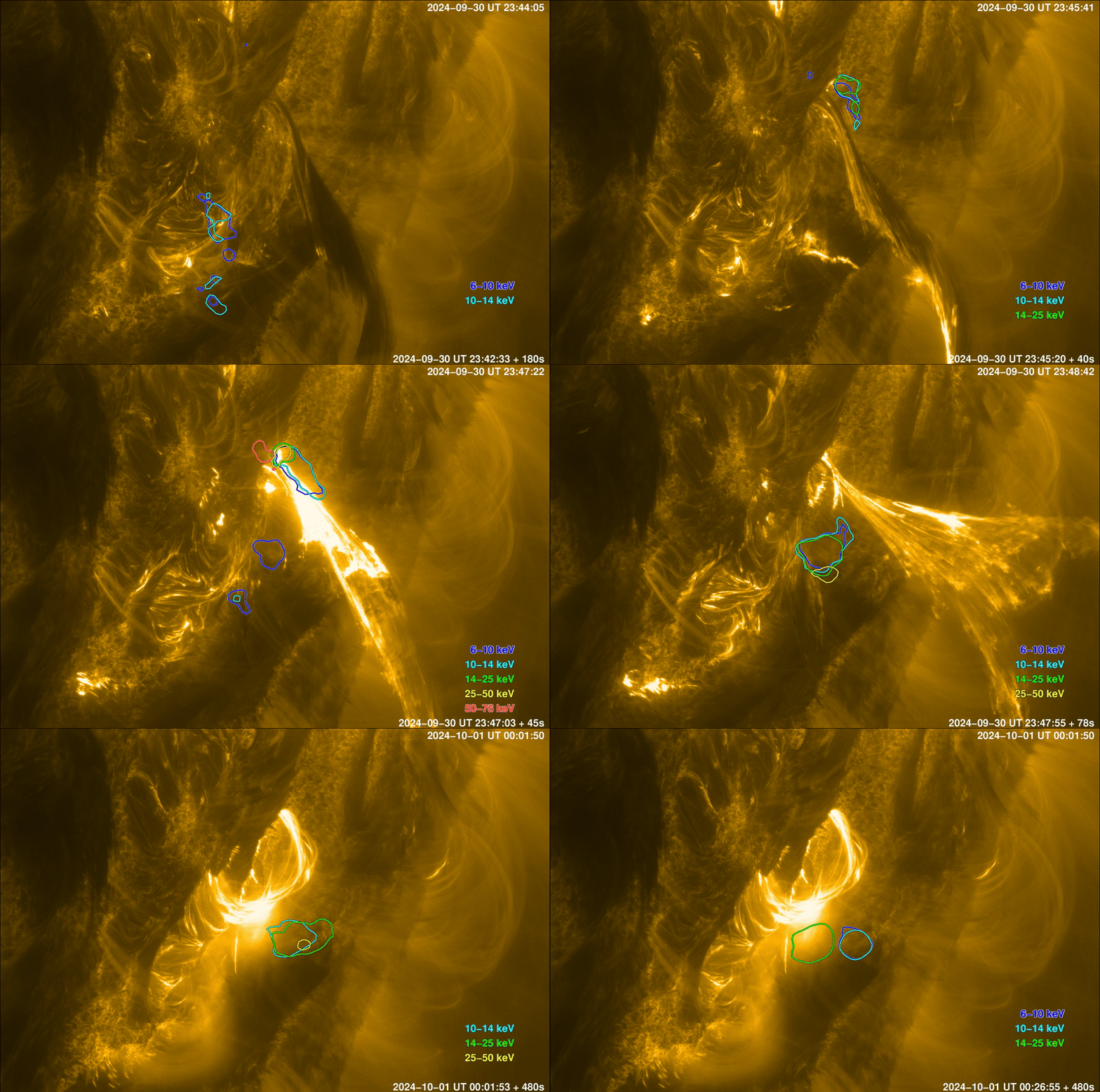 X-rays blast from the solar flare. Credit: ESA
Solar Orbiter also caught related brightenings far from the main blast site, connected by long coronal loops. The observation suggests that energy released in one region of the Sun can rapidly propagate across vast distances.
Together, the spacecraft’s instruments traced the flare from the corona down to the Sun’s visible surface, offering one of the most complete three-dimensional views of a flare ever assembled.
“This is one of the most exciting results from Solar Orbiter so far,” said Miho Janvier, ESA’s Solar Orbiter co-project scientist, in a statement. “Solar Orbiter’s observations unveil the central engine of a flare and emphasise the crucial role of an avalanche-like magnetic energy release mechanism at work.”
The sun is an active star, and its tantrums can wreak havoc on our technological civilization. The most powerful flares, often accompanied by Coronal Mass Ejections (CMEs), can slam into Earth’s magnetic sphere, triggering geomagnetic storms that fry satellites, endanger astronauts, and disrupt power grids.
If large flares grow out of cascades of smaller events, the earliest warning signs may be subtle, fast, and dangerously easy to miss.