
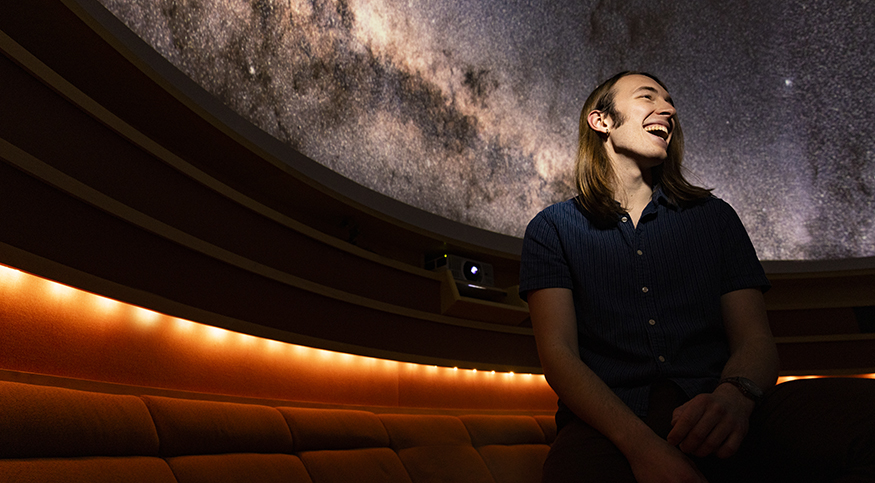
The powerful 3.5-meter ARC telescope can capture images of distant celestial objects. The facility, located in New Mexico, is owned by a consortium of universities including the UW, with a limited amount of telescope time allotted to each institution. Most research is done remotely rather than on site.
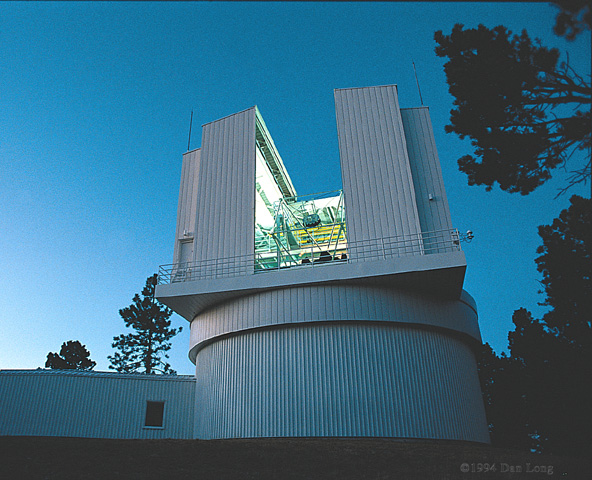
The 3.5-meter telescope at Apache Point Observatory.
Undergraduates rarely, if ever, have the opportunity to use APO’s 3.5-meter telescope, but postdoc Chandler was in a bind. He needed a second researcher to help during his allotted APO time and the postdoc who had served in that role was no longer available. For Frissell, it was the opportunity he’d been waiting for. Chandler’s focus on asteroids, comets, and other small bodies in our Solar System perfectly aligned with Frissell’s own interests. He joined Chandler’s research project in 2024.
Frissell explains that studying small celestial bodies can provide clues to the early Solar System. For example, as a comet nears our Sun, the Sun’s heat turns the ice on the comet’s surface to gas and dust, creating a coma (a cloud around the comet) and tail. Tracking the comet’s orbit backward, researchers can surmise what the orbit might have looked like in the distant past and how the comet’s interaction with planets might have sent it closer to the Sun.
“The crown jewel of the project is looking for objects that have comet tails when close to the Sun because that means those objects probably have some ice on them, which can tell us where water is in our Solar System,” says Frissell. He explains that comets can directly interact with planets by crashing into them — and possibly delivering water when they crash.
“Comets are a possible source for Earth’s water, but we don’t know for sure,” he says. “A big question to figure out is how much water comets could have delivered to the Earth early in the history of the Solar System.”