
One class of hypothetical stars has now emerged as a single explanation for three of the most perplexing objects seen in the early universe.
That connection reframes unexpected galaxies, outsized black holes, and compact red sources as outcomes of the same fast, exotic stellar pathway.
Three early mysteries

Images from the James Webb Space Telescope revealed an early universe crowded with objects that appeared too bright, too massive, or too compact to fit existing timelines.
In examining those observations, a team led by Professor Cosmin Ilie at Colgate University demonstrated that a single type of star could reproduce all three signatures without invoking separate origins.
The result ties extreme brightness, rapid black hole growth, and dust-poor compact sources to conditions present during the universe’s first few hundred million years.
At the same time, the idea sets clear limits that require closer inspection of where these objects appear and how their light is structured.
Stars powered by dark matter
Researchers call them dark stars, hypothetical stars heated by dark matter collisions, and they would have formed before most galaxies assembled.
The new paper laid out how dark matter particles could destroy each other and release energy, supplying steady heat inside a forming star.
That heat kept the star puffed up, so it kept pulling in gas and grew far larger than normal.
Because it burned no heavy elements at first, the star stayed relatively cool and left little dust behind.
Galaxies that are too bright
Some JWST targets, nicknamed blue monsters, ultra-bright compact galaxies with little dust, appeared where theories predicted slower buildup.
A single supermassive dark star could have produced galaxy-level light, while a surrounding gas cloud spread that glow over space.
One analysis found that the galaxies’ transparency stayed hard to explain even when models assumed unusually strong dust destruction.
If dark stars accounted for some blue monsters, then star-formation estimates above 50% would drop, easing a key tension.
Black holes that grew too fast
Another surprise emerged from galaxies that already contained black holes tens of millions of times heavier than the Sun, even though the universe was still very young.
In Professor Ilie’s scenario, a supermassive dark star eventually lost its extra source of heat, allowing gravity to overwhelm it and trigger a rapid collapse.
That pathway becomes especially relevant for UHZ1, a galaxy observed about 470 million years after the Big Bang – far earlier than standard black hole growth models can accommodate.
Starting from such an unusually massive stellar seed allows ordinary gas accretion to build the observed black hole without requiring extreme or prolonged growth rates.
The mystery of tiny red dots
JWST also found little red dots, tiny sources that stayed quiet in X-rays, even when astronomers looked hard.
One study argued that dense, electrically charged gas formed a cocoon that blocked high-energy light.
Professor Ilie proposed that a collapsed dark star could leave behind a black hole wrapped in leftover material, building a similar cocoon.
If that link holds, little red dots may mark a brief stage, but some could still come from ordinary galaxies.
Searching for helium patterns
Evidence still hinges on finding a signal that cleanly separates dark stars from compact galaxies or actively feeding black holes.
To look for that distinction, researchers examined how light from some of the earliest objects breaks into its component colors, searching for patterns expected from helium-rich stellar atmospheres.
In a small number of extremely distant sources, the light showed signs that helium was absorbing specific wavelengths in a way standard galaxy models struggle to reproduce.
Those signals remain suggestive rather than decisive, and only repeated detections with stronger clarity could elevate helium absorption into a reliable test of the idea.
New clues about dark matter
Confirming a dark star would show dark matter acting as fuel, not just as gravity that tugs on galaxies.
Because the heating depends on the particles’ interactions, the star’s size and temperature would encode clues about dark matter physics.
Those clues could guide laboratory searches on Earth, which still have not caught a dark matter particle in the act.
Even then, the evidence would stay indirect, and competing explanations would need to fail before physicists changed course.
Limits of dark stars
“Some of the most significant mysteries posed by the JWST’s cosmic dawn data are in fact features of the dark star theory,” said Professor Ilie.
For now, dark stars remain hypothetical, and astronomers have proposed other ways the early universe could produce unusually bright objects and massive black hole seeds.
Some models invoke powerful outflows that clear away dust, while others begin with black holes forming already massive from the collapse of gas.
Future research directions
Future Webb programs can separate a true star from a small galaxy by measuring how its light varies across wavelengths.
Repeated spectra could confirm helium absorption, and deeper X-ray checks would reveal energetic black holes inside little red dots, or set limits.
If dark stars masquerade as blue monsters, then sharper images should show a single central source rather than a spread-out cluster.
Either way, the next rounds of data will narrow the options, and some popular early-universe stories may fall apart.
Dark stars provide a framework for viewing odd galaxies, hidden black holes, and compact red sources as connected outcomes of a single early process.
The theory now hinges on direct evidence, something JWST is expected to test in the years ahead.
The study is published in Universe.
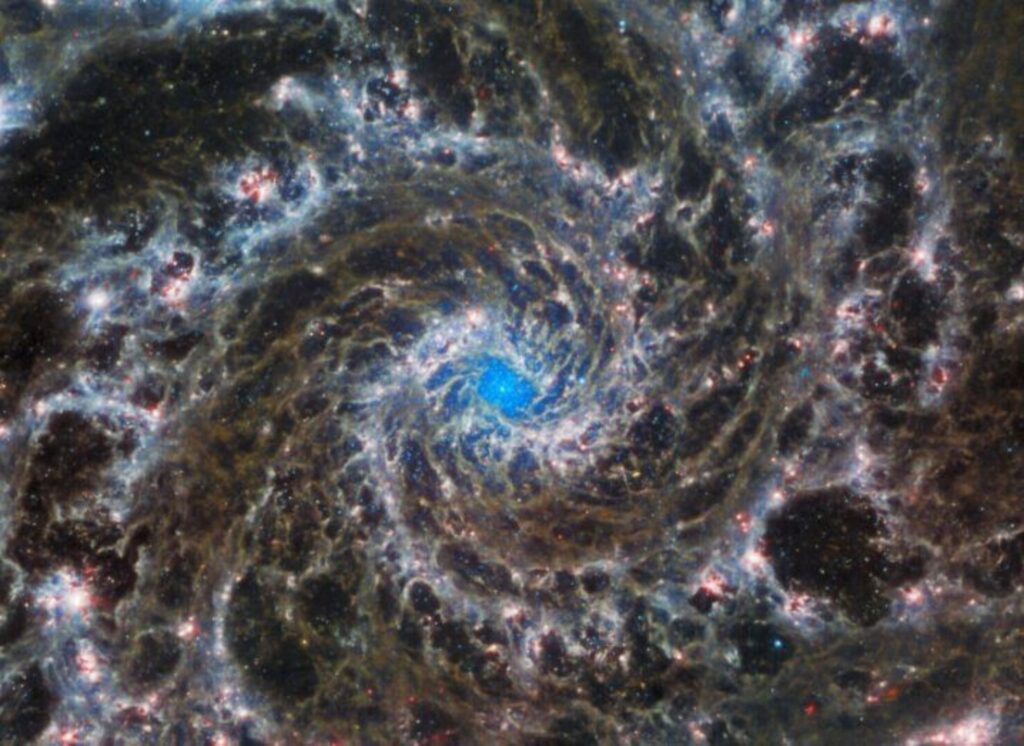
Image Credit: ESA/Webb/NASA/CSA/J Lee/PHANGS-JWST Team
—–
Like what you read? Subscribe to our newsletter for engaging articles, exclusive content, and the latest updates.
Check us out on EarthSnap, a free app brought to you by Eric Ralls and Earth.com.
—–