
Your support helps us to tell the story
From reproductive rights to climate change to Big Tech, The Independent is on the ground when the story is developing. Whether it’s investigating the financials of Elon Musk’s pro-Trump PAC or producing our latest documentary, ‘The A Word’, which shines a light on the American women fighting for reproductive rights, we know how important it is to parse out the facts from the messaging.
At such a critical moment in US history, we need reporters on the ground. Your donation allows us to keep sending journalists to speak to both sides of the story.
The Independent is trusted by Americans across the entire political spectrum. And unlike many other quality news outlets, we choose not to lock Americans out of our reporting and analysis with paywalls. We believe quality journalism should be available to everyone, paid for by those who can afford it.
Your support makes all the difference.Read more
Nasa has been forced to delay its first crewed mission around the Moon in more than 50 years due to unseasonably cold weather in Florida.
The US space agency said that a “rare arctic outbreak” at the launch site meant that the timeline for the Artemis II mission had to be pushed back.
The launch of the first Artemis moonshot with a crew is now targeted for no earlier than 8 February, two days later than planned.
Nasa was all set to conduct a fueling test of the 98-metre (322-foot) Space Launch System (SLS) rocket on Saturday, but called everything off late Thursday because of the below-freezing conditions forecast.
The critical dress rehearsal is now set for Monday, weather permitting.
“Teams and preparations at the launch pad remain ready for the wet dress rehearsal,” Nasa said in a statement.
“However, adjusting the timeline for the test will position Nasa for success during the rehearsal, as the expected weather this weekend would violate launch conditions.”
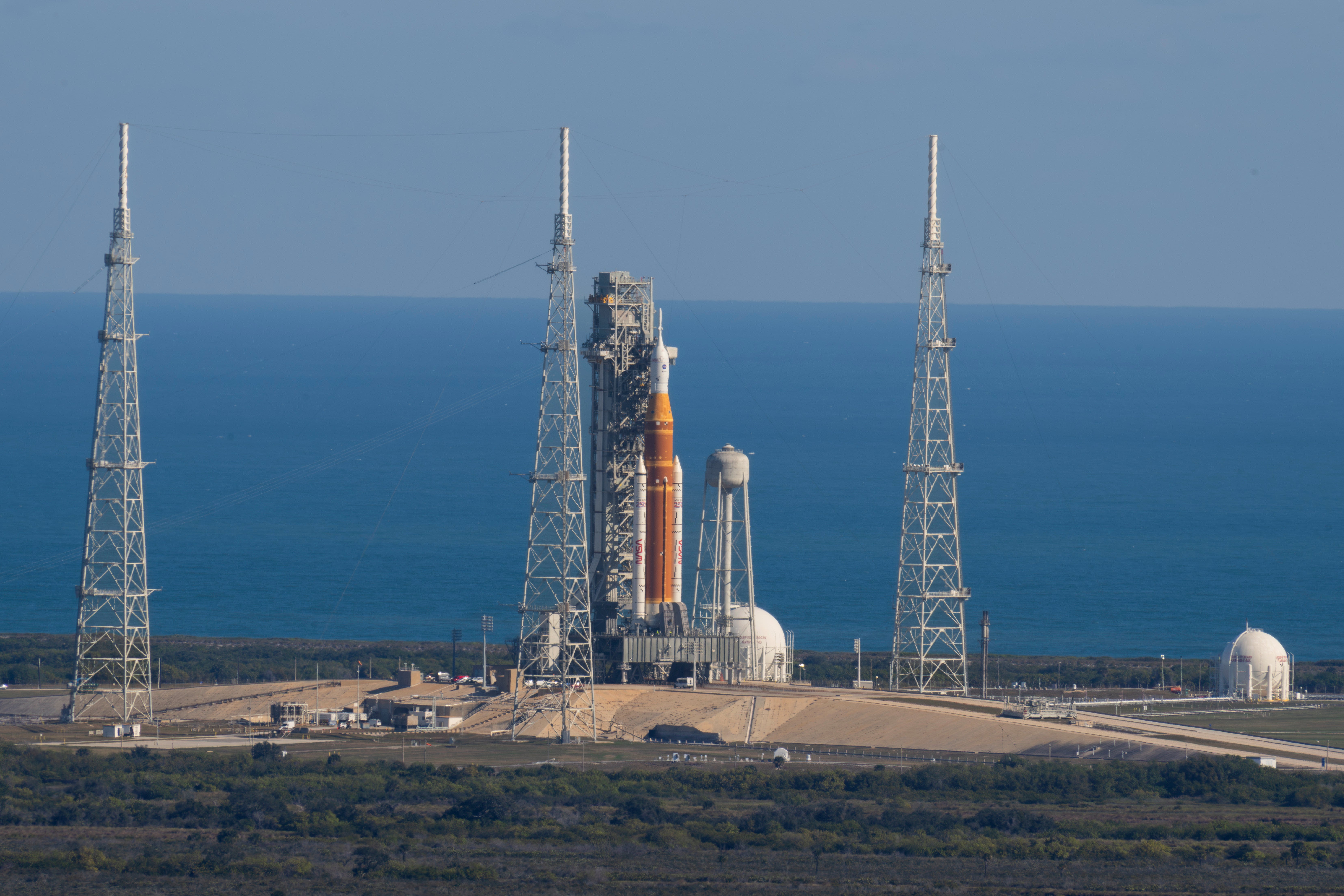
open image in gallery
The Artemis II SLS (Space Launch System) rocket with the Orion spacecraft atop a mobile launcher at Launch Complex 39B, on 29 January, 2026, at Nasa’s Kennedy Space Center in Florida (Nasa)
Nasa has only a handful of days in any given month to launch its first lunar crew due to a narrow Earth-Moon alignment window.
The latest change leaves Nasa with only three days in February to send four astronauts around the Moon and back, before slipping into March.
“Any additional delays would result in a day for day change,” Nasa said in a statement on Friday.
Heaters are keeping the Orion capsule warm atop the rocket, officials said, and rocket-purging systems are also being adapted to the cold.
The crew remain in quarantine in Houston and their arrival at Kennedy Space Center in Florida is uncertain.
The four astronauts – Nasa’s Reid Wiseman, Victor Glover and Christina Koch , and Jeremy Hansen from the Canadian Space Agency (CSA) – are supposed to spend roughly 14 days in quarantine to limit their exposure to illnesses.
The crew will still be able to contact friends, family and colleagues, but they will avoid public places, wear masks, and maintain distance from anyone they come in contact with.
The 10-day Artemis II mission will be the furthest humans have travelled since the Apollo 17 mission in 1972, which was also the last time an astronaut walked on the Moon.
There will be no Moon landing on this mission, with the objectives being to test the systems and hardware needed to return a crew to the lunar surface for the upcoming Artemis III mission in 2027.
Additional reporting from agencies.