
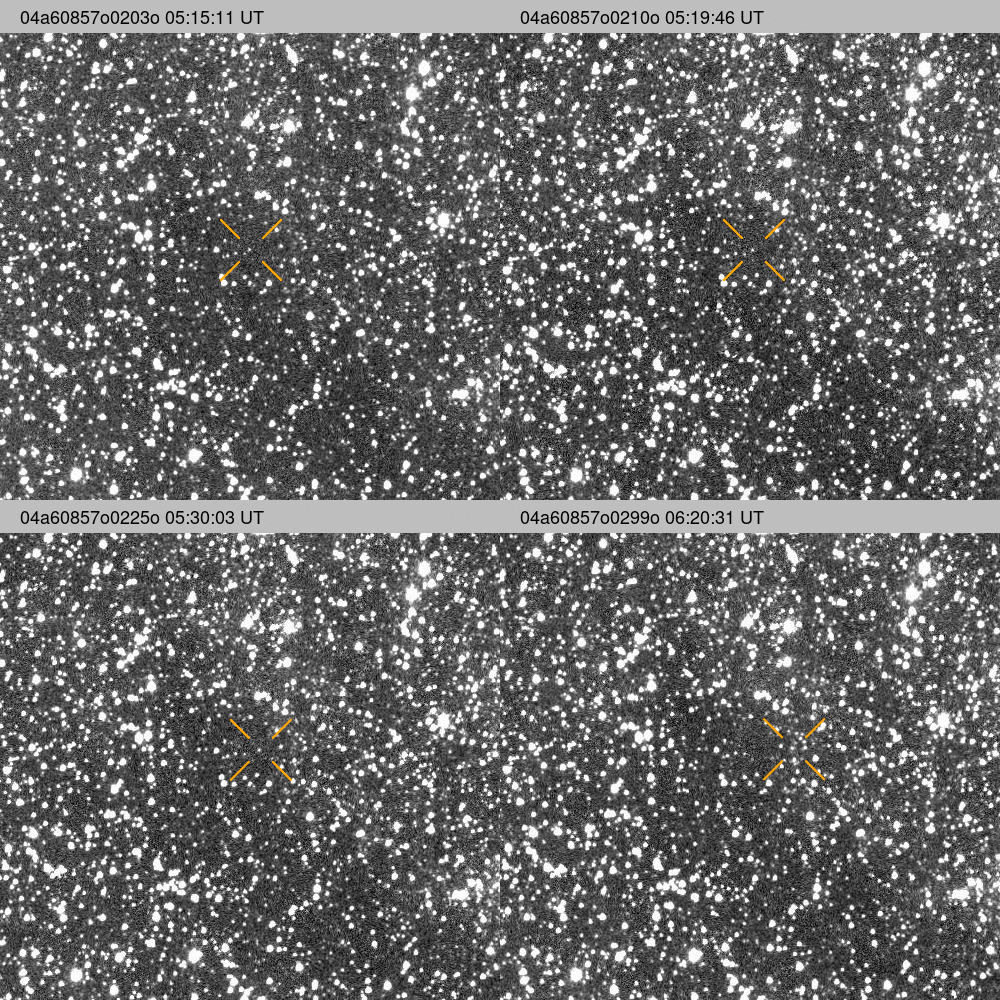
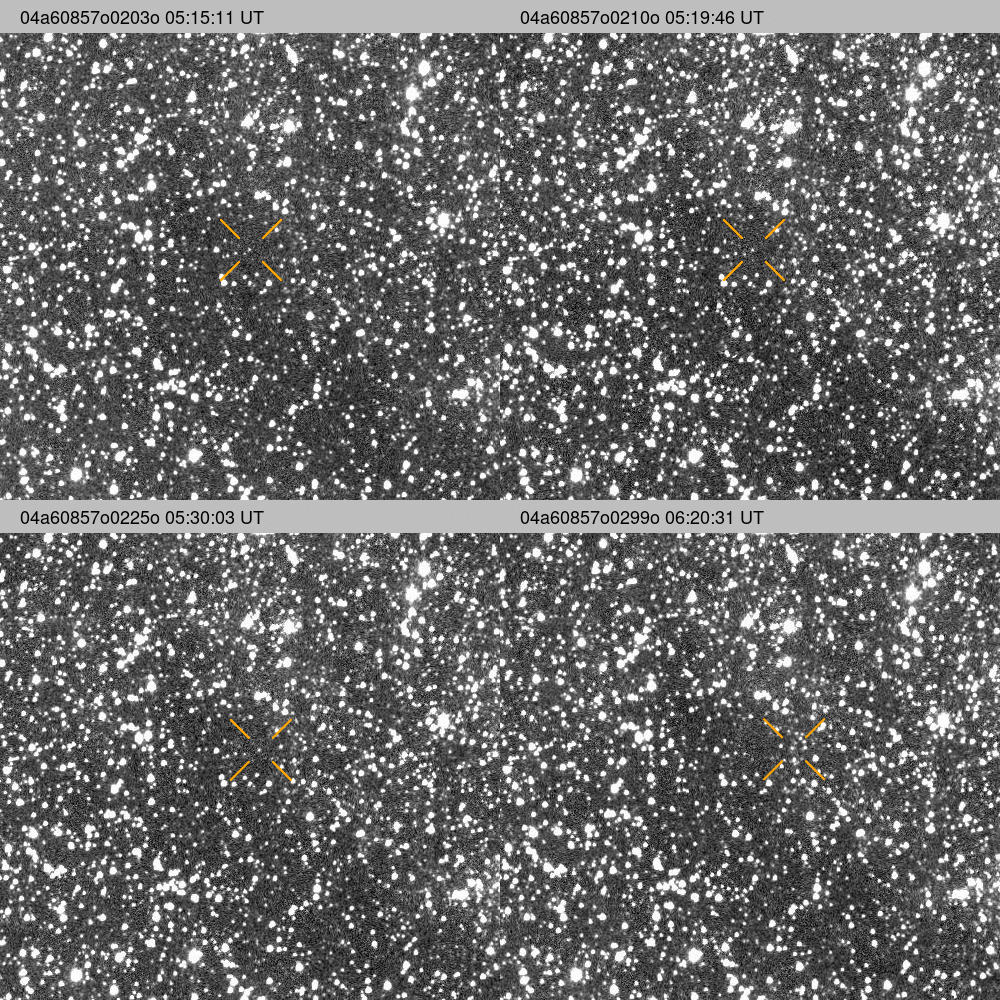
 Annotated frame from a NASA-released animation depicting observations of 3I/ATLAS at the time of its reported discovery on July 1, 2025. While presented publicly as the first image of the interstellar object, NASA’s original caption describes this material only as an animation, without disclosing that it is derived from processed or combined survey data rather than a single raw exposure. The object’s position is indicated near center. (Image credit: ATLAS/University of Hawaii/NASA; reproduced for news reporting and analysis under fair use, 17 U.S.C. §107.)
Inside This Report
Scientists have now confirmed that interstellar object 3I/ATLAS was captured in archival space-based observations months before humanity knew it existed.
The object appears in data collected as early as May and June 2025, visible only after thousands of images were reprocessed and combined retroactively.
The revelation raises difficult questions about how modern astronomy detects, filters, and ultimately recognizes objects already recorded by its own instruments.
Long before interstellar object 3I/ATLAS was publicly identified, it was already there.
[USA HERALD] – Newly confirmed analyses show that the object existed within archived observational data dating back to May and June of 2025—nearly two months before its formal discovery. At the time, it passed silently through wide-field survey images, indistinguishable from background light until scientists revisited the data with updated parameters and stacking techniques.
The confirmation did not come from a new telescope or a fresh observation, but from a re-examination of data already in hand. By coadding more than 9,000 individual frames collected during routine sky surveys, researchers were able to reconstruct a faint but consistent signal corresponding to the trajectory later attributed to 3I/ATLAS.
In its earliest appearances, the object showed no obvious coma, tail, or extended glow. It resembled an inactive point source—one of countless faint lights recorded nightly by automated survey systems. Only with hindsight did its presence become clear.
This retrospective detection underscores a paradox at the heart of modern astronomy. Humanity now operates a global network of telescopes and space-based observatories that continuously record the sky in extraordinary detail. Yet discovery is often not a matter of observation alone, but of interpretation—dependent on algorithms, thresholds, and the questions scientists know to ask at the time.
NASA’s Transiting Exoplanet Survey Satellite, designed to monitor stellar brightness for exoplanet detection, was among the instruments that unknowingly captured 3I/ATLAS during its early passage. The data existed, but the object remained effectively invisible until its later activity prompted targeted scrutiny.
Crucially, there is no evidence that the data was intentionally concealed. However, the delayed recognition illustrates how automated filtering systems can sideline anomalous signals that do not fit predefined categories. Interstellar objects, by definition rare and unexpected, are especially vulnerable to such oversight.
The discovery process, in this case, was less a sudden revelation than a stumble—a realization that what was sought had already been recorded, quietly archived, and set aside.
USA Herald Analysis
The confirmation that 3I/ATLAS existed in archival data months before discovery has implications that extend beyond this single object.
First, it challenges assumptions about discovery timelines. Detection does not always mark the moment an object enters human awareness; it often marks the moment humans learn how to recognize it. In an era of data abundance, the bottleneck is no longer observation, but discernment.
Second, the episode highlights a growing reliance on automated systems to flag what matters. While essential for managing vast datasets, these systems are built on expectations shaped by known phenomena. Objects that fall outside those expectations—such as interstellar visitors—may be recorded without being understood.
Finally, the case of 3I/ATLAS suggests that other interstellar objects may already reside within archival datasets, awaiting reinterpretation. Their discovery may depend not on new technology, but on new questions—and the willingness to revisit what has already been seen.
USA Herald’s Contextual Insight
3I/ATLAS did not suddenly appear when humanity noticed it. It was already there, moving through recorded space, unseen in plain sight. Its rediscovery within archival data serves as both a scientific achievement and a cautionary reminder: in the modern age, the universe may reveal itself not only through new observations, but through the careful reexamination of what we thought we had already understood.
About the Author
Samuel Lopez is a legal analyst and investigative journalist for USA Herald whose work focuses on evidence-based reporting, institutional accountability, and the intersection of data, technology, and public understanding. His coverage of interstellar phenomena emphasizes forensic reconstruction of observational records and transparency in scientific discovery.
USA Herald continues to provide independent, in-depth reporting and analysis you won’t find anywhere else. Readers who want access to exclusive insights, developing investigations, and original reporting are encouraged to join the USA Herald newsletter.