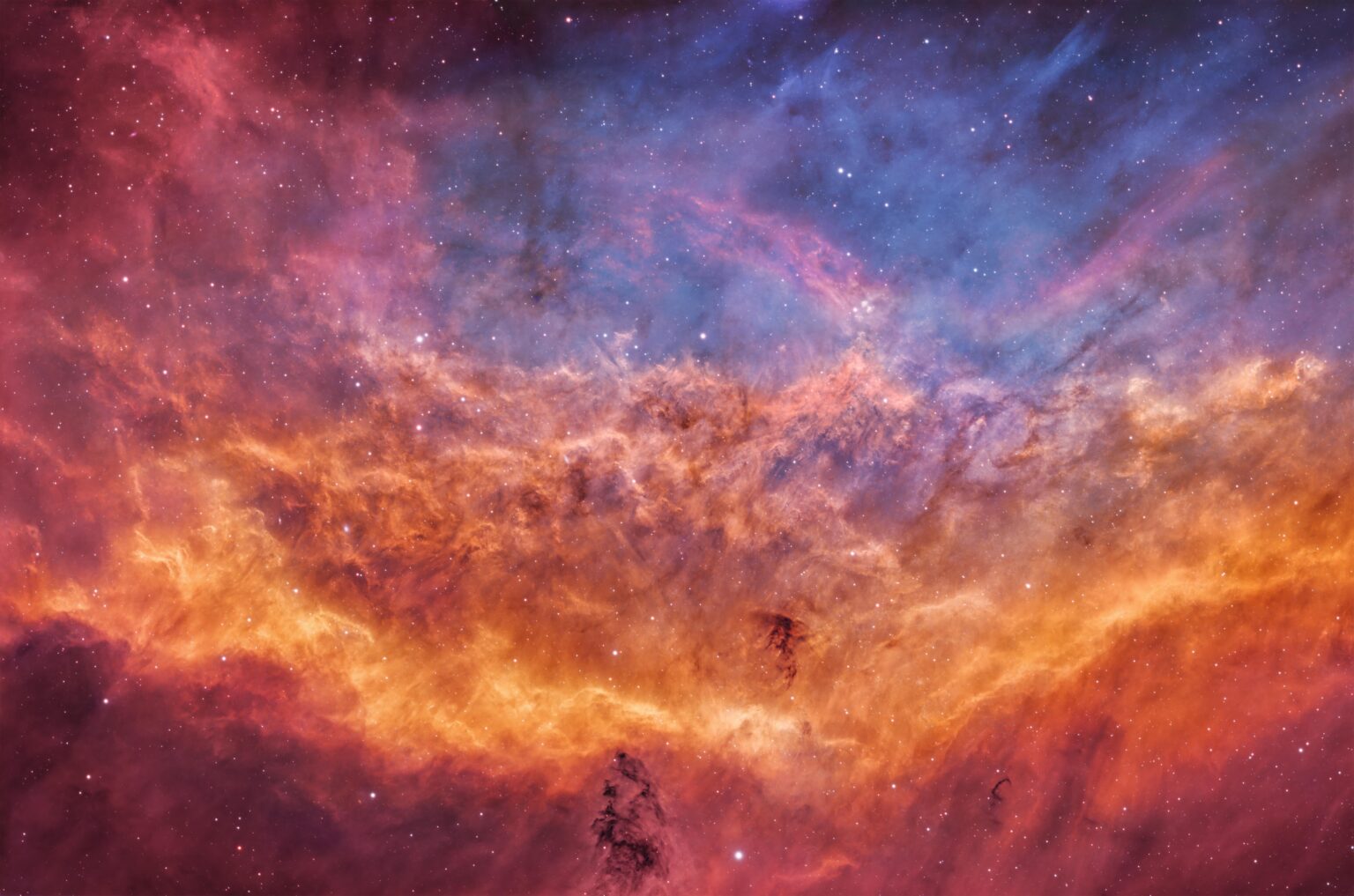
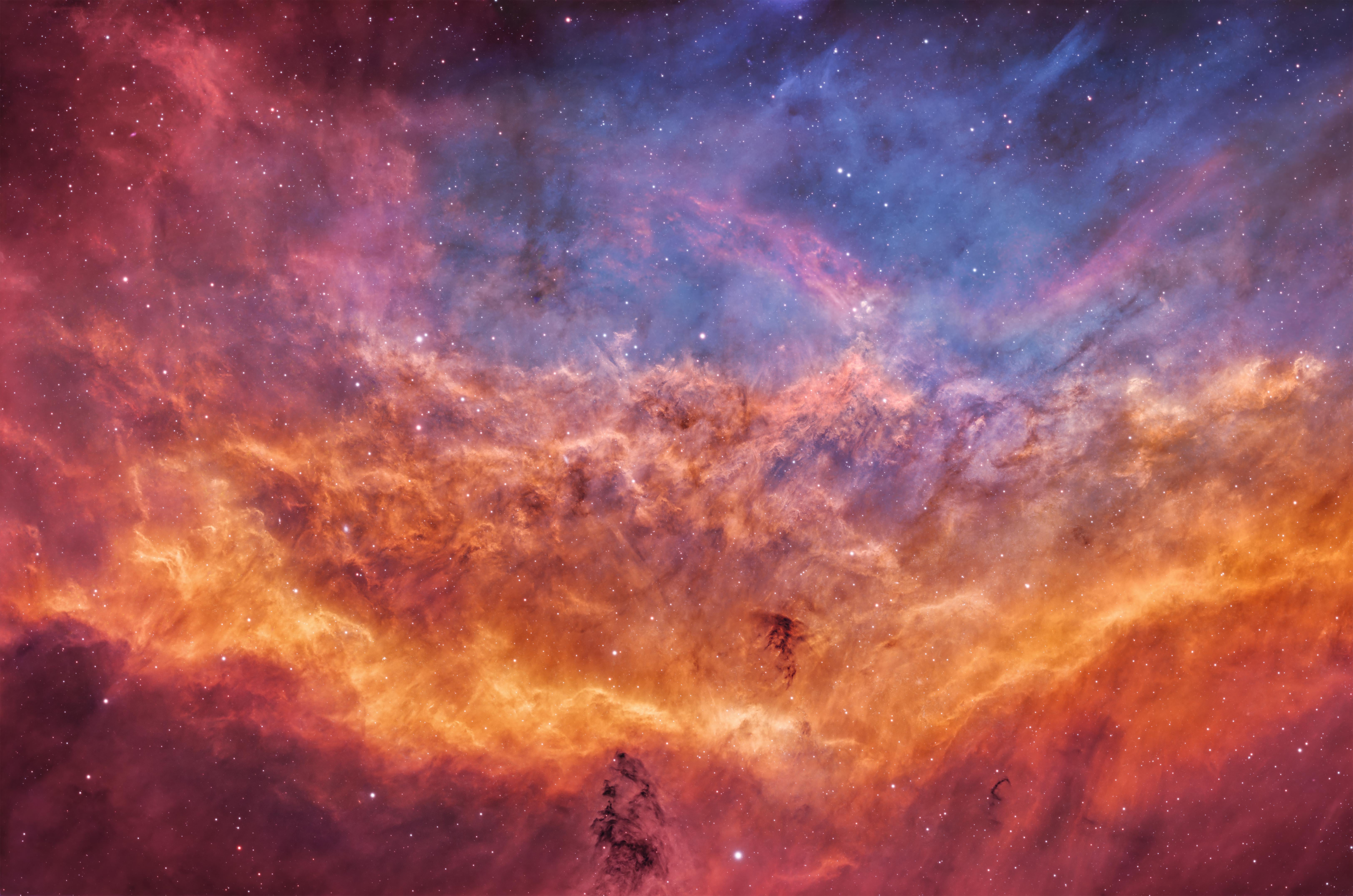
Taken over the course of 35 nights, this is 193 hours of integration time from my Bortle 8.5 backyard in Nashville, TN.
The California Nebula is strong in H-alpha signal, so trying to bring out the fainter structures can be a challenge. As usual, I’m using a “time is the filter” approach…imaging from heavily light-polluted backyard is basically a commitment to patience (even with strong filters), but with enough time, you can get a good amount of signal.
If you zoom in, there’s a surprising amount of complexity beyond the obvious emission: darker pockets, interesting texture, and layered structure that gives it a bit of depth (I think it looks like ocean waves, which is fitting.)
Technical Details:
Integration per filter:
– R: 36m (36 × 60″)
– G: 35m (35 × 60″)
– B: 33m (33 × 60″)
– Hα: 50h 10m (602 × 300″)
– SII: 50h (600 × 300″)
– OIII: 91h 20m (1096 × 300″)
Equipment:
– Telescope: Askar 120APO
– Camera: ZWO ASI2600MM Pro
– Mount: ZWO AM5
– Filters: Antlia 3nm Narrowband H-alpha 2″, Antlia 3nm Narrowband Sulfur II 2″, Astronomik Deep-Sky Blue 2″, Astronomik Deep-Sky Green 2″, Astronomik Deep-Sky Red 2″, Chroma OIII 3nm Bandpass 2″
– Accessories: Askar 0.8x Full Frame Reducer / Flattener for 120APO Telescope, ZWO ASIAIR Plus, ZWO EAF, ZWO EFW 7 x 2″
Integrated in Pixinsight using WBPP. BlurX, StarX, NoiseX, HDRMT, channel combination (including Foraxx Palette) in Pixinsight. Curves, color and final touches done in Photoshop.
bigmean3434 on
This is the best Cali nebula I have seen. Awesome dude!
I am B7 and agree, I started just putting time on objects, it seems to be the best way to go. I do wonder if I got better 3nm filters would be noticeable compared to my 6.5nm optilong filters. Any chance you started with wider filters and have experience going to the better ones?

4 Comments
More on Instagram: [@jeffreyhorne](https://www.instagram.com/jeffreyhorne)
Taken over the course of 35 nights, this is 193 hours of integration time from my Bortle 8.5 backyard in Nashville, TN.
The California Nebula is strong in H-alpha signal, so trying to bring out the fainter structures can be a challenge. As usual, I’m using a “time is the filter” approach…imaging from heavily light-polluted backyard is basically a commitment to patience (even with strong filters), but with enough time, you can get a good amount of signal.
If you zoom in, there’s a surprising amount of complexity beyond the obvious emission: darker pockets, interesting texture, and layered structure that gives it a bit of depth (I think it looks like ocean waves, which is fitting.)
Technical Details:
Integration per filter:
– R: 36m (36 × 60″)
– G: 35m (35 × 60″)
– B: 33m (33 × 60″)
– Hα: 50h 10m (602 × 300″)
– SII: 50h (600 × 300″)
– OIII: 91h 20m (1096 × 300″)
Equipment:
– Telescope: Askar 120APO
– Camera: ZWO ASI2600MM Pro
– Mount: ZWO AM5
– Filters: Antlia 3nm Narrowband H-alpha 2″, Antlia 3nm Narrowband Sulfur II 2″, Astronomik Deep-Sky Blue 2″, Astronomik Deep-Sky Green 2″, Astronomik Deep-Sky Red 2″, Chroma OIII 3nm Bandpass 2″
– Accessories: Askar 0.8x Full Frame Reducer / Flattener for 120APO Telescope, ZWO ASIAIR Plus, ZWO EAF, ZWO EFW 7 x 2″
– Software: Adobe Photoshop, Aries Productions Astro Pixel Processor (APP), Pleiades Astrophoto PixInsight, ZWO ASIAIR
Integrated in Pixinsight using WBPP. BlurX, StarX, NoiseX, HDRMT, channel combination (including Foraxx Palette) in Pixinsight. Curves, color and final touches done in Photoshop.
This is the best Cali nebula I have seen. Awesome dude!
I am B7 and agree, I started just putting time on objects, it seems to be the best way to go. I do wonder if I got better 3nm filters would be noticeable compared to my 6.5nm optilong filters. Any chance you started with wider filters and have experience going to the better ones?
Amazing photo, congratulations! 👏
Great detail and very tasteful processing!