
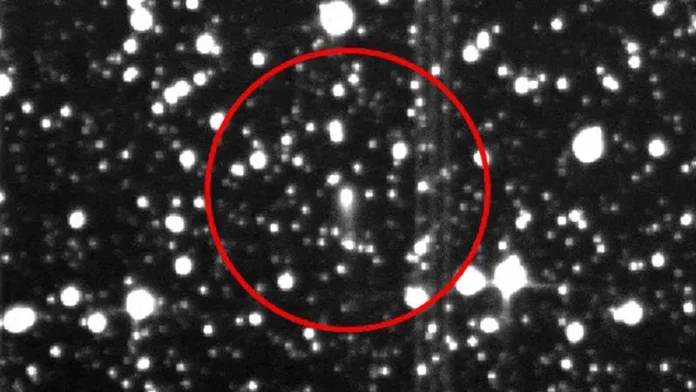
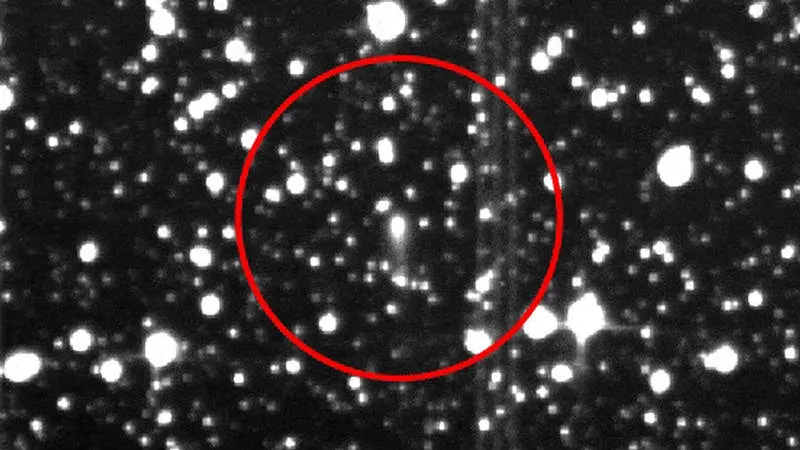
 Interstellar object 3I/ATLAS appears as a faint moving point amid background stars in a stacked image from NASA’s TESS, drawn from a 28-hour video sequence recorded between January 15 and January 18–19, 2026, as the object receded from the Sun. (Image credit: NASA/TESS/Daniel Muthukrishna; This image is reproduced for news reporting, scientific analysis, and public-interest commentary purposes under the fair use doctrine pursuant to 17 U.S.C. §107.
Inside This Report
A full day of continuous observation, a NASA space telescope quietly recorded an interstellar object as it moved away from the Sun, producing one of the longest uninterrupted visual records of 3I/ATLAS to date.
The resulting footage shows a persistent glow and a Sun-facing anti-tail, features that continue to challenge simple explanations and are now being examined for rotational patterns tied to earlier Hubble findings.
With a critical Jupiter flyby approaching in March, scientists are racing to extract every possible signal from existing data before the next—and potentially final—window for close observation opens.
[USA HERALD] – Between January 15 and January 22, 2026, NASA’s Transiting Exoplanet Survey Satellite, known as TESS, captured thousands of images of the interstellar object designated 3I/ATLAS as it receded from the Sun. When assembled, those images form a 28-hour time-lapse movie showing the object crossing a dense star field as a bright point of light accompanied by a distinct anti-tail oriented toward the Sun.
The footage was compiled after a brief interruption in observations caused by a spacecraft safe-mode event related to TESS’s solar panels. Despite the gap, the available data provided a rare, extended look at an interstellar visitor using an instrument never designed for small-body tracking. TESS normally surveys wide swaths of the sky to detect exoplanets by monitoring subtle dips in starlight, not to characterize fast-moving objects passing through the solar system.
What makes the TESS observations notable is not sharp detail, but duration. Due to the spacecraft’s low angular resolution, the object itself appears uneventful at first glance—a glowing dot drifting steadily across the frame. Yet embedded in that simplicity is an opportunity: sustained monitoring that may reveal changes in brightness or subtle variations in the anti-tail consistent with rotation.
Those questions build on earlier work led by Harvard astrophysicist Avi Loeb, who, along with collaborators, analyzed high-resolution images from the Hubble Space Telescope taken between late November 2025 and January 22, 2026. That dataset suggested a rotation period of approximately 7.1 hours—an inference now being tested against the longer, lower-resolution TESS record.
Importantly, the TESS archive also revealed that 3I/ATLAS had been present in the data months before its formal discovery. By stacking more than 9,000 images from May and June 2025, researchers were able to detect the object retroactively. At that earlier stage, the brightness profile resembled an inactive point source, lacking any visible coma or anti-tail—an observation that implies the object’s activity increased only later as its solar geometry changed.
Sharper snapshots from Hubble remain the gold standard for structural analysis, particularly those captured during a rare alignment in January when Earth, the Sun, and 3I/ATLAS were nearly collinear. Those images showed features that could not be resolved by TESS but now serve as a reference framework for interpreting the longer video record.
Looking ahead, attention is shifting to March 16, 2026, when 3I/ATLAS is expected to pass near Jupiter’s Hill radius—the region where Jupiter’s gravity overtakes the Sun’s tidal influence. During that window, NASA’s Juno spacecraft will be positioned roughly 53.6 million kilometers away, with the capability to observe the object using optical, infrared, particle, magnetic, plasma, microwave, and radio instruments.
USA Herald TESS Movie Analysis
From an investigative standpoint, the significance of the TESS movie lies less in what it shows visually and more in what it enables analytically. Continuous time coverage allows scientists to test rotational models, assess whether brightness changes repeat predictably, and evaluate whether the anti-tail exhibits synchronized motion with the object’s inferred spin.
Equally important is the contrast between early and later observations. The absence of visible activity in mid-2025 data, followed by a pronounced anti-tail months later, suggests that geometry, illumination angle, or delayed surface processes may play a decisive role. That progression complicates attempts to categorize 3I/ATLAS using familiar cometary or asteroidal frameworks.
Speculation about technological origins has been raised in public discourse, but it remains just that—speculation. At present, no direct evidence supports artificial signaling or probe deployment. What does exist is an unusually rich, multi-instrument dataset for an interstellar object, gathered almost accidentally by missions designed for entirely different purposes.
As with past interstellar visitors, the scientific value of 3I/ATLAS may ultimately lie in what it teaches researchers about the diversity of objects formed around other stars, and how incomplete our current classification schemes remain.
The 28-hour TESS movie of 3I/ATLAS does not deliver cinematic spectacle, but it adds a crucial temporal dimension to an unfolding scientific investigation. As the object continues its journey out of the inner solar system, each remaining observation carries added weight, narrowing the window in which definitive conclusions can be drawn. What emerges from that effort will shape how future interstellar visitors are detected, interpreted, and understood.
About the Author
Samuel Lopez is a legal analyst and investigative journalist for USA Herald who specializes in complex, data-driven reporting involving science, law, and public accountability. His coverage of interstellar objects focuses on forensic analysis of observational evidence, transparency in institutional narratives, and clear separation between verified data and conjecture.
USA Herald continues to provide independent, in-depth reporting and analysis you won’t find anywhere else. Readers who want access to exclusive insights, developing investigations, and original reporting are encouraged to join the USA Herald newsletter. Signing up takes just a moment and helps support ethical, transparent journalism.