
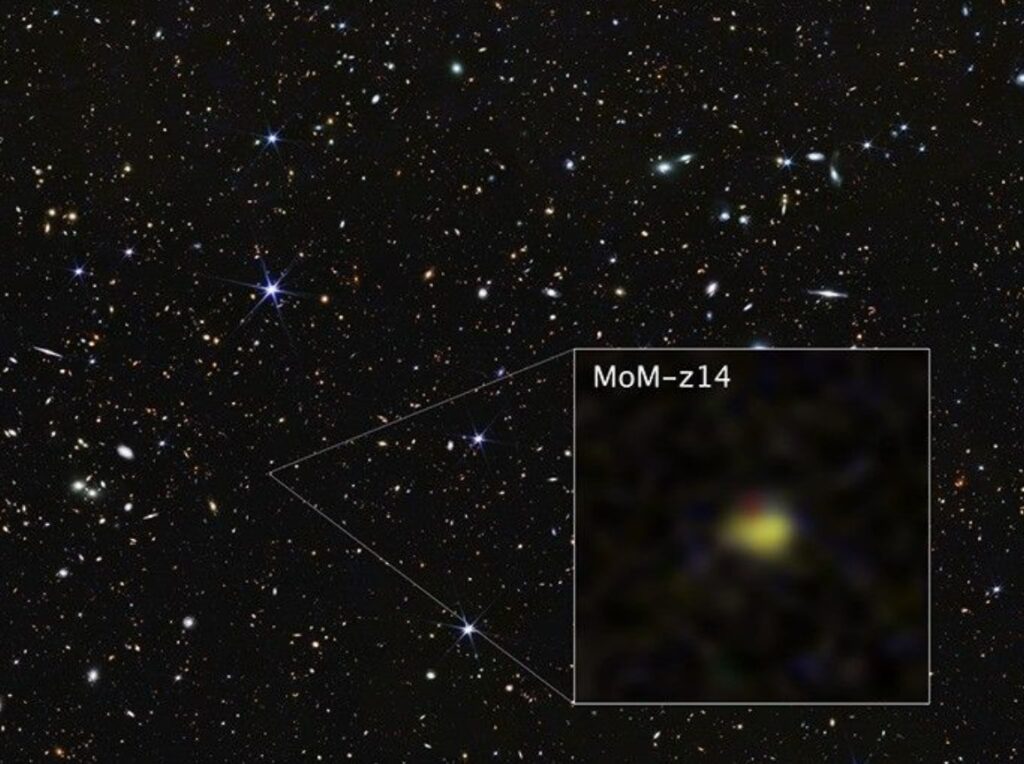
The James Webb Space Telescope continues to discover the most amazing objects in the Universe. Its latest discovery is a galaxy that formed just 280 million years after the Big Bang. It is one of the oldest and most distant galaxies ever observed, literally a window into the early Universe.
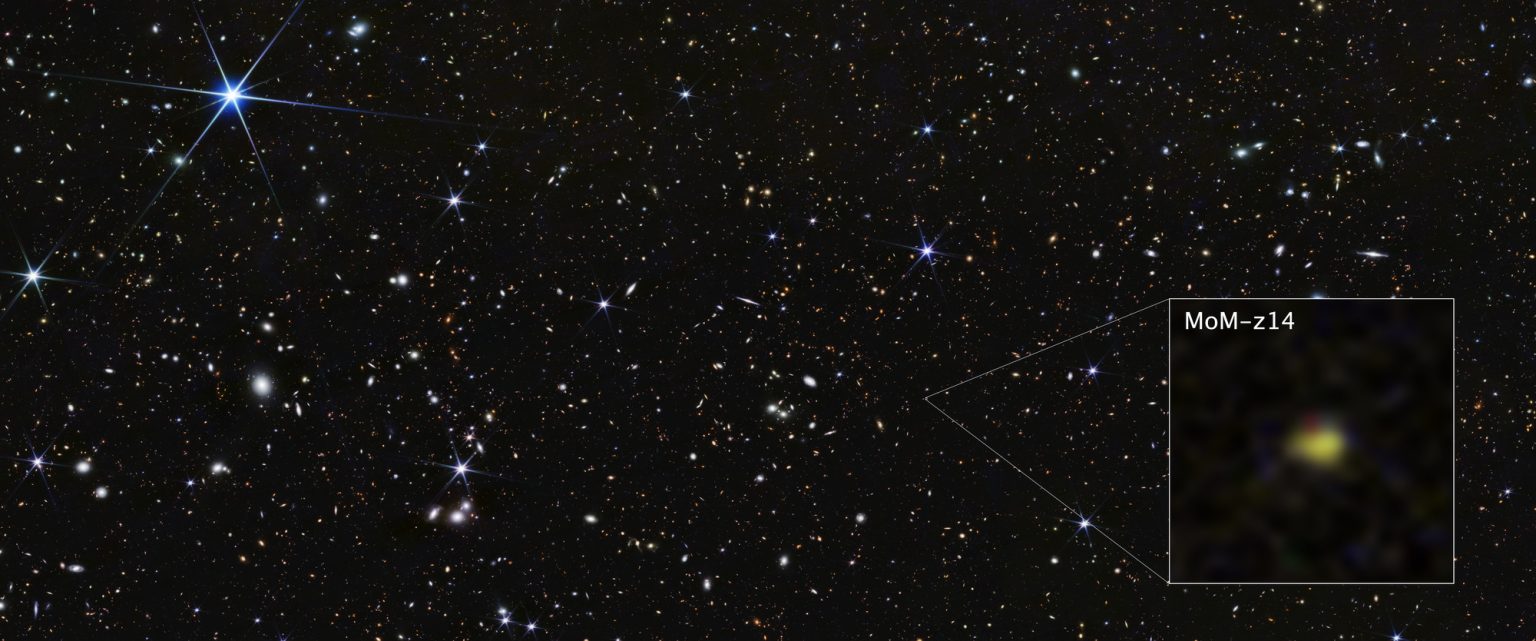 The galaxy designated MoM-z14 is currently the most distant galaxy ever discovered. It was discovered using the James Webb Space Telescope’s NIRCam (Near-Infrared Camera) and confirmed spectroscopically using its NIRSpec (Near-Infrared Spectrograph) instrument. Source: NASA
The galaxy, designated MoM-z14, existed when the Universe was only 2% of its current age (≈13.8 billion years). It is extremely bright, indicating violent star formation processes. “This is not at all what we expected. The discovery is both complex and exciting,” said Rohan Naidu, lead researcher at MIT.
The age of the galaxy was determined using the James Webb telescope’s spectrograph. Scientists analyzed how the wavelength of light from the galaxy changed as it traveled through space (the redshift effect). This allowed them to determine how long ago the light was emitted.
Scientific mysteries
The discovery of MoM-z14 raises new questions for astrophysicists:
Mystery of nitrogen. Unexpectedly high concentrations of nitrogen have been discovered in the galaxy’s spectrum. This is a heavy element that forms in the depths of stars and is scattered by supernova explosions. Its presence so early on forces us to rethink models of how quickly the first stars evolved and enriched the Universe with chemical elements.
Era of reionization. MoM-z14 may be the key to understanding how early stars “dispersed the fog” of the young Universe. Their intense light probably played a decisive role in the process of reionization – the “cleansing” of space from opaque hydrogen.
This discovery is just the beginning. Each ancient galaxy is a time capsule that helps us recreate the infancy of our Universe and understand the path from the Big Bang to the present day.
Earlier, we explained how galaxies in the early Universe differed from modern ones.
According to NASA
Brings 15 years of experience in science journalism. Holds a technical degree from the National Technical University of Ukraine “Igor Sikorsky Kyiv Polytechnic Institute” in “Automation and Control in Technical Systems.” His strong technical background and skill in simplifying complex material helped him work as an author and editor in the tech sections of major Ukrainian media outlets.
At Universe Space Tech, Ivan covers astronomy, science, technology, and discoveries in space research. His materials serve as a bridge between complex science and readers seeking to understand the universe in simple terms. Fascinated by space since childhood — especially black holes, dark matter, and quasars — he sees space not only as science but as a source of inspiration, philosophy, and humanity’s quest to understand their place in the cosmos.