
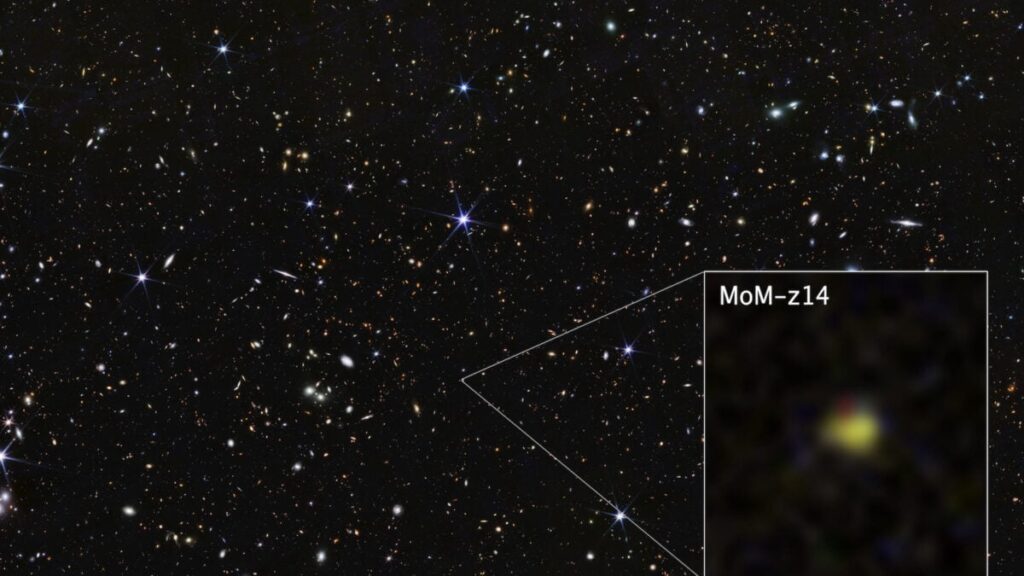
The Webb space telescope has allowed us to peer farther back into the universe than ever before, providing a rare glimpse of the cosmos a mere 280 million years after its very existence began.
Using Webb’s Near-Infrared Spectrograph, scientists have confirmed a new cosmic record of the most distant galaxy ever observed. Galaxy MoM-z14 existed just 280 million years after the big bang, providing clues to what the universe was like during its infancy and how it has evolved over time.
“With Webb, we are able to see farther than humans ever have before, and it looks nothing like what we predicted, which is both challenging and exciting,” Rohan Naidu, an astronomer at the Massachusetts Institute of Technology’s (MIT) Kavli Institute for Astrophysics and Space Research, said in a statement. Naidu is the lead author of the paper describing the discovery, published this week in the Open Journal of Astrophysics
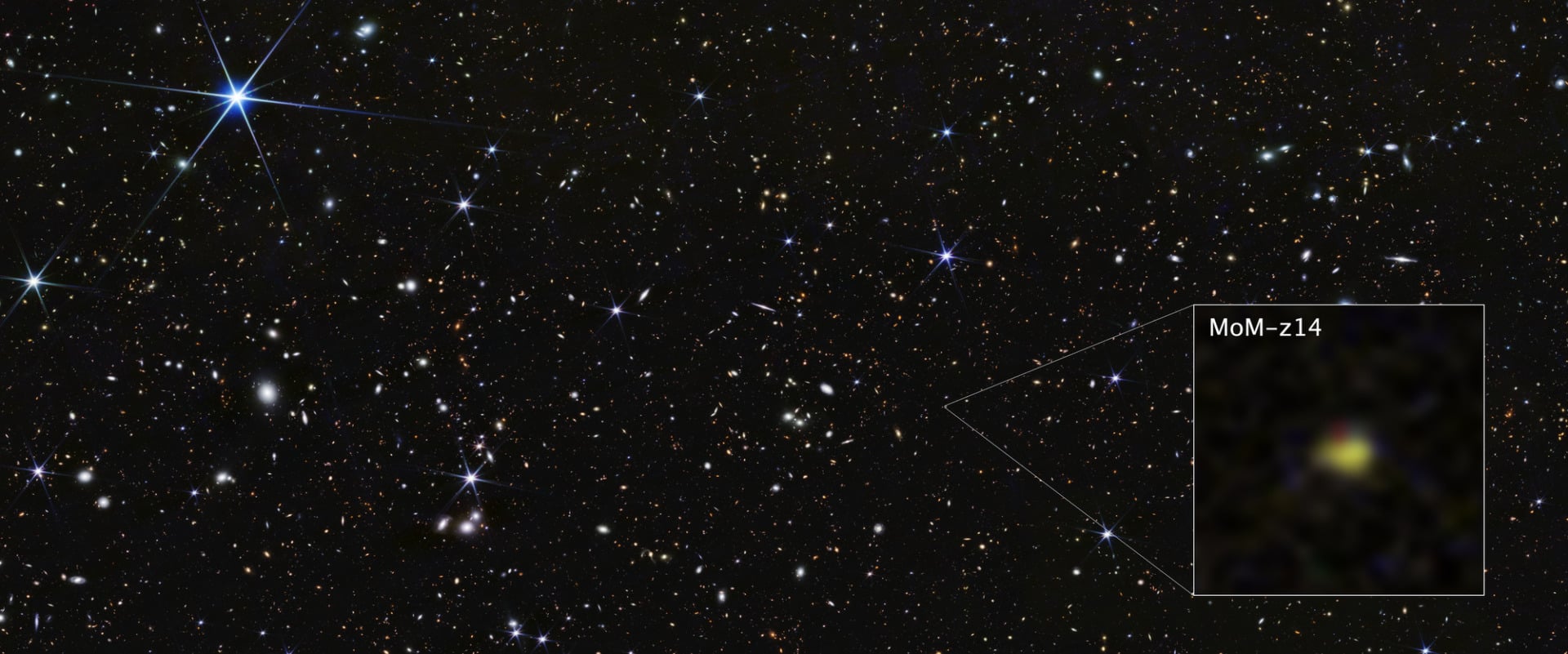 Through Webb, we are seeing this galaxy as it appeared in the distant past, only 280 million years after the Big Bang. Image: NASA, ESA, CSA, STScI, Rohan Naidu (MIT); Image Processing: Joseph DePasquale (STScI) Looking back
Webb first spotted MoM-z14 in May 2025, an exceptionally luminous and compact galaxy that’s around 50 times smaller than the Milky Way. The galaxy appeared to be very young, teeming with the formation of new stars.
Following its discovery, scientists had to confirm just how far the galaxy is. Due to the universe’s sheer size, distant objects appear as they existed millions, or even billions, years ago. The universe is also expanding, so physical distances in terms of light years becomes a tad more tricky when looking at objects this far.
Astronomers found that MoM-z14 has a redshift of 14.44, meaning that the light from the galaxy has been traveling through space for so long that it’s been stretched and shifted toward longer, more red wavelengths at the end of the spectrum due to the universe’s expansion.
By measuring the galaxy’s redshift, the scientists behind the discovery were able to confirm that its light has been traveling through space for 13.5 billion years. The universe is estimated to be around 13.8 billion years old, meaning this galaxy has existed during the relatively younger years of the cosmos.
The previous record holder is galaxy JADES-GS-z14-0, which existed 300 million years after the big bang.
Shine bright
MoM-z14 is surprisingly luminous, adding to a growing list of exceptionally bright galaxies found in the early universe that are 100 times brighter than theoretical studies predicted. Webb’s previous observations of early galaxies has shown that the stars inhabiting them have high amounts of nitrogen, which may contribute to their brightness.
“We can take a page from archeology and look at these ancient stars in our own galaxy like fossils from the early universe,” Naidu said. “Except in astronomy we are lucky enough to have Webb seeing so far that we also have direct information about galaxies during that time.”
Although those ancient stars would not have had enough time to produce such high amounts of nitrogen, scientists believe the dense nature of the early universe may have resulted supermassive stars capable of producing more nitrogen than the stars observed in the local cosmos.
The discovery of the ancient galaxy reveals more clues to the puzzle of the universe’s timeline, but there’s still a lot more cosmic mystery for telescopes like Webb to probe for answers.
“To figure out what is going on in the early universe, we really need more information,” Yijia Li, a graduate student at the Pennsylvania State University and a member of the research team, said in a statement. “It’s an incredibly exciting time, with Webb revealing the early universe like never before and showing us how much there still is to discover.”