
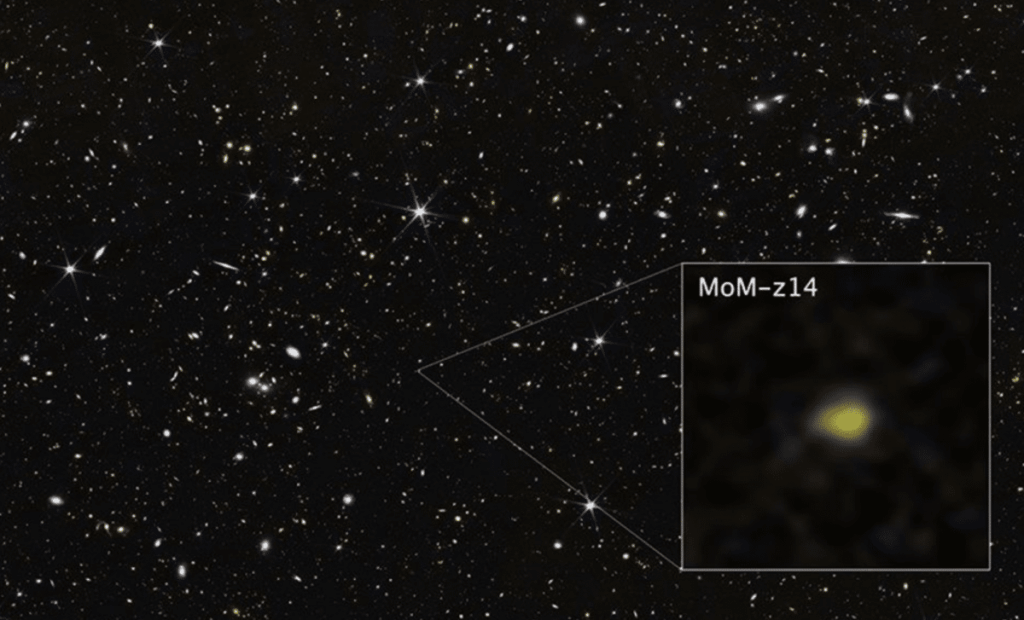
NASA’s James Webb Space Telescope has once again redefined the boundaries of cosmic observation. A recent study published via NASA Science confirmed the detection of galaxy MoM-z14, an unexpectedly bright and chemically rich galaxy that existed just 280 million years after the Big Bang. This milestone not only marks one of the earliest known galaxies ever observed but also raises key questions about star formation, cosmic reionization, and the nature of the early universe.
Galaxy MoM-z14: Brighter, Closer, Stranger Than Expected
Astronomers using Webb’s NIRSpec (Near-Infrared Spectrograph) have confirmed that MoM-z14 carries a redshift of 14.44, meaning its light has traveled for about 13.5 billion years across the expanding fabric of space. That puts the galaxy just behind the veil of cosmic dawn, a period in the universe’s infancy when the first stars and galaxies began to shine through the dense hydrogen fog left after the Big Bang.
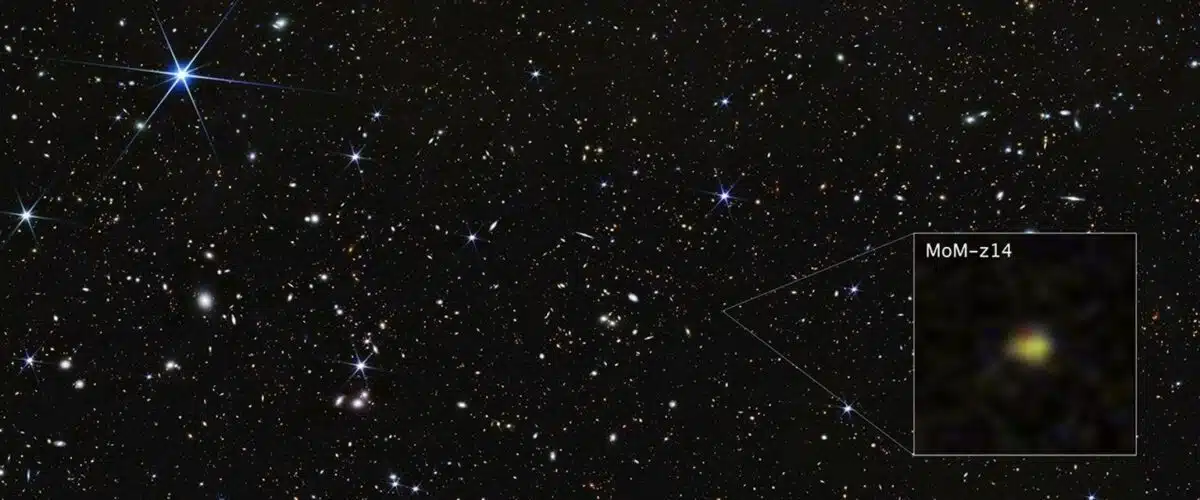 NASA’s James Webb Space Telescope shows galaxy MoM-z14 as it appeared in the distant past, only 280 million years after the universe began in the big bang.
Image: NASA, ESA, CSA, STScI, Rohan Naidu (MIT); Image Processing: Joseph DePasquale (STScI)
What makes MoM-z14 exceptional is not only its age but its unexpected luminosity and chemical complexity, which were previously thought impossible in such a young galaxy. “With Webb, we are able to see farther than humans ever have before, and it looks nothing like what we predicted, which is both challenging and exciting,” said Rohan Naidu of the Massachusetts Institute of Technology’s Kavli Institute for Astrophysics and Space Research, and lead author of the paper.
The implications of this are profound: our models of early galaxy formation may be missing critical elements, particularly regarding the timeline of star birth and chemical enrichment.
A Discrepancy Between Theory and Observation
Published by NASA Science, the study highlights how discoveries like MoM-z14 are forcing astrophysicists to re-evaluate long-standing theories. According to Jacob Shen, postdoctoral researcher at MIT and co-author of the study, “There is a growing chasm between theory and observation related to the early universe, which presents compelling questions to be explored going forward.”
Astronomers had not expected such galaxies to exist so early with such brightness, let alone with signs of nitrogen enrichment, a chemical marker typically associated with multiple generations of stellar evolution. But MoM-z14 seems to defy this timeline. Its existence suggests the early universe may have birthed supermassive stars capable of rapidly creating heavier elements.
“We can take a page from archeology and look at these ancient stars in our own galaxy like fossils from the early universe, except in astronomy we are lucky enough to have Webb seeing so far that we also have direct information about galaxies during that time. It turns out we are seeing some of the same features, like this unusual nitrogen enrichment,” added Naidu.
Spectroscopic Confirmation Changes The Game
The use of detailed spectroscopy was vital in establishing the identity of MoM-z14. While previous surveys could estimate redshifts based on photometry alone, Webb’s precision instruments allowed researchers to confirm the galaxy’s distance with greater certainty.
“We can estimate the distance of galaxies from images, but it’s really important to follow up and confirm with more detailed spectroscopy so that we know exactly what we are seeing, and when,” said Pascal Oesch of the University of Geneva, co-principal investigator of the survey.
These confirmations are key to building a timeline of reionization, the process during which the first light from stars and galaxies ionized the thick hydrogen fog that once cloaked the universe. MoM-z14 appears to be actively participating in this process, revealing new insights about how galaxies could transform the universe so rapidly.
What Comes Next: Thousands More Galaxies Await
The upcoming Nancy Grace Roman Space Telescope, slated for launch in the coming years, is expected to expand the sample size of early galaxies exponentially. With its wide-field infrared capabilities, Roman will provide context to the unique features found in MoM-z14 by identifying thousands more galaxies from the same epoch.
“To figure out what is going on in the early universe, we really need more information, more detailed observations with Webb, and more galaxies to see where the common features are, which Roman will be able to provide,” said Yijia Li, graduate student at Pennsylvania State University and part of the research team. “It’s an incredibly exciting time, with Webb revealing the early universe like never before and showing us how much there still is to discover.”
These new tools and surveys will not only help refine models of early star formation and galaxy evolution but may also uncover unknown processes that shaped the cosmos we live in today.