
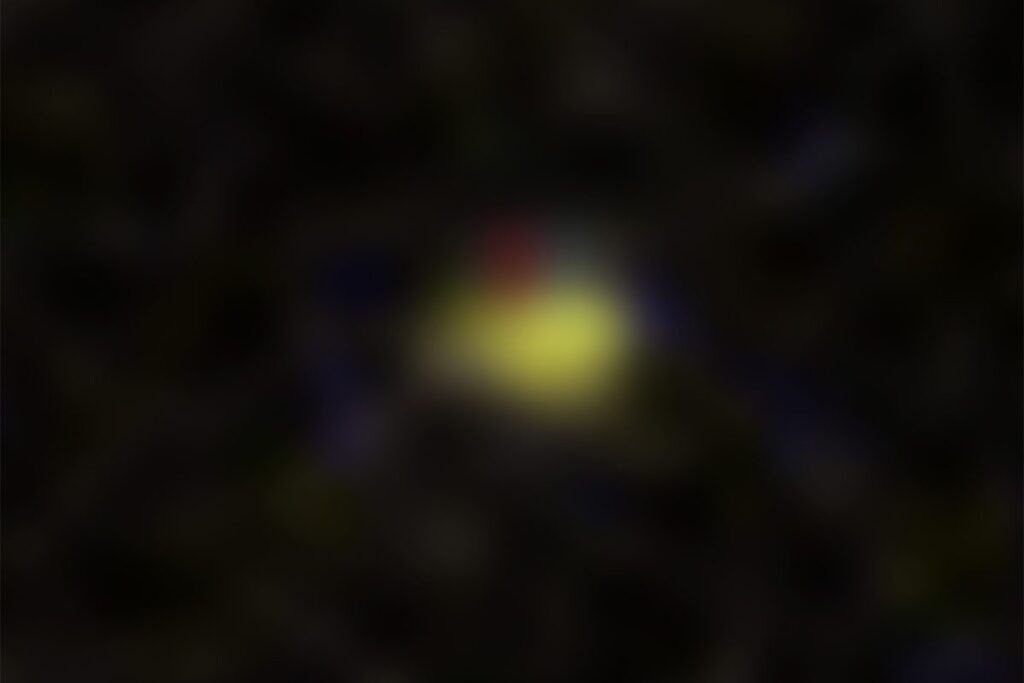
NASA’s James Webb Space Telescope has discovered a galaxy that existed just shortly after the Big Bang, and what astronomers have found is challenging key theories about the Universe.
The galaxy is so far away, it appears to us as it existed just 280 million years after the Big Bang. That’s when the Universe was just 2% of the age it is now.
Webb’s discovery is enabling scientists to look further into the history of the cosmos than ever before.
More mind-blowing Webb science
 Credit: NASA, ESA, CSA, STScI, A. Pagan (STScI)
Looking back in time
Because the Universe is so big, when we look at very distant objects, we’re seeing them as they existed millions, or even billions of years ago.
That’s because it takes light from distant objects millions or billions of years to reach our telescopes.
With more powerful telescopes, we can see further into space, and further back in time.
The newly-discovered galaxy is called MoM-z14, and we’re seeing it as it existed 280 million years after the Big Bang. For context, the current age of the Universe is thought to be 13.8 billion years old.
The galaxy’s name is a reference to its redshift, which is a unit of measurement astronomers use when talking about very distant galaxies.
Because light from these distant objects has been travelling across the Universe for so long, it’s been stretched and ‘shifted’ towards the red end of the spectrum by the expansion of the Universe.
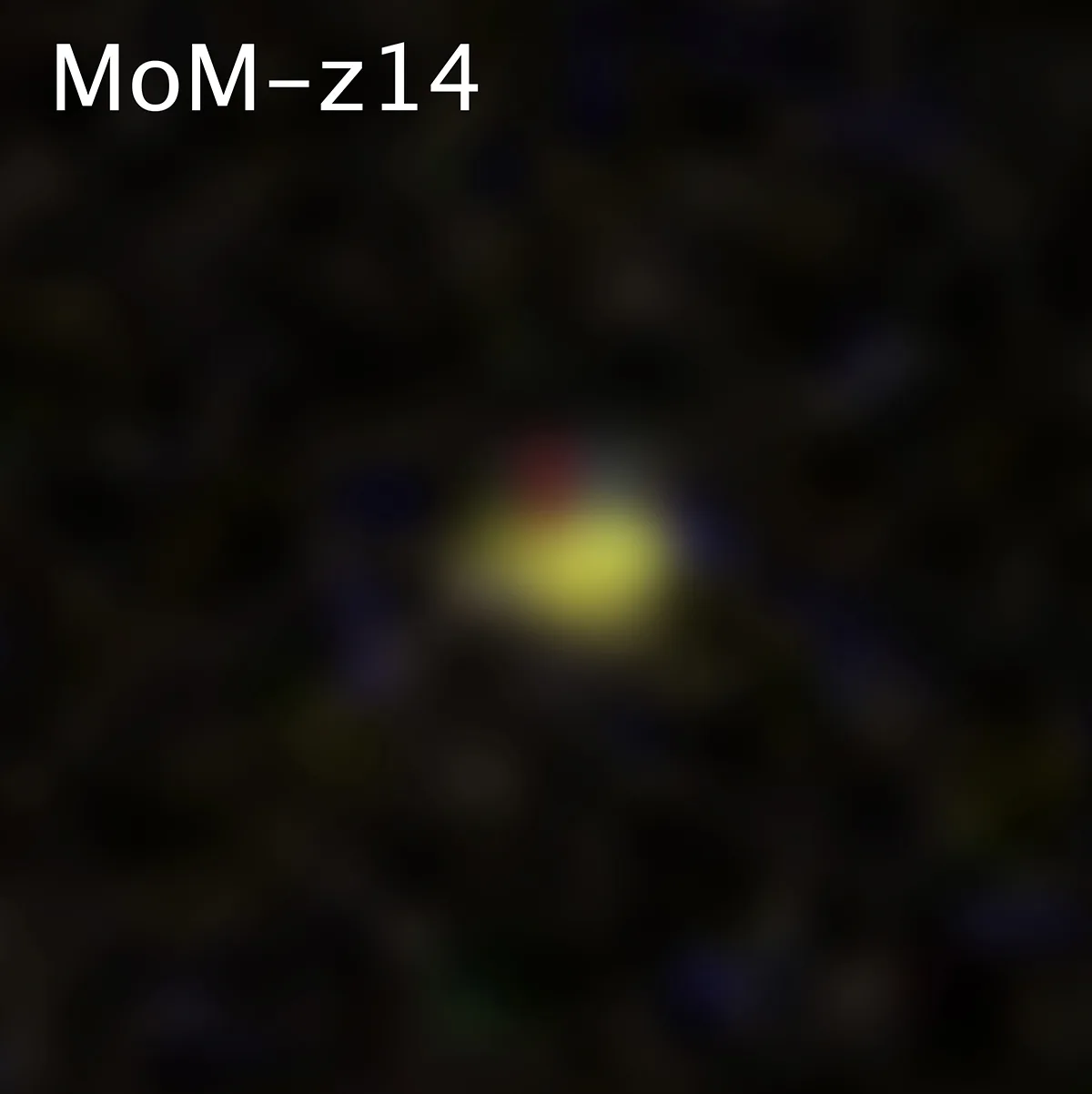 Galaxy MoM-z14 existed just 280 million years after the Big Bang. It’s seen here by the James Webb Space Telescope. Credit: NASA, ESA, CSA, STScI, Rohan Naidu (MIT); Image Processing: Joseph DePasquale (STScI)
Webb’s NIRSpec (Near-Infrared Spectrograph) instrument confirms MoM-z14 has a cosmological redshift of 14.44, meaning its light has been travelling through the expanding Universe for about 13.5 billion years.
“With Webb, we are able to see farther than humans ever have before, and it looks nothing like what we predicted, which is both challenging and exciting,” says Rohan Naidu of the Massachusetts Institute of Technology’s Kavli Institute for Astrophysics and Space Research, lead author of the study.
“We can estimate the distance of galaxies from images, but it’s really important to follow up and confirm with more detailed spectroscopy so that we know exactly what we are seeing, and when,” says Pascal Oesch of the University of Geneva, co-principal investigator of the survey.
Rewriting the history of the Universe?
MoM-z14 is one of a few bright galaxies that have been seen in the early Universe, and which theoretically shouldn’t exist.
For starters, it’s 100 brighter than theoretical studies predicted a galaxy so early in the Universe should be.
And because galaxy MoM-z14 existed just 280 million years after the Big Bang, scientists say there shouldn’t have been enough time for generations of stars to produce such high amounts of nitrogen.
One theory, the team say, is that the dense early Universe enabled supermassive stars able to produce more nitrogen than stars observed in the local Universe.
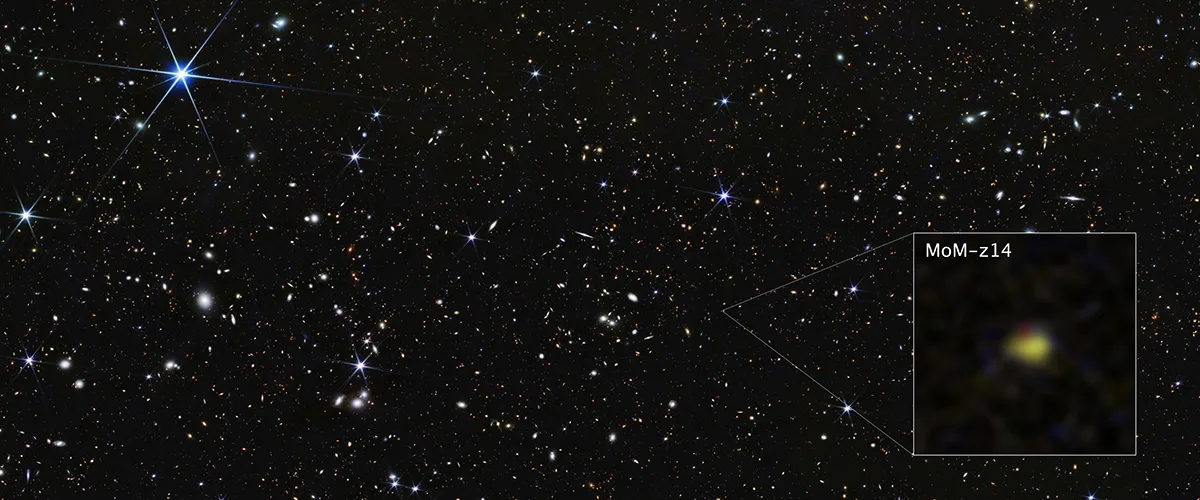 Credit: NASA, ESA, CSA, STScI, Rohan Naidu (MIT); Image Processing: Joseph DePasquale (STScI)
“There is a growing chasm between theory and observation related to the early Universe, which presents compelling questions to be explored going forward,” says Jacob Shen, a postdoctoral researcher at MIT and a member of the research team.
Scientists say they can look to the oldest stars in our own Galaxy, a small percentage of which have high amounts of nitrogen.
“We can take a page from archeology and look at these ancient stars in our own galaxy like fossils from the early universe, except in astronomy we are lucky enough to have Webb seeing so far that we also have direct information about galaxies during that time. It turns out we are seeing some of the same features, like this unusual nitrogen enrichment,” says Naidu.
MoM-z14 is also giving astronomers a view into a key epoch in the timeline of the Universe.
They say the galaxy is showing signs of clearing out the thick fog of hydrogen in the early Universe.
This period is known as the epoch of reionisation, because it was the time shortly after the Big Bang when early stars produced enough light to break down the thick gas in the early Universe, and that light could begin travelling through space.