
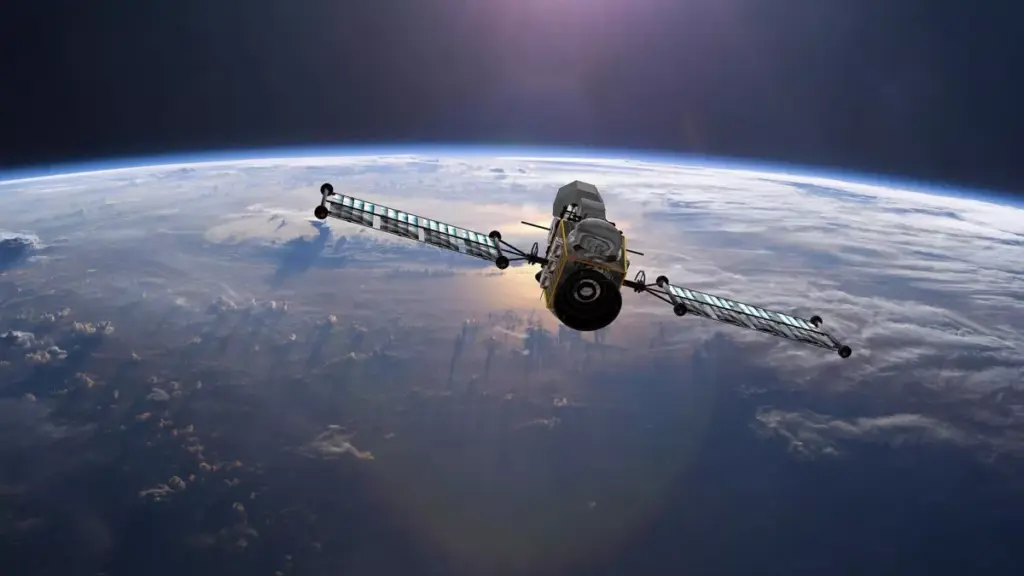
Germany is moving to become the first European country to establish its own space-based missile detection system, aiming to reduce Europe’s long-standing dependence on the United States for early warning and defence capabilities.
Major General Michael Traut, head of Germany’s space command, said Berlin is now working toward creating the core components of a satellite-based missile detection network. Speaking to the Financial Times, Traut explained that the initiative would be a national project, though open to cooperation with other European partners.
He stressed that building sovereign capabilities would not weaken ties with Washington, but rather strengthen Germany and Europe as allies of the US.
At present, European countries depend on a shared space-based early warning system provided by the US through Nato to detect threats such as long-range missile launches. However, concerns have grown across Europe following US President Donald Trump’s unpredictable stance on Nato and his recent remarks about annexing Greenland, prompting European governments to accelerate efforts to boost their independent military capabilities.
Germany has emerged as a leader in this surge in defence spending. In 2025, Berlin announced plans to invest €35 billion in military space technologies by 2030, immediately placing the country among the world’s top spenders in this field.
The German government has already launched the European Sky Shield Initiative, aimed at strengthening Europe’s ground-based air and missile defence systems.
Addressing the European Space Conference in Brussels, Traut described missile detection as a top operational priority.
“Space-based early warning and satellite-based missile detection are extremely urgent because the threat is imminent,” he said.
He added that Europe has relied heavily on the US across nearly all areas of space capability.
“There is a strong need to build up German and European sovereign capacities in missile detection and interception,” Traut said. “We not only want to detect missiles early — we also want to be able to fight them early.”
If implemented, Germany’s plan would provide Europe with its first fully operational space-based missile detection system. France previously tested launch-detection satellites, including the Spirale programme in 2009, but the effort ended without progressing into an operational capability. Germany’s Fraunhofer Institute for High-Speed Dynamics launched another demonstrator satellite focused on detecting rocket launches in 2024.
In a separate interview, European Space Agency (ESA) Director-General Josef Aschbacher said the agency is currently in discussions about how it could contribute to future missile detection developments.
He noted that regular talks are taking place between ESA and Germany regarding system architecture that could integrate German capabilities into a broader European infrastructure.
However, Aschbacher emphasized that these discussions remain in the early stages.
While dual-use technologies are becoming a growing priority for ESA, he made clear the agency would not take part in developing offensive weapons.
Historically, ESA has focused solely on civilian space programs. That approach shifted in November, when its member states — including EU countries, as well as Canada, Norway and the UK — agreed to fund the agency’s first explicitly dual-use initiative. The programme aims to develop technology for a space-based intelligence, surveillance and reconnaissance network.
Aschbacher said dual-use projects are likely to account for a much larger share of ESA’s work in coming years, a shift that would require Europe to double its collective space spending by 2030.
“You can’t do defence without space,” he said.
Europe’s vulnerability in missile detection has been highlighted by Russia’s introduction of the Oreshnik ballistic missile, which has reportedly been deployed twice in Ukraine and is considered nearly impossible to intercept.
Traut declined to provide specific figures or timelines for Germany’s planned space-based system, but warned that action could not be postponed.
“Our chief of defence in Germany has ordered us to be ready for war by 2029,” he said. “But when it comes to space, we must be prepared to fight now if necessary.”
By Tamilla Hasanova