
Theories on 3I/ATLAS might not be as broad or mind-boggling as fake moon landing theories or the assassination of JFK. But since the discovery of the mysterious comet 3I/ATLAS, which came from outside the solar system, it has undoubtedly become one of those moments that sparks wide speculation, touching politics (NASA’s late photo release of 3I/ATLAS), science (claims that it could be an alien spaceship), and even science fiction.
In spite of that, apart from Professor Avi Loeb, who has been at the forefront of proposing new theories and discussing how closely he has “worked” on it, no one has claimed to physically “work on” comet 3I/ATLAS, which is 230 million miles from Earth. Unbelievable as it sounds, a renowned astronomer has now claimed to “work on comet 3I/ATLAS” on Reddit, and it’s true, based on how it’s interpreted.

What it means when an astronomer says she “works on” a comet 230 million miles away. (Image: Reddit)
Also Read: NASA study using 50-year-old Apollo Moon samples suggests Earth’s water may not have come from meteorites“I work on comet 3I/ATLAS”
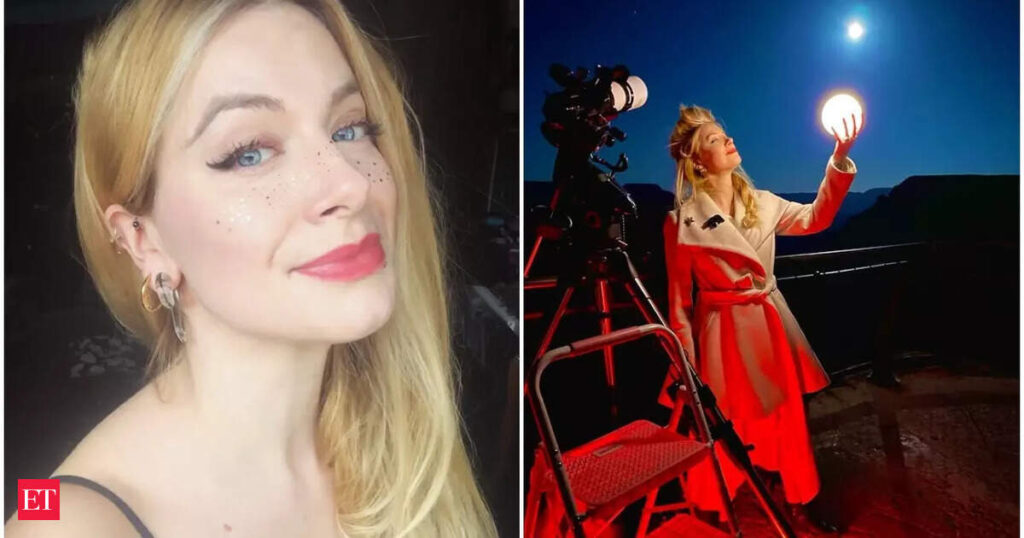
The person behind the post was Laura-May Abron, a French-American astronomer, and her explanation was more grounded in science than science fiction. Abron made the comment in r/Astronomy, one of Reddit’s most active science communities, where she shared images and observations of comet 3I/ATLAS. Live Events
“I work on comet 3I/ATLAS, which I recently imaged with a Vaonis and observed through a medium-sized telescope,” she wrote, posting original astrophotography taken from Southern California.
“Working on” an object means observing, imaging, tracking, and analyzing it from Earth. In physics, however, “working on” an object specifically means applying a force to that physical object, causing it to move or displace in the direction of that force.Probably in that context a user commented, ‘That must be a hell of a commute each day…’
Internet reacts after Laura-May Abron says she works on comet 3I/ATLAS.
A long-distance commute, telescope included
Abron explained that she manually imaged the comet using a Vaonis Vespera II-X, stacking around 300 individual 10-second exposures to create a usable image. The faint streaks visible in the photo were caused by non-sidereal tracking, a technique used when observing fast-moving objects that don’t follow the apparent motion of background stars.
She also observed the comet visually through a 22-inch Dobsonian telescope at a dark-sky site about an hour north of Los Angeles, classified as Bortle 3, meaning minimal light pollution.
“It was a faint smudge,” she noted, but one worth catching. According to Abron, 3I/ATLAS is brighter than both ‘Oumuamua and Borisov, the two previously known interstellar visitors, making it a rare opportunity for astronomers and serious amateurs alike.
Science, not science fiction
Far from claiming any physical interaction with the comet, Abron used the post to encourage others to observe it while conditions allow. “Reach out to your local astronomical society if you don’t have a big scope,” she advised.Who is Laura-May Abron?
Laura-May Abron is a French-American astronomer, science communicator, artist, and journalist who works at the Griffith Observatory in Los Angeles. Born in France to an American mother and a French father, she grew up bilingual in a multicultural, artistic environment, spending part of each year in Paris and summers in Washington, D.C. She later moved to Madrid to pursue art and journalism before formally studying astronomy and astrophysics at the Paris Observatory (OBSPM). She graduated in 2016 with highest honours, producing a research memoir on exoplanetary systems, and also trained in astrophotography using large observatory instruments.
Laura- May moved to Los Angeles in 2017 to focus on science communication, as per her LinkedIn. She has since worked as a writer, consultant, presenter, and educator for science platforms and shows, including Generation Genius. She founded Inspired Science Women of Los Angeles, teaches astronomy, creates bilingual astrophysics content online under CelestialMachines, and regularly hosts public astronomy programs. Her science-inspired artwork has been featured by NASA, New Scientist, and international galleries.
She was selected as the Grand Canyon’s 13th Astronomer in Residence, where she led public programs such as constellation talks, solar viewing sessions, and Full Moon gatherings, while also creating night-sky paintings and music videos. As per the National Park Service website, she is also a co-host of the podcast “All Space Considered” and frequently appears as a public astronomer and presenter through the Griffith Observatory and its education programs.
About 3I/ATLAS
Comet 3I/ATLAS is only the third confirmed interstellar object ever observed passing through our solar system. Unlike typical comets that originate in the Kuiper Belt or Oort Cloud, this one came from beyond the Sun’s gravitational influence.
That alone has made it a magnet for theories, some scientific, others speculative. Harvard astrophysicist Avi Loeb has publicly encouraged open discussion around such objects, contributing to public fascination and occasional misinterpretation.
Abron’s Reddit post, stripped of context, briefly fed into that confusion. But her work has some standard astronomical practices, and they are pretty cool too: remote observation using advanced optics, careful tracking, and collaborative verification through professional observatories, including recent observation runs at Gemini Observatory.
Add  as a Reliable and Trusted News Source