
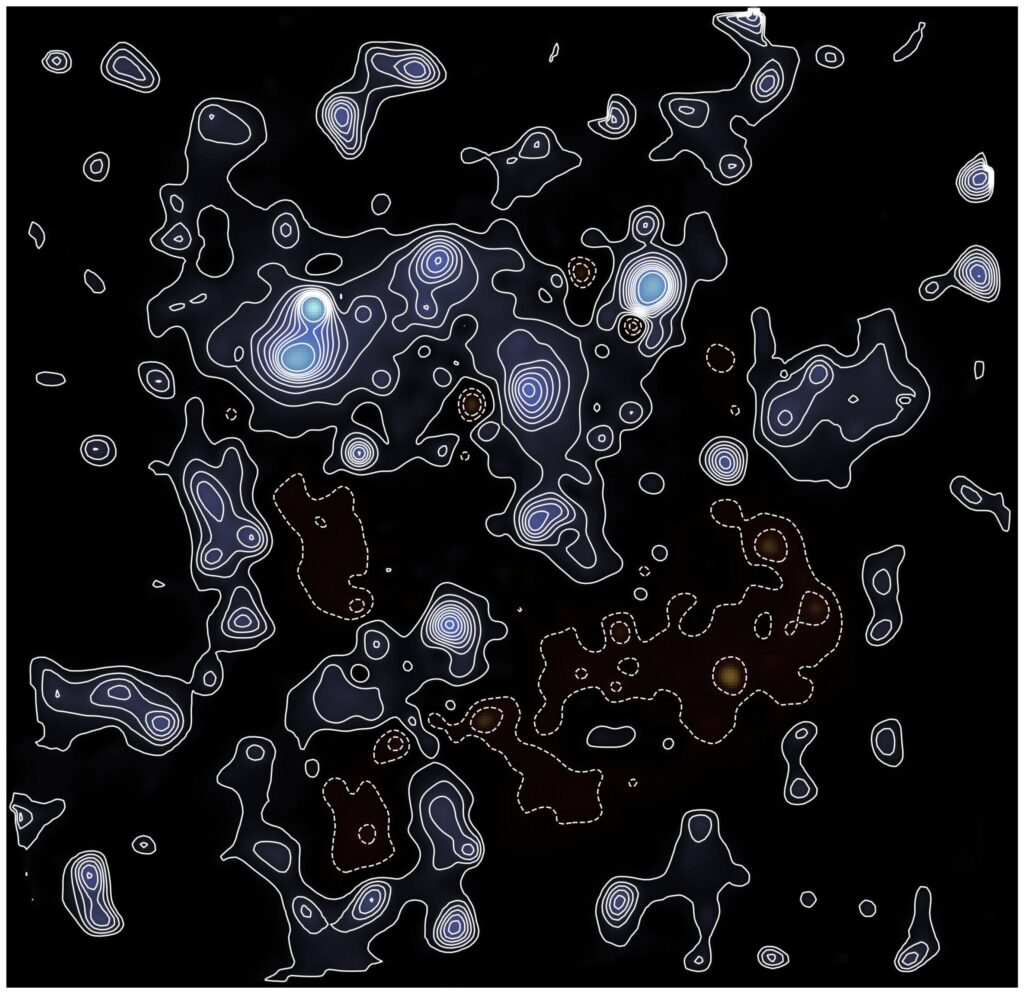
Researchers at Durham University have created a map of dark matter with the highest possible resolution. It shows its influence on the formation of stars, galaxies, and the entire structure of our Universe.
Map of dark matter
Dark matter is one of the greatest mysteries of modern science. This is the name given to a mysterious form of matter that accounts for over 80% of the total mass of the Universe. Unlike ordinary matter, it does not participate in electromagnetic interactions and cannot be observed directly. Dark matter reveals its presence only through gravitational interactions.
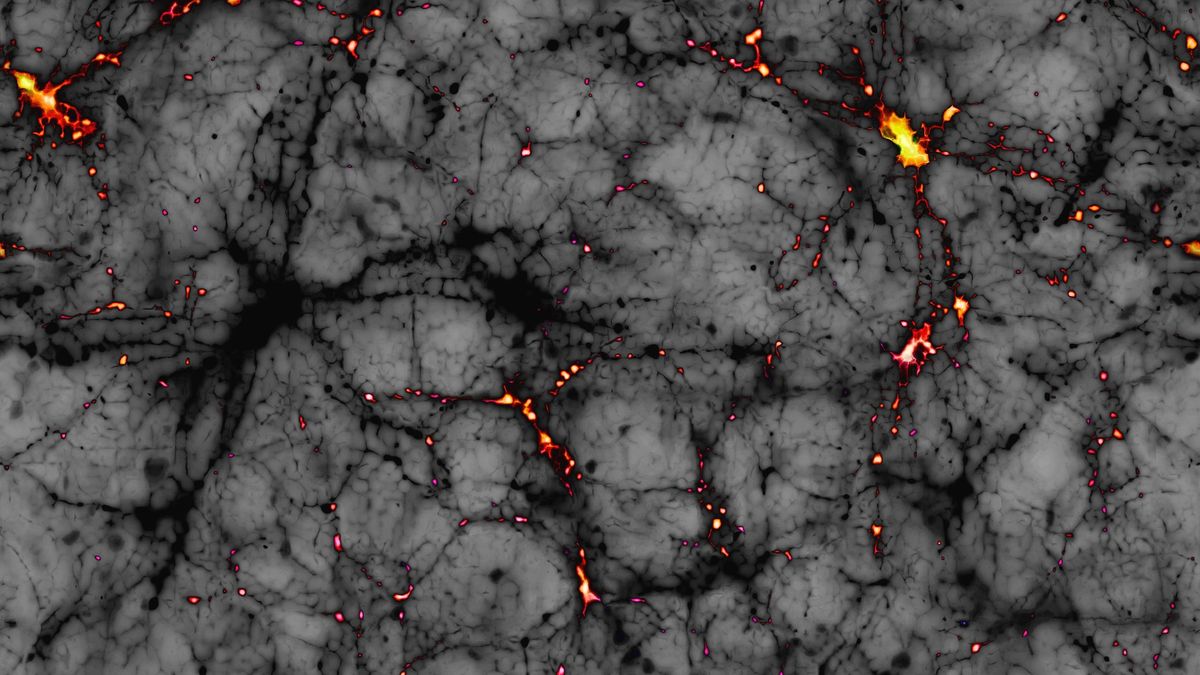 Simulation of dark matter structures in the Universe. Source: MARK GARLICK/SCIENCE PHOTO LIBRARY via Getty Images
Scientists have been trying to uncover the secret of dark matter and how it interacts with ordinary matter for a very long time. In a new study, they used data collected by the James Webb Space Telescope (JWST) to create the most detailed map of its distribution to date. It covers an area of the sky in the constellation Sextans, approximately 2.5 times the size of the full moon.
JWST observed this area for a total of 255 hours and identified nearly 800,000 galaxies, many of which were discovered for the first time. The map contains information about approximately ten times more galaxies than can be seen with ground-based telescopes and twice as many as can be seen with the Hubble Space Telescope.
The influence of dark matter on the Universe
By analyzing the map, scientists were able to see in greater detail how dark matter interacts with the rest of the Universe through gravity. Evidence of this interaction is the degree of overlap between the dark matter and normal matter maps. JWST observations confirm that such a close match cannot be coincidental.
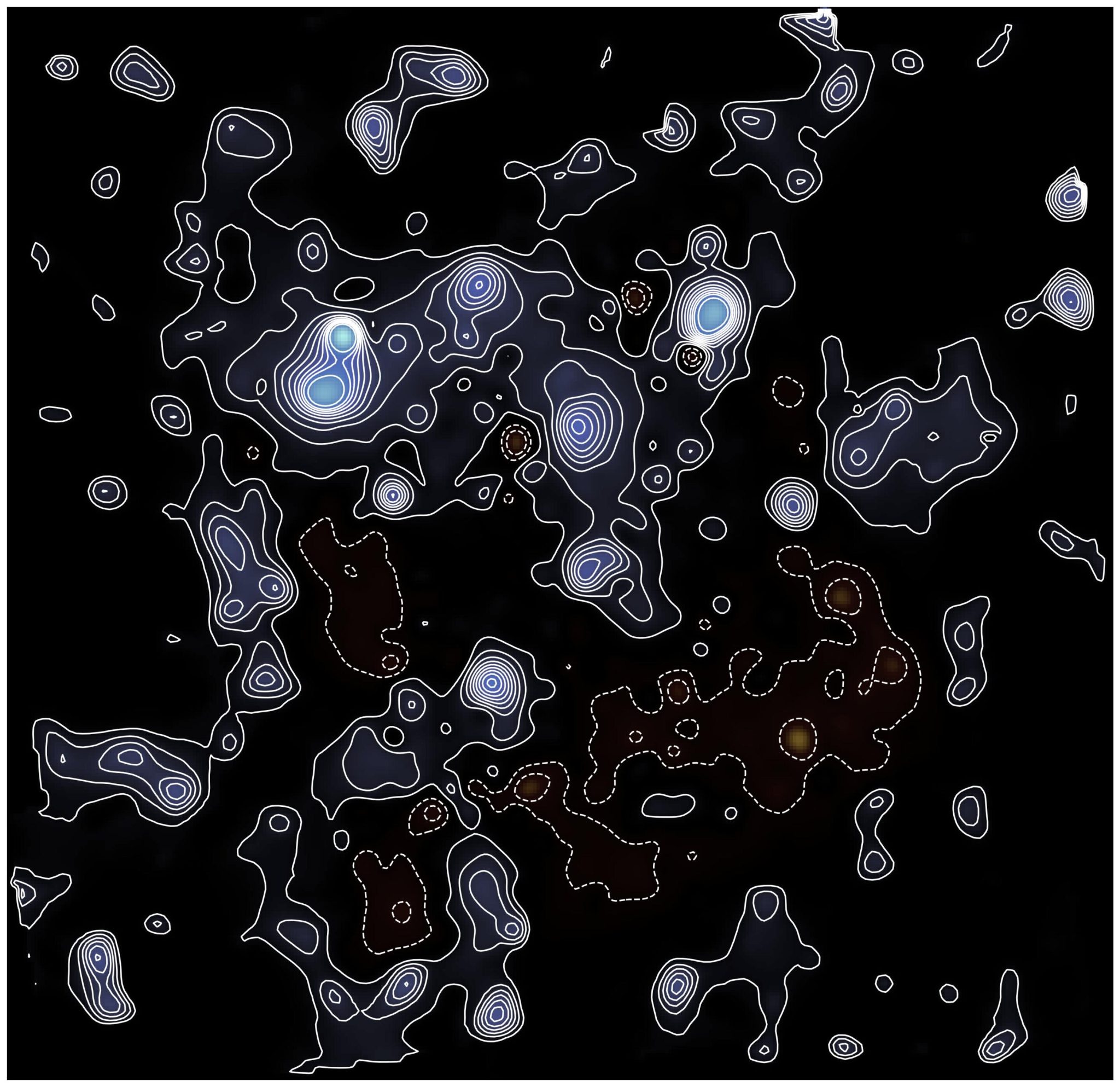 Map of dark matter distribution obtained using the James Webb Telescope. The superimposed contours indicate areas with the same density of dark matter, with blue corresponding to regions with the highest concentration. Source: Dr. Gavin Leroy/COSMOS-Webb collaboration.
Astronomers believe that this is due to the fact that throughout history after the Big Bang, the gravity of dark matter attracted ordinary matter, leading to the formation of the Universe as we see it today.
“By revealing dark matter with unprecedented precision, our map shows how an invisible component of the Universe has structured visible matter to the point of enabling the emergence of galaxies, stars, and ultimately, life itself. This map reveals the invisible, but essential role of dark matter, the true architect of the Universe, which gradually organises the structures we observe through our telescopes,” commented study co-author Dr. Gavin Leroy.
In the future, researchers plan to create a global map of dark matter covering the entire Universe. They will be assisted in this by the Euclid telescope, which has already been launched, and the Roman telescope, which is scheduled for launch in the second half of this year. It will allow us to learn more about the fundamental properties of dark matter and how it may have changed throughout the history of the cosmos. As for the map compiled by JWST, it will become the benchmark against which all future maps will be refined and compared.
According to Durham University