
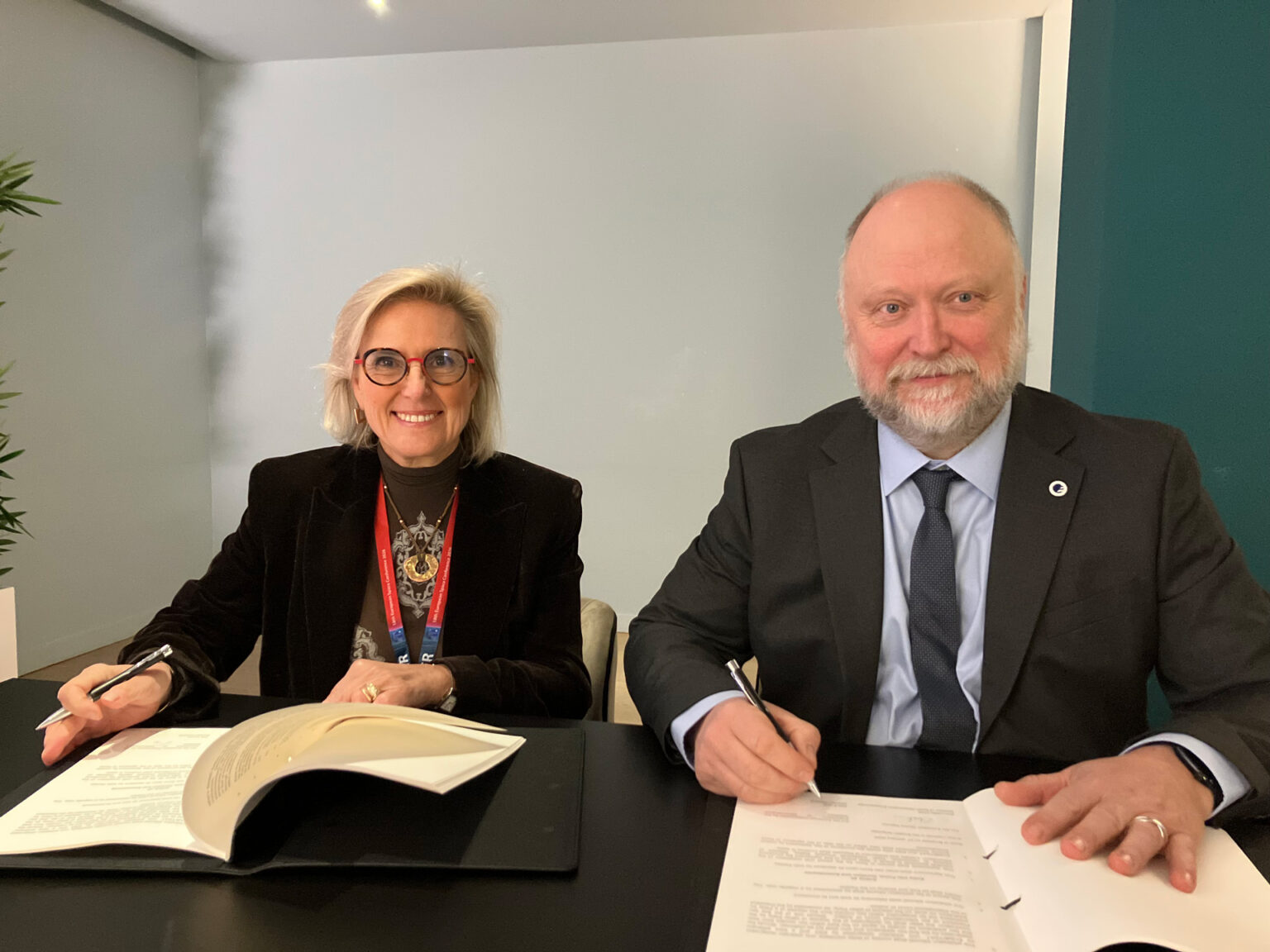
Simonetta Cheli, Head of the Strategy, Programme and Coordination Office for ESA Earth Observation, and Phil Evans, EUMETSAT Director-General, sign the EPS-Sterna cooperation agreement
With the agreement now in place, the EPS-Sterna programme will move into its execution phase. Industrial contracts can be placed, satellite development can begin, and Europe’s innovative constellation of weather and climate monitoring small satellites can take shape.
EUMETSAT will fully fund the programme and operate its satellites throughout their lifetime. Once operational in 2029, EPS-Sterna will complement the Metop-SG polar-orbiting satellites with more frequent observations of the atmosphere’s temperature and humidity. It will thus contribute to strengthening weather forecasts, improving early warnings for extreme events, and reinforcing Europe’s leadership in space-based weather and climate monitoring.
Overall, the constellation is expected to improve the accuracy and reliability of numerical weather prediction models by 6% over the mid-latitudes of Europe and by 9% over the Arctic regions.
“This signature turns thirty national commitments into concrete action,” said Phil Evans, Director-General of EUMETSAT. “EPS-Sterna can now move at full speed from planning to hardware, thanks to the strong partnership between EUMETSAT and ESA and the confidence shown by our Member States.”
Under the agreement, ESA will act as the procurement agent for the satellites, drawing on Europe’s industrial and technical expertise, while EUMETSAT will develop the ground systems, manage launches, operate the constellation and deliver data to weather services across Europe and beyond.
The cooperation builds on decades of successful collaboration between ESA and EUMETSAT, which together have delivered many of Europe’s most important weather satellite programmes. EPS-Sterna continues this model, combining EUMETSAT’s operational and user-driven approach with ESA’s space engineering excellence.
EPS-Sterna also builds on the successful ESA demonstration mission Arctic Weather Satellite (AWS), which is in orbit since August 2024 and has demonstrated that the benefits expected from EPS-Sterna will be met.
With the agreement signed and funding secured, EPS-Sterna is no longer a future concept. It is now a programme in motion.