
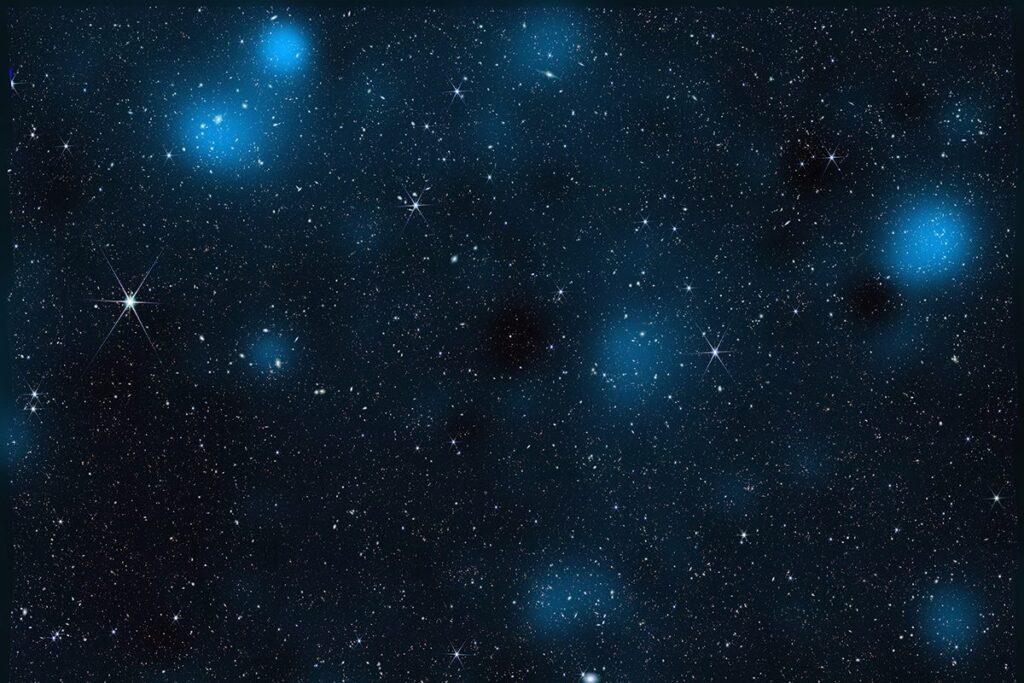
The James Webb Space Telescope has created one of the most detailed, high-resolution maps of dark matter ever produced, according to NASA.
“This is the largest dark matter map we’ve made with Webb, and it’s twice as sharp as any dark matter map made by other observatories,” says Diana Scognamiglio of NASA’s Jet Propulsion Laboratory and lead author of the study.
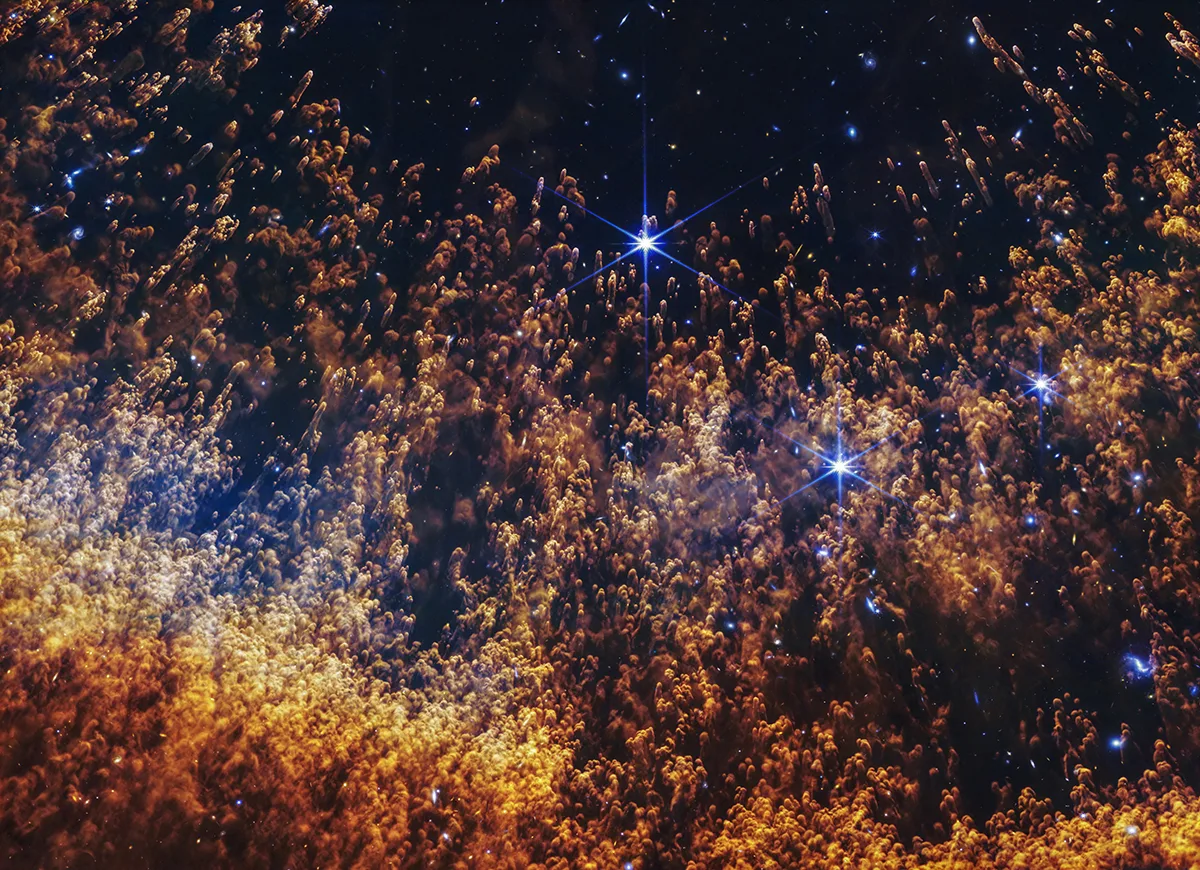 Credit: NASA, ESA, CSA, STScI, A. Pagan (STScI)
The map is enabling scientists to learn more about how dark matter influences stars, galaxies and planets, including our own.
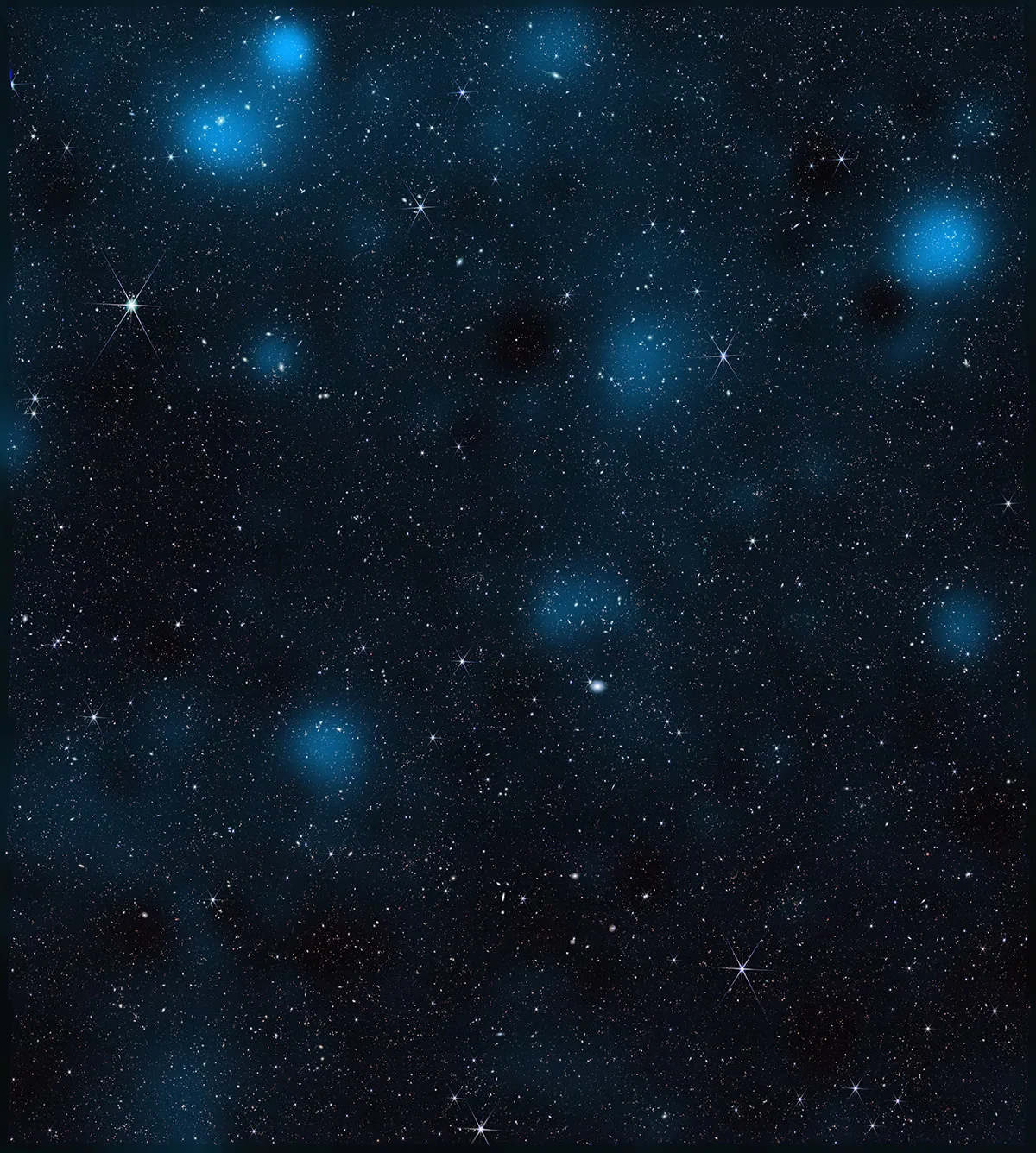 Image by the James Webb Space Telescope overlaid with a map of dark matter, represented in blue. Brighter blue areas indicate a higher density of dark matter. Credit: NASA/STScI/J. DePasquale/A. Pagan
The strange mystery of dark matter
Dark matter is the name given to the invisible substance that makes up about 27% of everything in the Universe.
It can’t be seen, but its existence is used to explain a strange anomaly in physics.
When astronomers observe galaxies, if they calculate the total mass of all the ‘normal’ matter they can see – stars, gas, dust etc. – there’s not enough ‘stuff’ to provide the gravitational heft to hold the galaxies together.
As these galaxies rotate rapidly, they should be flinging themselves apart.
But they’re not. So there must be a large amount of extra matter that can’t be directly detected. This has become known as dark matter, and there are numerous theories as to what dark matter could be.
Learning more about dark matter and mapping its distribution throughout the Universe is a vital clue to understanding how the Universe works, and what makes it tick.
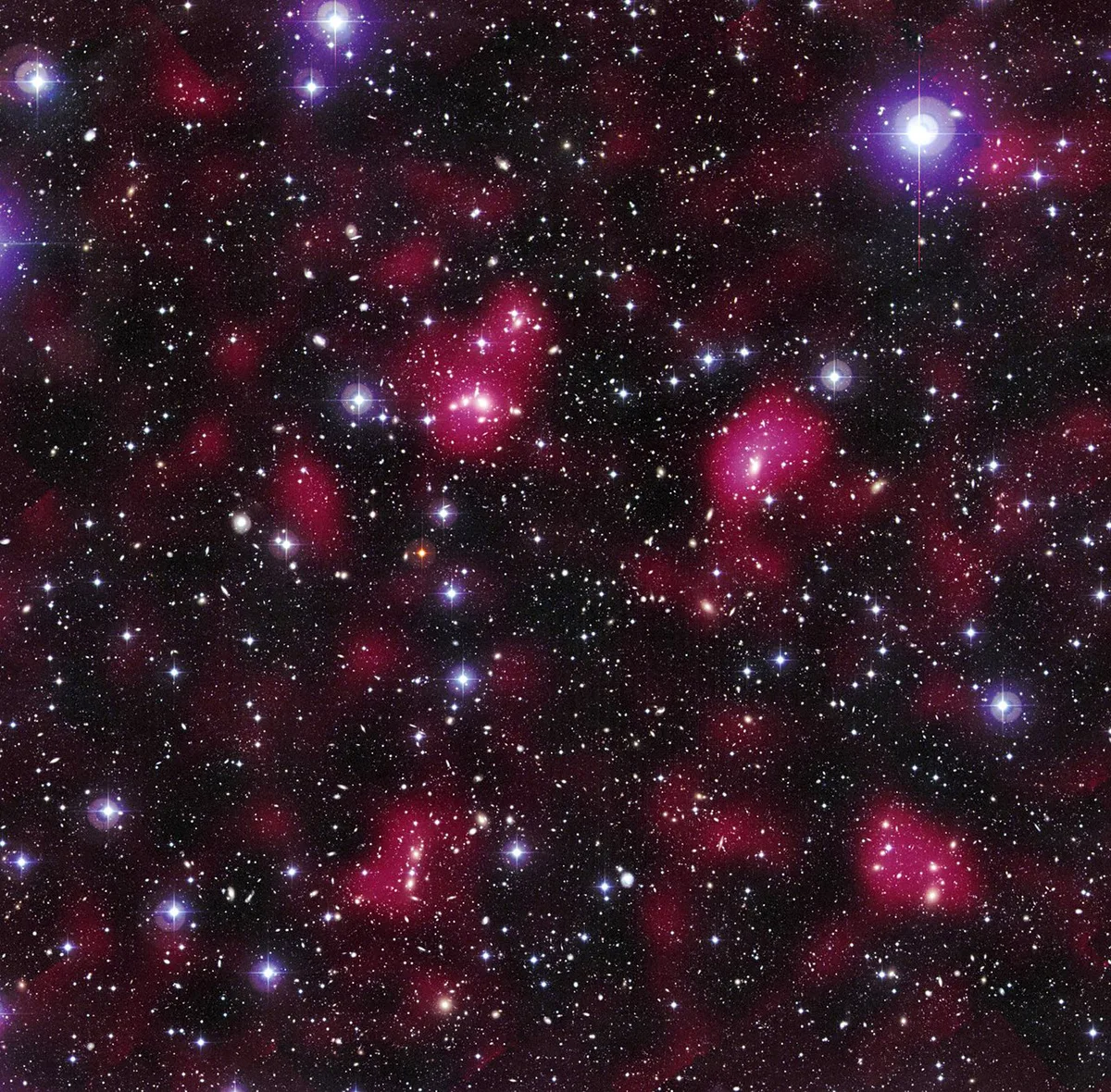 A dark matter map produced by the Hubble Space Telescope in 2008, showing the distribution of dark matter in the supercluster Abell 901/902. Credit: NASA, ESA, C. Heymans (University of British Columbia, Vancouver), M. Gray (University of Nottingham, U.K.), M. Barden (Innsbruck), and the STAGES collaboration
Webb’s dark matter map
This new dark matter map produced using the James Webb Space Telescope builds on previous studies and gives scientists more information about how dark matter has shaped the Universe.
It reveals dark matter’s influence on the largest objects in the Universe, like galaxy clusters stretching millions of light years across.
“Previously, we were looking at a blurry picture of dark matter. Now we’re seeing the invisible scaffolding of the Universe in stunning detail, thanks to Webb’s incredible resolution,” says Scognamiglio.
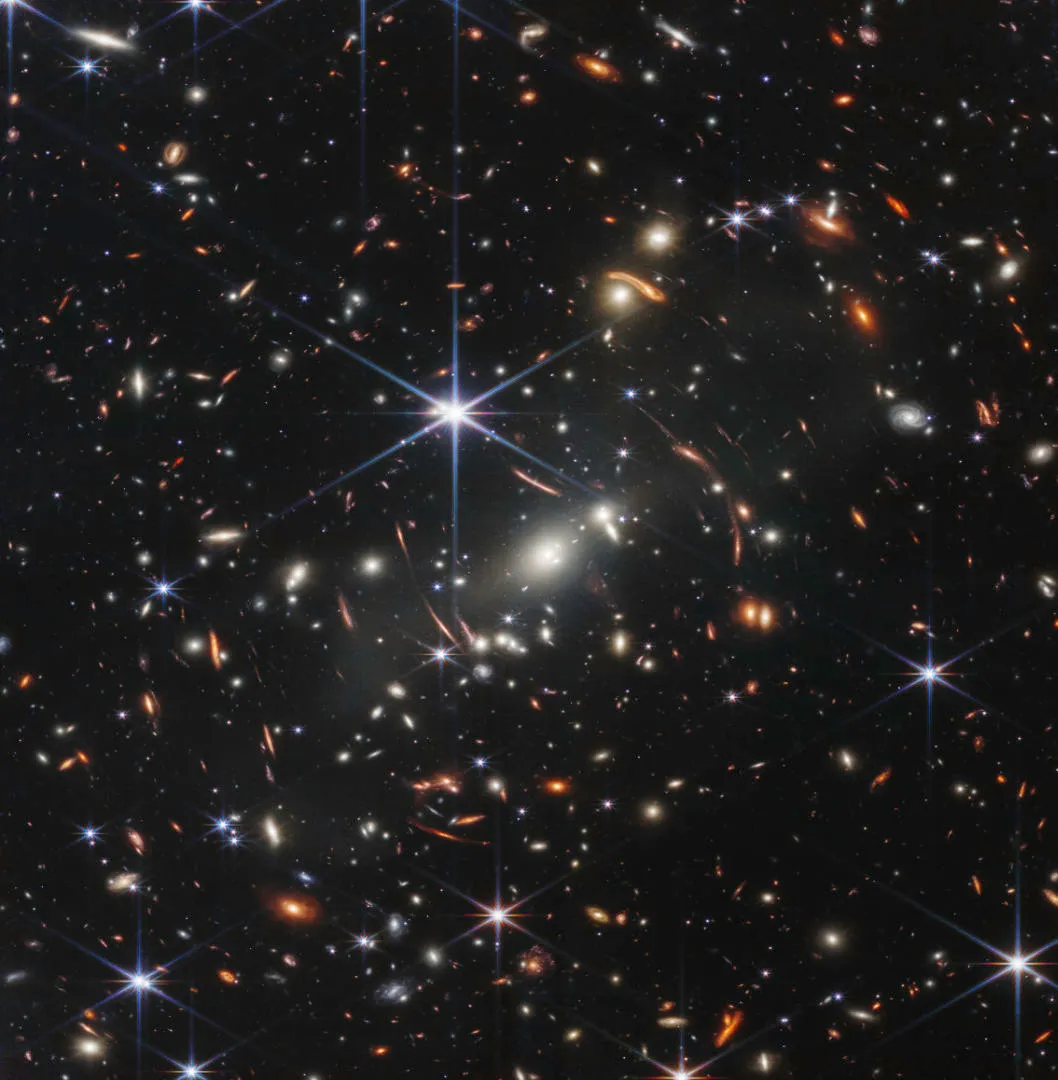 A deep view of the Universe, captured by the James Webb Space Telescope, showing a vast collection of distant galaxies. Dark matter is thought to be responsible for influencing the formation and distribution of galaxies we see in the Universe today. Credit: NASA, ESA, CSA, STScI
How to see the invisible
If dark matter doesn’t seem to react with regular, optical light in any way, how can we see it?
Because it’s ‘matter’, dark matter does react with its surroundings through gravity. After all, it’s what’s used to explain how galaxies have enough gravitational pull to hold themselves together.
Webb’s map shows dark matter’s gravitational interactions with new clarity, says NASA.
The study authors say Webb’s observations show the overlap between dark matter and regular matter, confirming dark matter’s role in pulling regular matter together throughout the history of the Universe.
“Wherever we see a big cluster of thousands of galaxies, we also see an equally massive amount of dark matter in the same place. And when we see a thin string of regular matter connecting two of those clusters, we see a string of dark matter as well,” says Richard Massey, an astrophysicist at Durham University in the United Kingdom and a coauthor of the new study.
“It’s not just that they have the same shapes. This map shows us that dark matter and regular matter have always been in the same place. They grew up together.”
The dark matter map explained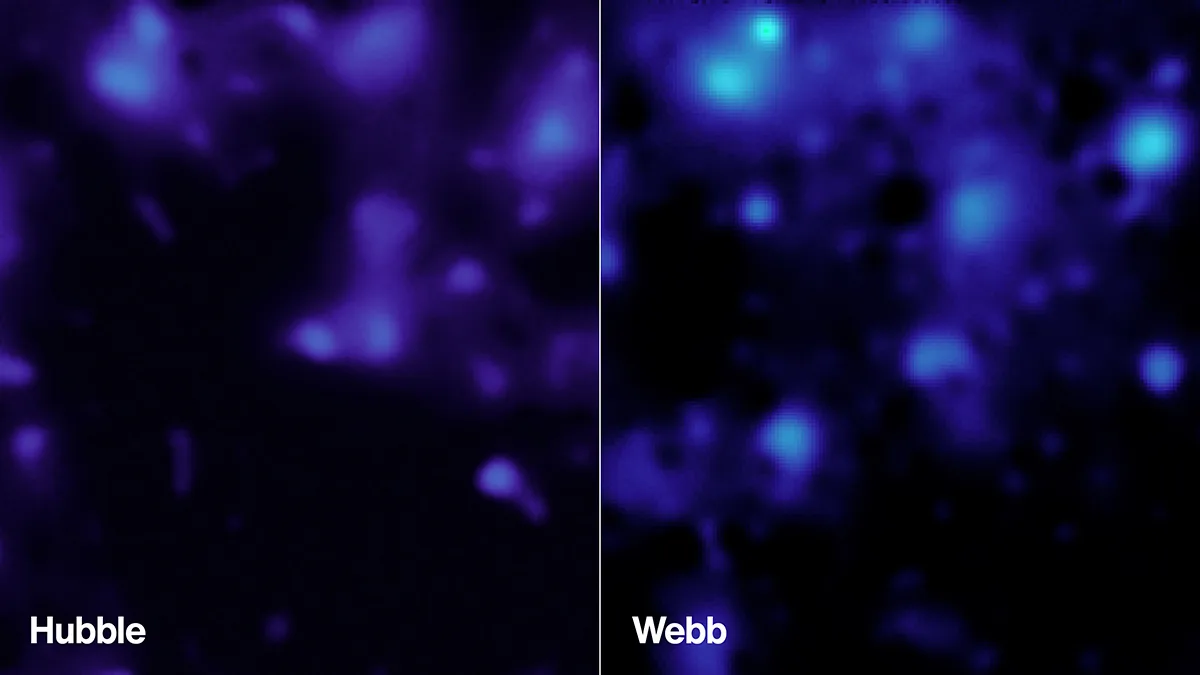 Two dark matter maps showing the same region of the sky, one made by the Hubble Space Telescope and the other by the James Webb Space Telescope. Credit: NASA/STScI/A. Pagan
Webb’s dark matter map covers an area of the sky 2.5 as big as the full Moon and is focussed on the region of the sky in the constellation Sextans.
The first dark matter map of the area was made in 2007 using the Hubble Space Telescope.
That project was led by Massey and another JPL astrophysicist Jason Rhodes, who’s a coauthor of the paper.
Webb studied this section of the sky for over 10 days and identfied 800,000 galaxies, some of which were seen for the first time.
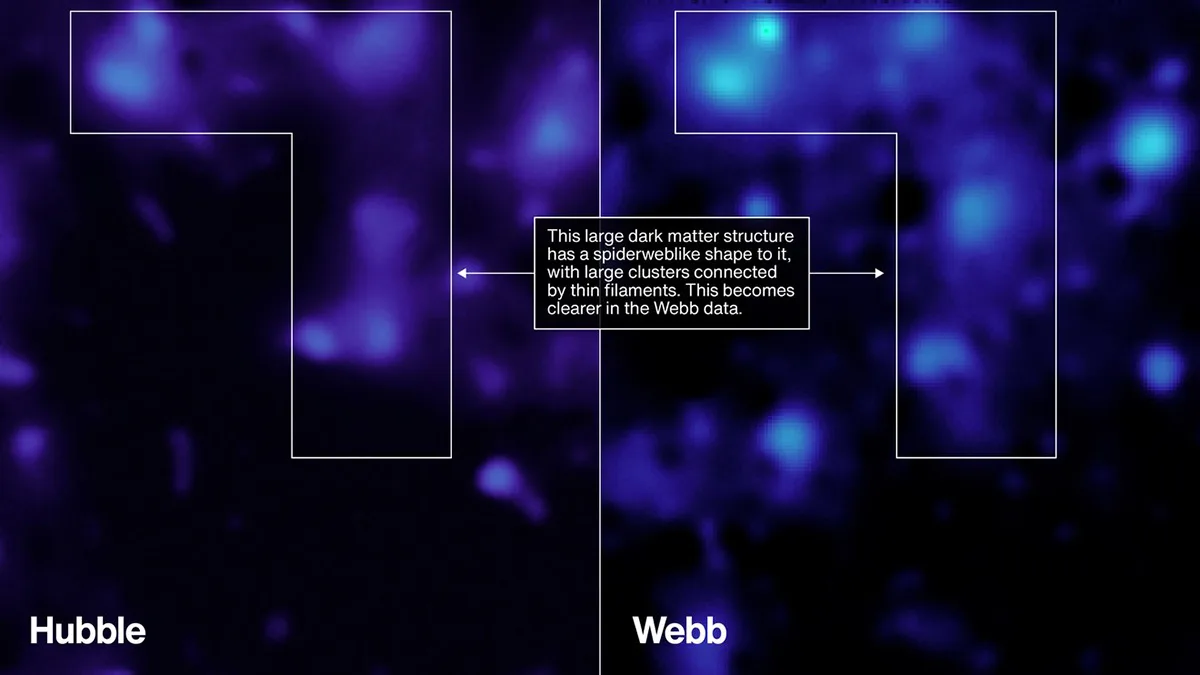 Hubble and Webb versions of the same dark matter map. Dense regions of dark matter are connected by lower-density filaments, forming a weblike structure known as the cosmic web. Credit: NASA/STScI/A. Pagan
Scognamiglio and colleagues were able to find dark matter in the region by observing how its mass curves space, bending light from distant galaxies.
Mass curves space-time, and one effect of this is known as gravitational lensing, where light from distant objects is warped by the mass of closer objects. It’s a well-known phenomena first predicted by Einstein.
Webb’s observations of this region contain about 10 times the number of galaxies compared to maps of the area from ground-based observatories, and twice as many as Hubble’s map, says NASA.
And it shows new clumps of dark matter in higher-resolution.
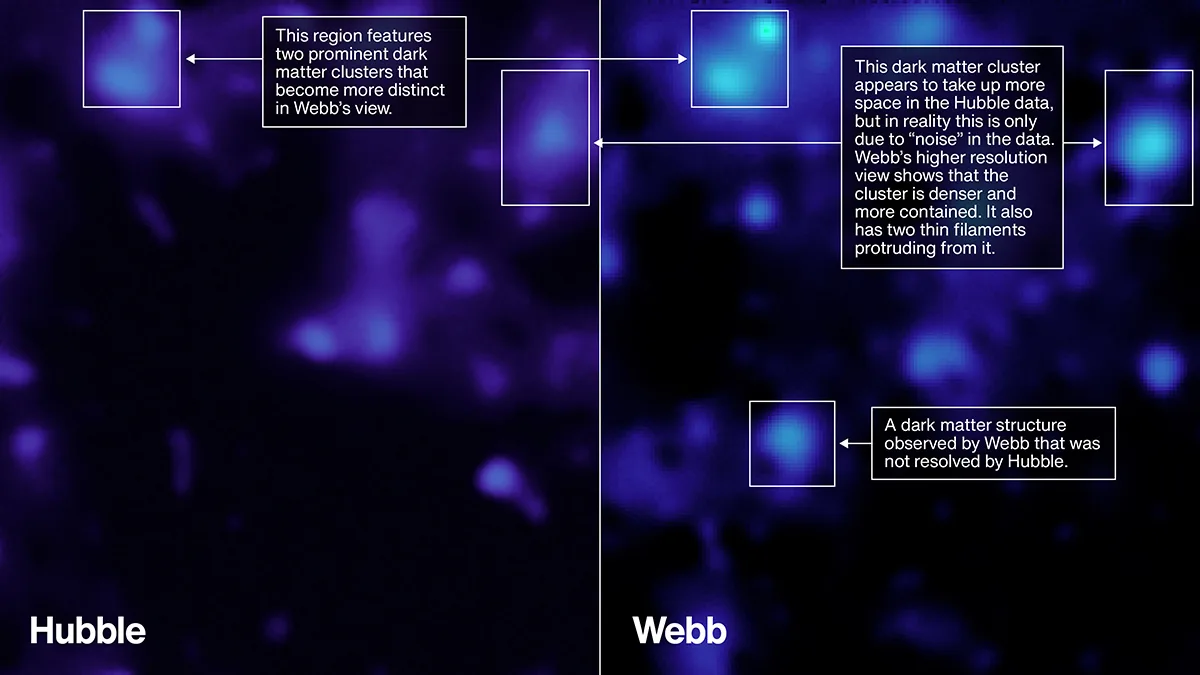 Hubble’s dark matter map vs Webb’s. Some dark matter structures appear smaller in Webb’s data because they’re coming into sharper focus, according to NASA. Credit: NASA/STScI/A. Pagan
A clue to the evolution of the cosos
Scientists think that, in the early Universe, regular matter and dark matter were sparsely distributed. Then dark matter clumped together and began pulling together regular matter.
This in turn produced condensed regions of vital material required for stars and galaxies to form.
If true, that means dark matter is responsible for the distribution of galaxies we see in the Universe today.
It also means dark matter influenced the formation of planets, including planets like Earth. You could say, without dark matter, we wouldn’t be here.
“This map provides stronger evidence that without dark matter, we might not have the elements in our galaxy that allowed life to appear,” says Rhodes.
“Dark matter is not something we encounter in our everyday life on Earth, or even in our Solar System, but it has definitely influenced us.”
Scognamiglio and the team say they’ll map dark matter with NASA’s upcoming Nancy Grace Roman Space Telescope over an area 4,400 times bigger than this region.
It seems we could be on the brink of discovering vital clues about the nature of this strange ‘glue’ holding the Universe together, and the role it played on producing the cosmos as we see it today.