
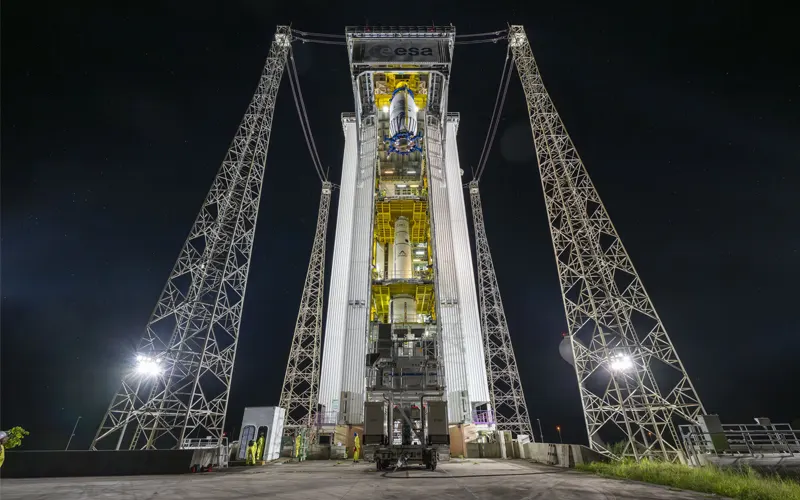
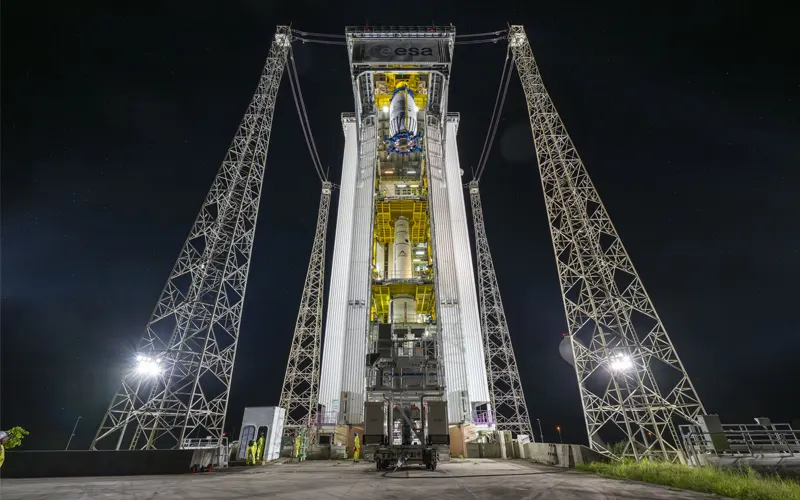
 Credit: ESA / CNES / Arianespace / Optique vidéo du CSG / S. Martin
Brazil’s National Institute for Space Research (INPE) has awarded a contract to SpaceLaunch for the launch of its Amazonia-1B Earth observation satellite aboard a Vega C rocket in 2027.
In September 2025, Italian rocket builder Avio announced that it had signed a launch services agreement with US-based launch aggregator SpaceLaunch to carry an Earth observation satellite for an “extra-European institutional customer.” At the time, Avio said it could not reveal the customer’s identity but would do so at a later date.
While the customer was not disclosed in 2025, INPE published a press release on 27 January 2026 confirming that it was the “extra-European institutional customer.” Although the announcement did not include a contract value, a public release from Brazil’s Ministry of Science, Technology and Innovation on 21 January, announcing the contract’s award to SpaceLaunch, listed the “Total Approved Purchase Value” at R$ 188,200,504.56 (approximately €30 million).
Commenting on the procurement process, INPE Director Antonio Miguel Vieira Monteiro said that four proposals were received and evaluated based on both technical criteria and value. He added that the institute was satisfied with the selection of Vega C for the launch of Amazonia-1B, as well as the additional support provided by SpaceLaunch.
SpaceLaunch CEO Marcy Mabry said that Vega C offered the performance and reliability required for the mission.
“Vega-C offers a strong combination of performance and reliability for Amazonia-1B, and we look forward to working closely with INPE and Avio to deliver a successful mission,” Mabry said.
The selection marks an important milestone for Avio as it continues its transition away from Arianespace and seeks to expand its presence in the global launch market. Avio CEO Giulio Ranzo said he was “excited about Amazonia-1B.”
“Honored for the trust in our capabilities to secure access to space for Earth observation,” Ranzo said. “[It’s] a demonstration that Vega C is a competitive product globally.”
The first Amazônia satellite was launched aboard a PSLV rocket in February 2021. Following the launch of Amazonia-1B in 2027, a third satellite, Amazonia-2, is expected to join the constellation. The constellation will be tasked with monitoring deforestation in the Amazon region, as well as supporting agricultural monitoring across Brazil.
Keep European Spaceflight Independent
Your donation will help European Spaceflight to continue digging into the stories others miss. Every euro keeps our reporting alive.