
Comets have a reputation for being cold, dirty snowballs lingering far from the Sun. Yet for years, astronomers have puzzled over one strange fact.
Many comets contain crystalline silicates – minerals that form only under intense heat. That reality clashes with life in the deep freeze at the edge of a solar system.

The puzzle has lingered for decades. How do materials that need extreme heat end up locked inside objects that spend most of their lives in bitter cold?
The answer, it turns out, may lie in the messy and violent childhood of stars.
Watching a young star make crystals
New observations from NASA’s James Webb Space Telescope offer the clearest explanation yet.
By looking at a very young star still wrapped in gas and dust, astronomers have watched crystalline silicates being made close to the star and then pushed far away into colder regions.
This is the first time scientists have directly linked the hot inner zones of a forming star system to the cold outer regions where comets are expected to form.
Compared to our own mature solar system, this crystal factory sits roughly in the region between the Sun and Earth.
A stellar conveyor belt
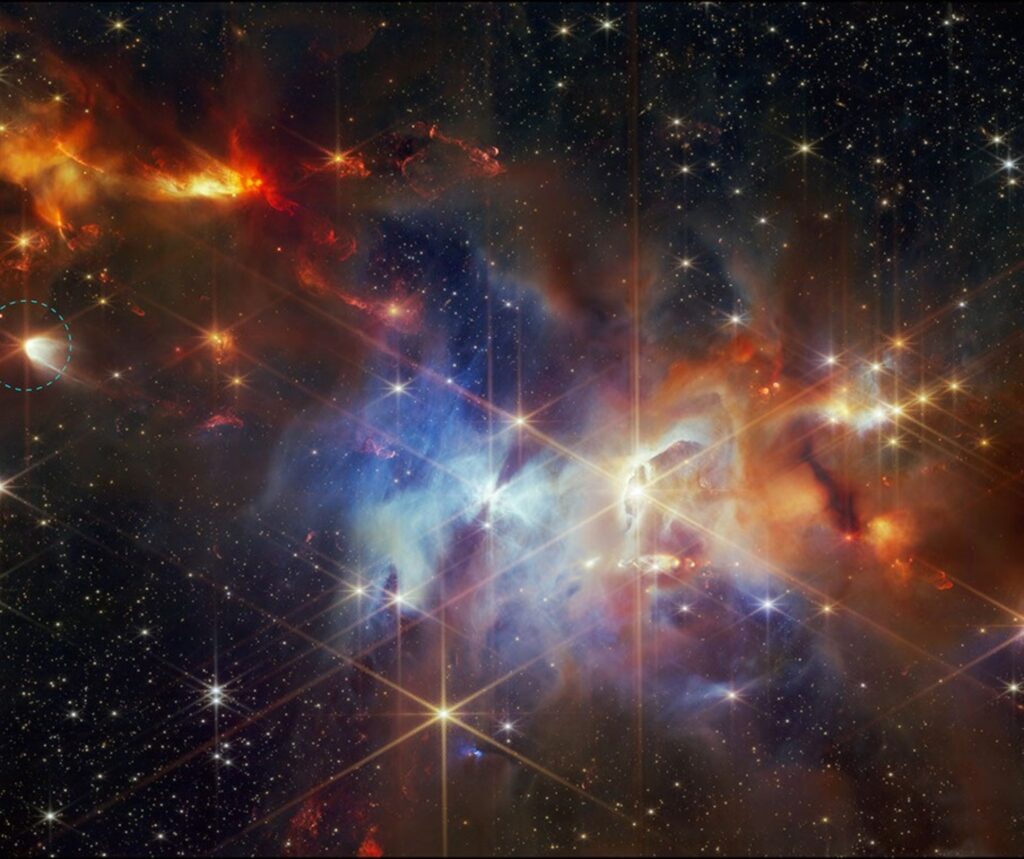
The star at the center of this discovery is called EC 53. It is still actively feeding on the disk of gas and dust around it.
Deep in that disk, temperatures soar high enough to turn raw dust into crystalline silicates. That part was long suspected. What Webb showed, clearly and in detail, is how those crystals get out.
Jeong-Eun Lee, a professor at Seoul National University in South Korea, is the study’s lead author.
“EC 53’s layered outflows may lift up these newly formed crystalline silicates and transfer them outward, like they’re on a cosmic highway,” said Lee.
“Webb not only showed us exactly which types of silicates are in the dust near the star, but also where they are both before and during a burst.”
Those outflows act like powerful winds. They rise from the hottest parts of the disk and move outward, carrying newly formed crystals with them.
Over time, the crystals can reach the outer, colder edges of the disk, the same kind of places where comets may eventually take shape.
A star with a steady rhythm
EC 53 is not a quiet neighbor. About every 18 months, it enters a burst phase that lasts around 100 days.
During these episodes, the star ramps up its feeding, pulling in gas and dust at a faster rate. At the same time, it blasts some of that material back out as jets and winds.
These bursts are predictable, which makes EC 53 especially valuable for study. Some young stars behave wildly or stay in an active phase for centuries.
EC 53 follows a steady cycle, giving astronomers a rare chance to watch the same process repeat and compare calm periods with active ones.
The team used Webb’s mid-infrared instrument to collect detailed spectra during both quiet and burst phases. This allowed them to identify specific minerals and map where they sit around the star as conditions change.
Minerals we know from Earth
Study co-author Dr. Doug Johnstone is an astronomer at the National Research Council Canada.
“Even as a scientist, it is amazing to me that we can find specific silicates in space, including forsterite and enstatite near EC 53. These are common minerals on Earth. The main ingredient of our planet is silicate,” noted Dr. Johnstone.
For years, researchers had already found crystalline silicates in comets in our solar system and in disks around other young stars. What was missing was the mechanism.
Webb’s data fills in that gap by showing both where the crystals form and how they travel.
Watching the system in motion
The observations go beyond chemistry. Webb also captured the movement of gas and dust around the star.
Narrow, high-speed jets shoot out near the star’s poles. Slower, cooler winds flow from the inner disk itself. Together, they shape the system and help spread material far from its birthplace.
Study co-author Joel Green is an instrument scientist at the Space Telescope Science Institute in Baltimore, Maryland.
“It’s incredibly impressive that Webb can not only show us so much, but also where everything is,” said Green.
“Our research team mapped how the crystals move throughout the system. We’ve effectively shown how the star creates and distributes these superfine particles, which are each significantly smaller than a grain of sand.”
These details matter. They turn a long-standing theory into something close to a complete story.
From dust to planets
EC 53 is still buried in dust and may stay that way for another 100,000 years. Over millions of years, its disk will be full of tiny grains and small pebbles smashing into each other.
Some of those collisions will stick. Slowly, larger rocks will form. Planets may follow. As the dust clears, the system will start to look more familiar.
A Sun-like star will sit at the center, with rocky planets and gas giants taking shape. Crystalline silicates will be scattered throughout, including in icy bodies far from the star.
EC 53 is located about 1,300 light-years from Earth in the Serpens Nebula, a region packed with stars in various stages of birth.
By watching this one system closely, astronomers are learning how common materials like silicates can survive wild journeys from searing heat to deep cold.
The research serves as a reminder that even the most peaceful objects in space were shaped by chaos in their youth.
The full study was published in the journal Nature.
Image Credit: NASA, ESA, CSA, STScI, Klaus Pontoppidan (NASA-JPL), Joel Green (STScI); Image Processing: Alyssa Pagan (STScI)
—–
Like what you read? Subscribe to our newsletter for engaging articles, exclusive content, and the latest updates.
Check us out on EarthSnap, a free app brought to you by Eric Ralls and Earth.com.
—–