
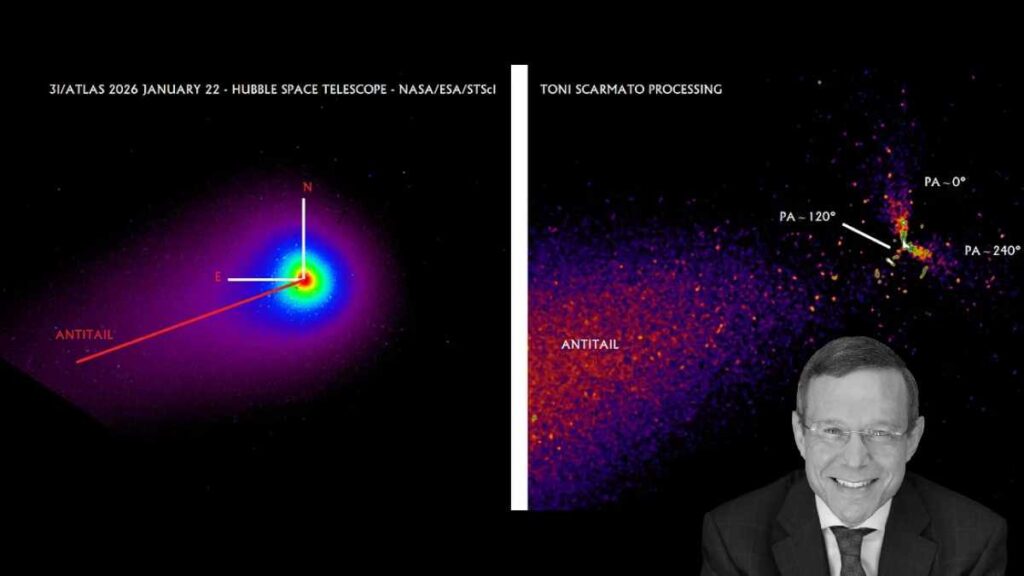
3I/ATLAS the third-ever interstellar interloper to cruise through the solar system after 1I/Oumuamua (2017) and 2I/Borisov (2019), entered a rare “full moon phase” on Jan 22 (or Jan 23 IST), 2026. During the opposition event, the exocomet aligned with the Sun-Earth axis, causing a brightness surge. During the event, NASA’s Hubble captured six images of the interstellar comet. No additional data have been made public other than the Hubble images by NASA. What does this new set of six 170 second exposures from the legacy space telescope reveal? Harvard astrophysicist Avi Loeb explains in his latest blog.
The exposures display brightness maps of the glowing halo surrounding 3I/ATLAS. The glow is elongated by about 100,000 kilometers in the direction of the Sun, a length scale that is about ten times larger than the Earth’s diameter.
After getting the images processed via the Larson-Sekanina Rotational Gradient filter by Loeb’s collaborator Toni Scarmato, here’s what it reveals
the residuals showed the system of 4 jets, including a prominent anti-tail directed nearly towards the Sun and Earth, supplemented by three mini-jets. The mini-jets are equally separated from each other by an angle of 120 degrees, and one of them (labeled by a position angle PA=120 degrees in the above image) is faint, possibly because it is hidden in an unfavorable orientation relative to Earth.
Loeb further adds
If the anti-tail had been exactly pointed at Earth, it would have been embedded in the circularly symmetric glow around 3I/ATLAS. However, the jet system wobbles periodically every 7.2 hours by +/- 20 degrees around the rotation axis. This explains why it is unlikely for the anti-tail jet to be aligned to better than 20 degrees with the Sun-Earth axis most of the time.
He states
we still do not know the nature of the anti-tail that allows it to penetrate hundreds of thousands of kilometers through the Solar wind and radiation without being deflected away from the Sun, as is often the case in familiar cometary tails.
Prof Loeb asks
Is the anti-tail composed of fragments of ice (as suggested in a paper I published with Eric Keto here), large dust grains (as I suggested here), or massive objects (as I published here)? The symmetric system of 3 mini-jets that supplement the anti-tail remains a potential technological signature (as discussed here).