
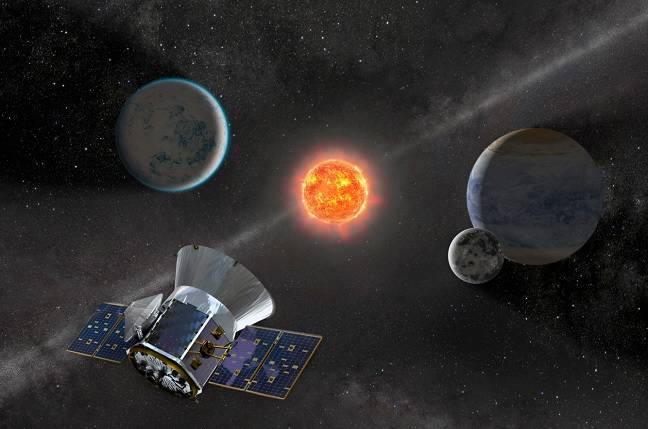
Good news for planet hunters – NASA’s Transiting Exoplanet Survey Satellite (TESS) is back online after a short flirtation with safe mode.
TESS entered safe mode after being slewed to point at a target. The spacecraft’s solar panels did not rotate to remain pointed at the Sun, resulting in a slow discharge of TESS’s batteries. A low-power condition was detected, and the spacecraft entered safe mode until ground controllers could address the issue.
Things returned to normal at the end of last week, and on January 23, NASA announced that science operations had resumed.
Safe mode was tripped on January 15 during a week of comet 3I/ATLAS observations.
TESS was launched atop a Falcon 9 on April 18, 2018, on a two-year mission to search for exoplanets. The mission, which detects exoplanets as they pass in front of their parent stars, was extended beyond its original two-year prime mission and is currently planned for operations into the latter half of the decade, with the spacecraft’s orbit permitting observations through at least 2028.
Assuming, of course, the mission isn’t ended by politicians. Had the proposed cuts to NASA’s science budget gone ahead, TESS operations stood a good chance of being severely cut back or terminated altogether.
It’s been almost two years since TESS previously dropped into safe mode following a reaction wheel problem. Engineers dealing with NASA’s MAVEN orbiter – which failed to make expected contact during a Mars orbit – will likely envy the latest recovery.
NASA lost contact with the Mars Atmosphere and Volatile EvolutioN (MAVEN) orbiter at the start of December 2025. Tracking data from December 6 showed the spacecraft “rotating in an unexpected manner” when it emerged from behind Mars. Its altered trajectory suggests it attempted to enter safe mode behind the red planet or fired thrusters for another reason, but the operation failed.
Attempts to contact the spacecraft were suspended during the solar conjunction, when Earth and Mars are on opposite sides of the Sun, but were expected to resume after January 16. The Register understands that an update on the mission is expected soon.
It unclear how TESS ended up in a position where its solar arrays weren’t gathering sufficient sunlight. We’ve asked NASA for more information and will update this piece if the space agency responds. ®