
Back to Article List
24P/Schaumasse is skimming south of globular clusters M53 and NGC 5053. Viewing them together may be difficult due to the Moon, but worth a try.
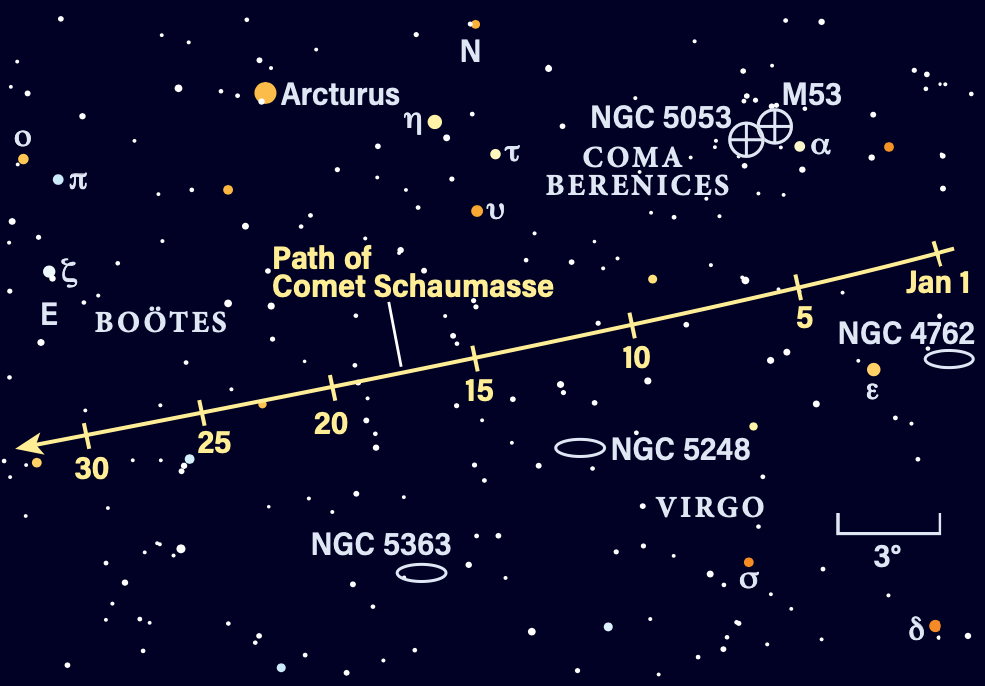
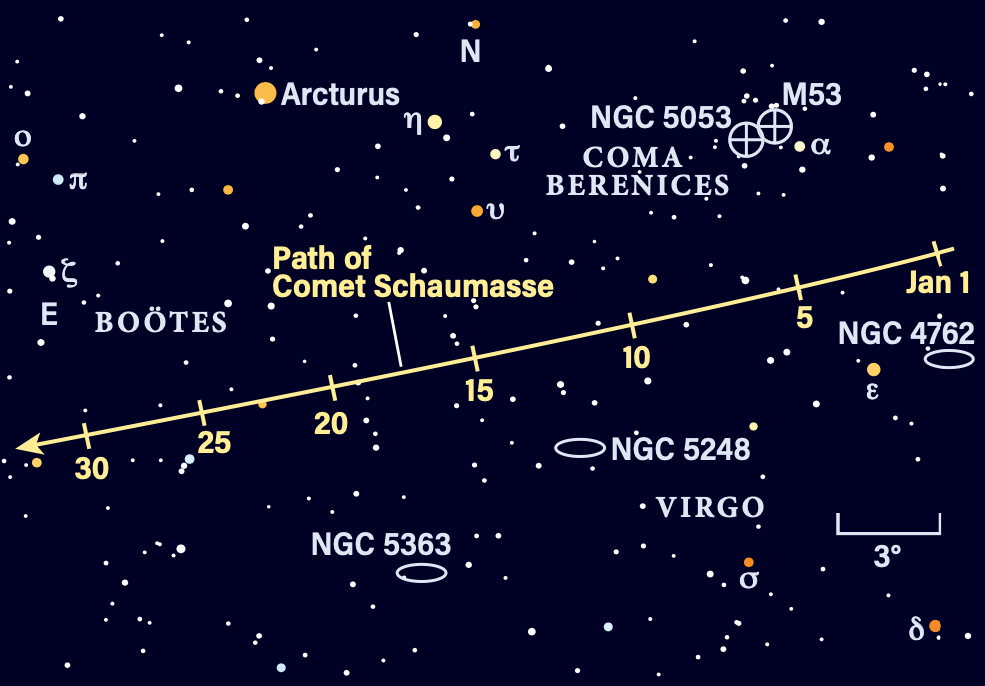
Comet Schaumasse leaves the galaxy-rich regions of Virgo and spends its time south of Arcturus later this month. Credit: Astronomy: Roen Kelly
Looking for a sky event this week? Check out our full Sky This Week column.
January 4: The Winter Hexagon
Rising shortly before midnight on January 4 and best viewed in the hours before dawn, Comet 24P/Schaumasse is located in northern Virgo, traveling through a rich region of the sky. Although the bright Moon will likely interfere, observers with larger scopes or astrophotography rigs may want to brave the moonlight to spot Schaumasse near the globular clusters M53 and NGC 5053 this morning.
By 4 A.M. local time, this region of the sky is some 50° high in the southeast. Schaumasse, recently observed around magnitude 10, lies roughly between the stars Diadem (Alpha [α] Comae Berenices) and Vindemiatrix (Epsilon [ε] Virginis). For a more precise position, look 4° due south of Diadem to find it.
M53 and NGC 5053 lie just over 1° east of Diadem, so you can use this star as a jumping-off point to find them as well. Both are roughly the same angular size (10’) but M53 is brighter at magnitude 7.6, compared to NGC 5053’s magnitude of 9.8. The latter is much closer to the current magnitude of the comet.
The comet remains near the two clusters for the next several days, but the Moon — although waning — is also approaching this region day by day, so your best chance to see the grouping is now, while Luna still floats relatively far away in the sky.
Sunrise: 7:22 A.M.
Sunset: 4:49 P.M.
Moonrise: 7:39 P.M.
Moonset: 9:16 A.M.
Moon Phase: Waning gibbous (90%)
*Times for sunrise, sunset, moonrise, and moonset are given in local time from 40° N 90° W. The Moon’s illumination is given at 10 P.M. local time from the same location.