
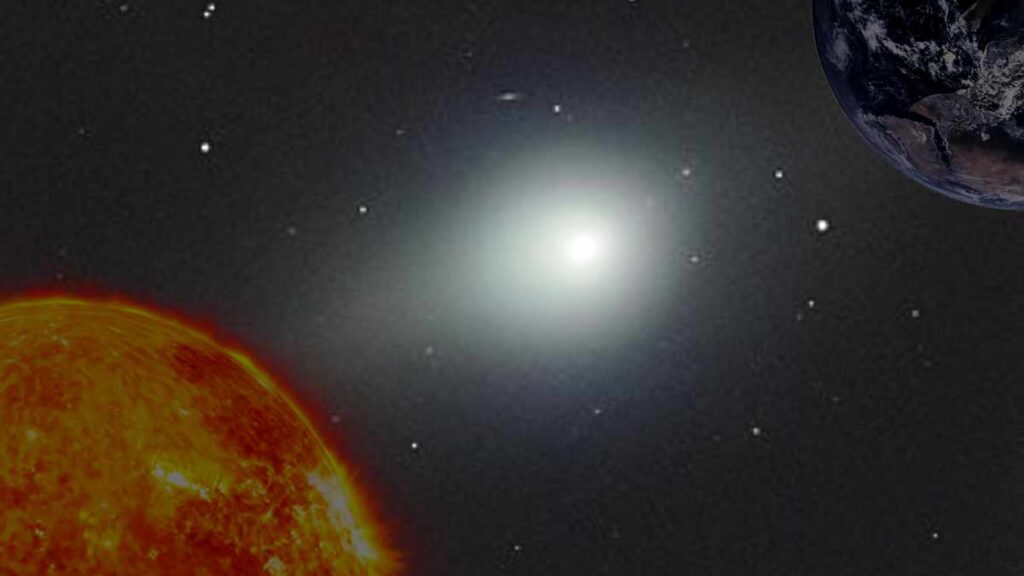
3I/ATLAS will enter a rare opposition phase, aligning on the axial path of Earth and Sun on Jan 22 (EST) or Jan 23 at 5 am (IST). The extraordinary event is a rare “full moon phase” for the interstellar visitor to the solar system. What exactly does this entail? Harvard astrophysicist Avi Loeb in his latest Medium blog explains
when observers from Earth will see it from the direction of the Sun to within an extremely small misalignment angle of just 0.69 degrees (0.012 radians). This rare alignment will result in a brightness surge whose magnitude and growth rate could constrain the composition and structure of the particles shed by 3I/ATLAS.
In his preprint paper co-authored with Mauro Barbieri, entitled “Rare Near-Opposition Alignment of 3I/ATLAS on 22 January, 2026,” Prof. Avi Loeb notes
This rare alignment provides unique circumstances for measuring the opposition surge and polarimetric properties of interstellar cometary dust.
The paper further explains how the opposition surge works
At phase angles α < 10°, most Solar System bodies show a nonlinear brightness increase, called the opposition surge. This surge arises from two physical effects:
Shadow-hiding: (α > 2◦): When the Sun, object, and observer are nearly aligned, shadows cast by dust particles are hidden behind the particles. This eliminates dark areas, increasing the object’s brightness.
Coherent backscatter: (α < 2◦): At very small angles, light traveling on reciprocal paths through a dusty medium interferes constructively, creating a narrow brightness spike.
Loeb and Barbieri’s research states
As of now, only one comet has a well-measured opposition surge: 67P/C-G. The surge was observed from the Rosetta spacecraft at α = 1.3◦ → 5◦, yielding ∆m = 0.15 ± 0.02 mag and a very dark albedo with ω0 = 0.034 ± 0.007.
In the paper the researchers suggest ways to squeeze the maximum possible info on the exocomet possible, including photometry, polarimetry and multi-band observations, among other recommendations.
Meanwhile, Avi Loeb flagged irrefutable 18 anomalies of the interstellar exocomet ahead of Jan 22 opposition. The new anomaly spotted is the 3 symmetrical jets on the exocomet that extend 25,000 kilometers. He remarks in his latest blog
When taking into account the large velocity of 3I/ATLAS relative to the Sun, supplemented by the pushback from the solar wind and radiation, the material carried by the anti-tail, including the poisonous cyanide, has no chance of reaching the Earth and affecting our life. The only exception involves technological mini-probes, which can maneuver enough to bridge the gap between 3I/ATLAS and the Earth.