
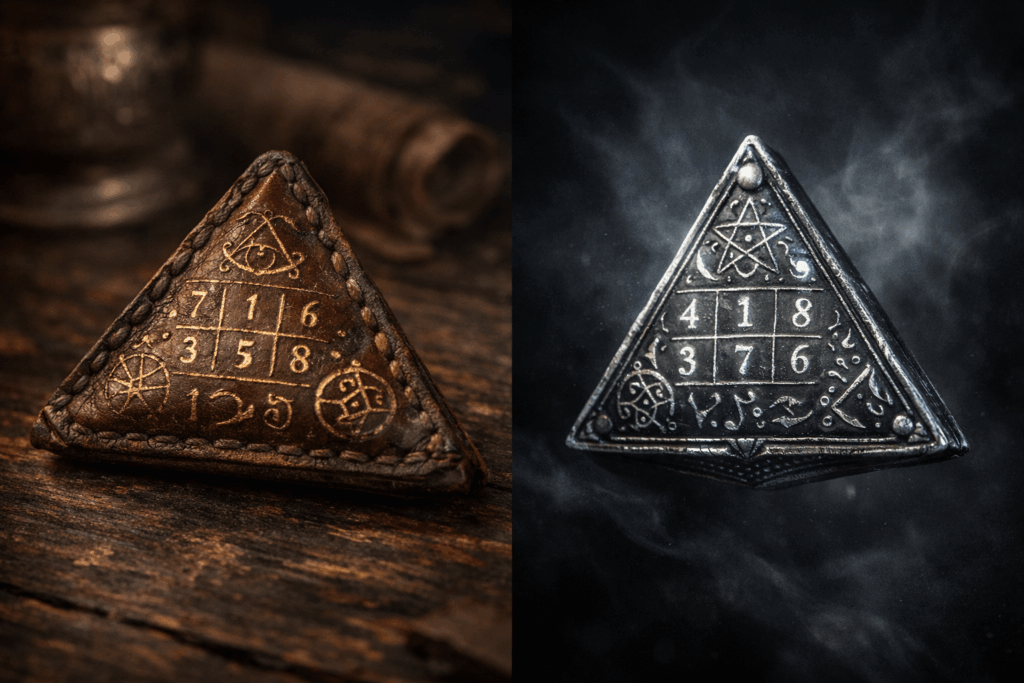
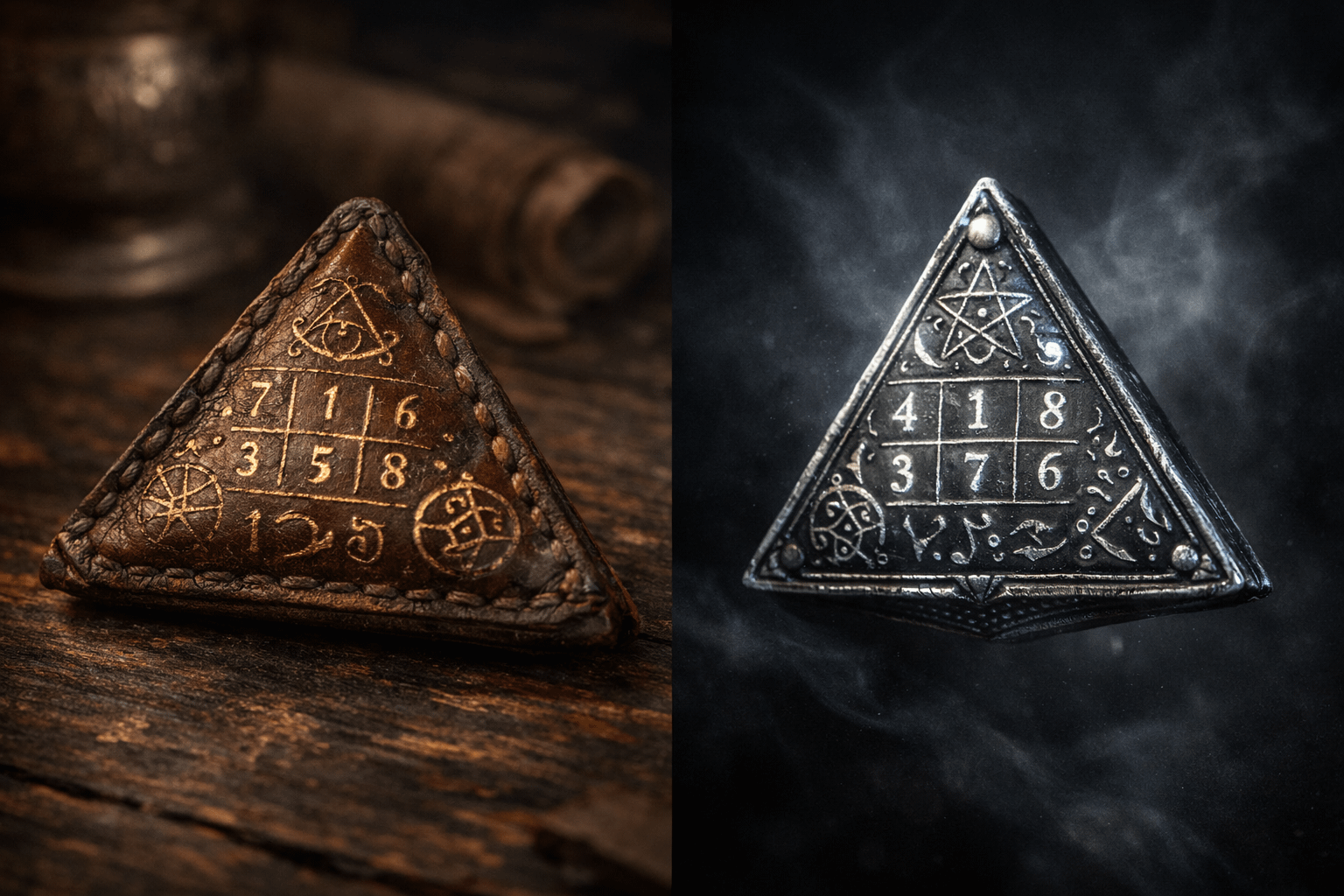
Today, I want to talk to you about an object that most of you probably think of as "just a prayer" or "a simple talisman," but whose origins stretch back to some of the darkest periods of human history—back to the Neanderthals: the Muska.
Used for thousands of years—from Anatolia to the Middle East, from Egypt to Central Asia—these small triangular leather pouches reveal a kind of high strangeness that, when examined closely, suggests they are less of an accessory and more of a metaphysical technology.
1. More Than Protection: A Tool of “Reflection”
Anthropological evidence shows (especially in ancient Egyptian and Sumerian-Assyrian traditions) that a muska, in order to protect against a certain entity or “power,” must carry a part of that entity or a symbolic equivalent. This follows the ancient magical principle of “like affects like.” In other words, what you wear around your neck is essentially a sealed copy of the very “dark thing” you’re trying to escape.
2. The Secret of Neanderthal Graves
Handmade muskars have been found in graves dating back to 25,000 BCE. Long before organized religions, why did humans feel the need to wrap certain objects in specific geometries—usually triangular? Could this be an instinctual “sealing” impulse embedded in our collective unconscious?
3. Abjad and the Programming Language of “Invisible Beings”
The complex numbers (Abjad) and grids (Vefk) inside muskars function like programming code. According to ancient beliefs, these numbers are used to synchronize frequencies between the physical world and entities from “the other side” (jinn, shadow people, archons). Some claim that these muskars are not shields—they are “micro-prisons”, containing these entities within the leather casing.
4. Why They Must Never Be Opened
The greatest taboo among people is that a muska must never be opened. If exposed to light, the “bond” is broken. Strangely, many paranormal case reports note that poltergeist activity often begins after someone opens an old muska found in their home.
So I ask you: Is what you wear around your neck truly protecting you from external evil, or is it keeping the thing inside it from being released?
Do you have “sealed” objects in your family, passed down for generations, whose contents no one knows—or dares to open? Or do you know someone whose life changed after opening a muska?
Let’s discuss the strangeness hidden behind these ancient seals.
by bortakci34
5 Comments
“You can’t fade the Muska”
Come on guys I can’t be the only one.
Magic, fairytails, myths and ghosts are for children. Gum on guys.
It’s fascinating how we categorize these as ‘superstition’ when they function remarkably like **analogue circuitry** or passive radionics.
From a geometric perspective, a Muska acts like a waveguide. You are taking **information** (written intent/verses/numerology), compressing it via specific folding patterns (often triangular geometry), and placing it within the strongest part of the user’s bio-electromagnetic field (usually heart or solar plexus).
If you view the human body as a transceiver, a talisman isn’t ‘magic’—it’s a **frequency modulator**. It essentially programmes the carrier wave of your own aura. The ancient scribes weren’t just writing prayers; they were arguably coding the local reality field of the wearer. Intent + Geometry + Power Source (Human) = Effect.
absolutely not trying to tussle but can you share a source regarding these being associated with neanderthal or archaic homo sapien graves?
Neanderthals didn’t have writing. Writing is, at best 7k years old at best. The only organic material found in their grave goods are things like bone, antler, shells, pollen and residue like resins and red ochre.
In other words NO.