

The NASA SPHEREx mission has revealed an extraordinary surge of sublimation activity on the interstellar comet 3I/Atlas following its passage near the Sun, according to a new paper published on arXiv. The study presents compelling evidence that the comet’s composition and activity levels changed drastically after perihelion, suggesting the exposure of new volatile materials previously locked beneath its surface.
What SPHEREx Saw After Perihelion
The SPHEREx telescope, designed to map the entire sky in near-infrared light, captured new emissions from 3I/Atlas that show a striking transformation in the object’s volatile chemistry. The arXiv paper reports that carbon dioxide, carbon monoxide, and water vapor emissions surged to record levels as the comet spent several months inside the solar system’s ice line, the boundary where sunlight can warm and vaporize icy materials.
“The CO₂ emitted flux is only about 33% larger than in August, which verifies that this species was fully active in August pre-perihelion. The CO emitted flux has increased ~20x, meaning that the CO/CO₂ abundance ratio has also increased ~15-fold. Along with the greatly enhanced H₂O flux and new C-H species emission, this implies that a new ice reservoir is now active along with the one supporting the CO₂-coma,” the study authors explain.
This dramatic change implies that as 3I/Atlas drew closer to the Sun, a deeper layer of ice, previously insulated beneath its crust, became active, fueling the surge of gas and dust now observed.
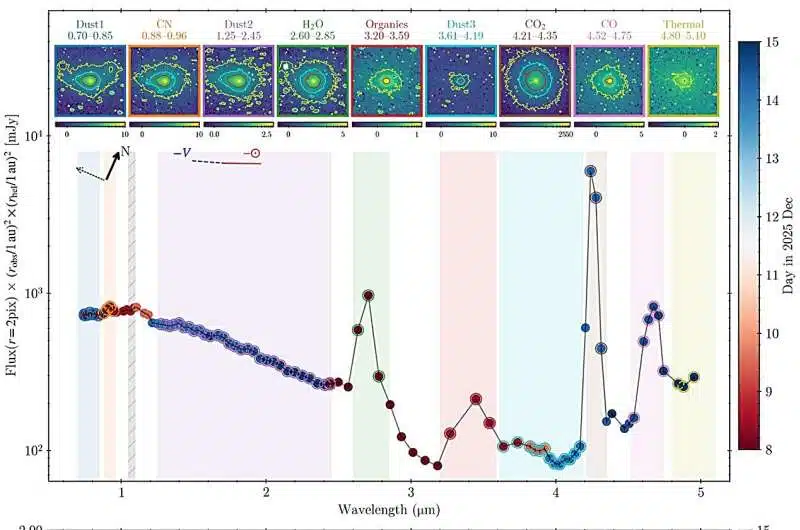 (Top Insets) SPHEREx 0.75-5.0μm imaging of 3I/ATLAS taken on 08-to-15-Dec2025. The 6.3’x6.3′ cutout contours are 5,20,&50 times the background noise; color bars are in MJy/sr. The celestial North-and-East directions are shown (black-arrows), along with the anti-velocity (dashed-blue) and anti-sun (solid-red) directions. Credit: arXiv (2026). DOI: 10.48550/arxiv.2601.06759
How 3I/Atlas Evolved Inside the Ice Line
The authors note that 3I/Atlas’s behavior before perihelion was markedly different from what SPHEREx detected later. Earlier in 2025, the comet’s activity was largely dominated by large icy grains, which released carbon dioxide but kept other volatile ices frozen due to their low temperature. Once 3I/Atlas crossed within the solar system’s ice line, conditions shifted dramatically.
“This change from pre-perihelion observations makes sense because, in August 2025, 3I’s behavior was dominated by large icy dust grain emission, with the icy grains too cold to sublimate anything more volatile than CO₂ fully. By December-2025, though, the ISO had spent ~3.5 months inside the solar system’s ice line, and all of the cometary constituents, not just the highly volatile CO₂ and CO ice portions, were active. I.e., bulk matrix comet material was evaporating, releasing everything the comet contains,” the study authors write.
These observations provide the first concrete evidence that interstellar objects (ISOs) can undergo multi-phase sublimation, depending on their proximity to the Sun. The findings, the team says, could help scientists better understand how comets from other star systems compare to those formed within our own.
A Rare Glimpse Into an Alien Comet’s Core
3I/Atlas, only the second confirmed interstellar comet after 2I/Borisov, offers a unique laboratory for studying the composition of other planetary systems. The SPHEREx data suggest that beneath its surface, the comet holds complex ices and organic compounds similar to those found in the early solar system. Such results strengthen the idea that the basic building blocks of planets and life may be widespread throughout the galaxy.
The study’s authors, whose findings are now publicly available on arXiv, emphasize that continued monitoring by SPHEREx and future missions like JWST could unveil even more about these alien travelers and their role in cosmic evolution.