


People queue ahead of a plenary session featuring US President Donald Trump during the 56th annual meeting of the World Economic Forum (WEF) in Davos, Switzerland, on Wednesday.
Keystone/Swissinfo
Welcome to our press review of events in the United States. Every Wednesday I look at how the Swiss media have reported and reacted to three major stories in the US – in politics, finance and science.
This content was published on
January 21, 2026 – 17:00
Thomas Stephens

I write articles on the Swiss Abroad and “Swiss Oddities” as well as weekly briefings and press reviews. I also translate, edit and sub-edit articles for the English department and do voiceover work for videos.
Born in London, I have a degree in German/Linguistics and was a journalist at The Independent before moving to Bern in 2005. I speak all three official Swiss languages and enjoy travelling the country and practising them, above all in pubs, restaurants and gelaterias.
All eyes were on the Swiss mountain resort of Davos on Wednesday as US President Donald Trump flew in for the annual meeting of the World Economic Forum (WEF) and two days of – well, who knows? Tuesday was the one-year anniversary of Trump’s return to the White House, and Swiss newspapers agreed that predictability was not one of his many qualities.
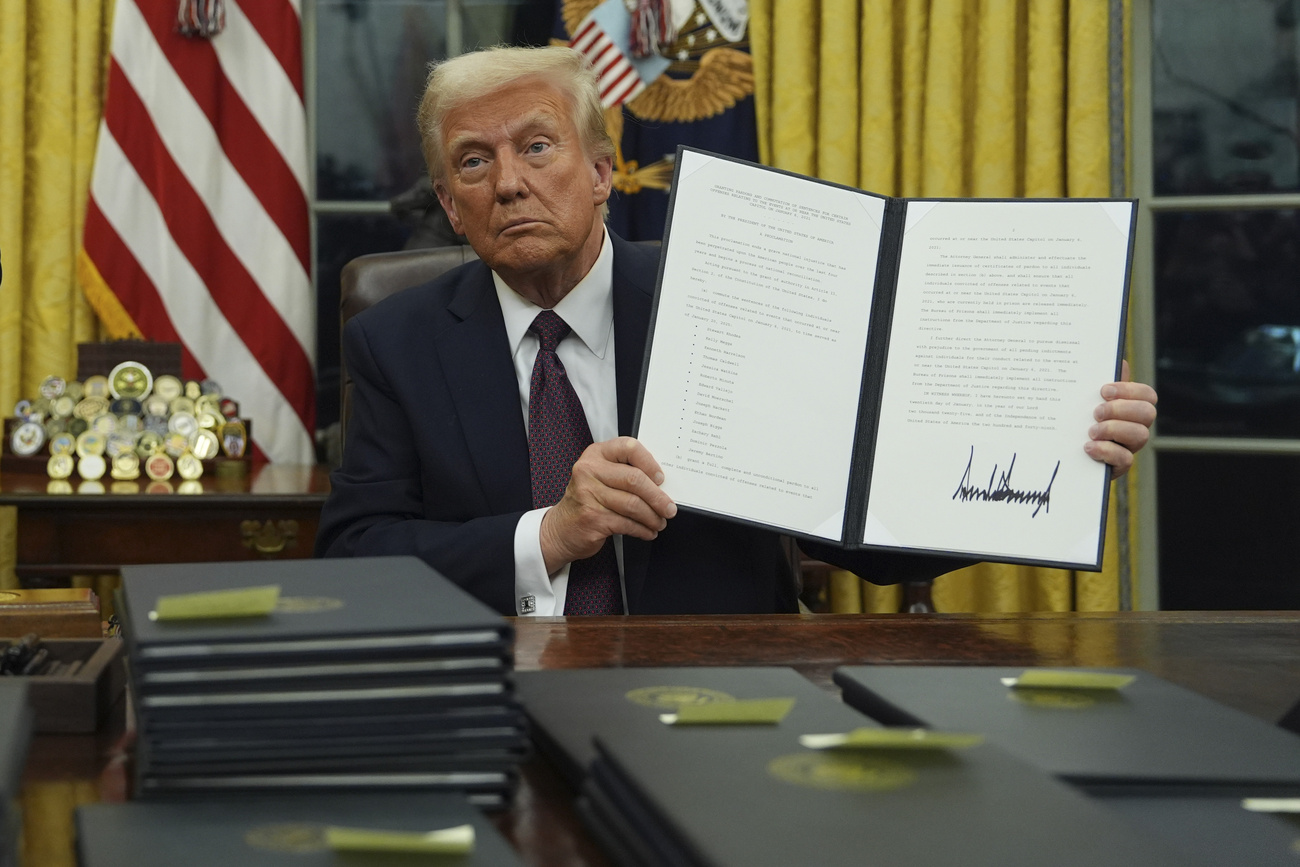
A year ago, on January 20, US President Donald Trump signed an executive order commuting sentences for people convicted of offences during the storming of the Capitol on January 6, 2021.
Copyright 2025 The Associated Press. All Rights Reserved
Swiss newspapers have assessed Donald Trump’s (second) first year as president. They’re not impressed, to put it mildly.
“There’s a saying in the US: if it walks like a duck, quacks like a duck and swims like a duck, it’s a duck,” Swiss public broadcaster SRF wrote on Monday. “Following this logic, Donald Trump is an authoritarian, anti-democratic ruler. The evidence for this is overwhelming.”
In its analysis entitled “Trump 2.0, the unleashed US president”, SRF pointed out how Trump doesn’t accept election defeats, instrumentalises the judiciary against his opponents and is putting universities and the media under pressure.
“Trump and his entourage are spreading untruths by the metre. What Americans saw with their own eyes is being distorted,” SRF wrote. “The violent storming of the Capitol on January 6, 2021, was reinterpreted as a peaceful protest. Trump pardoned around 1,500 men and women who had been convicted of this offence. By contrast, a woman who was shot dead by an ICE officer in Minneapolis [see last week’s press review] was summarily labelled a terrorist by the Trump administration even before her death had been investigated.”
Le Temps in Geneva said the “indecencies” have been repeated so many times that no one is shocked anymore. “And for what? […] Purchasing power is stagnating and the cost of living is rising – as is the cost of healthcare. The country is sinking into an authoritarianism that is no longer a theory,” it concluded.
“Trump governs the United States like the real estate mogul he once was,” said the Neue Zürcher Zeitung (NZZ). “After one year in office, he sees himself at the peak of his power. But in the politics of a democracy, the costs are calculated differently than in business: Trump has squandered the goodwill of many voters – and shaken the confidence of America’s allies.”
The Tages-Anzeiger analysed Trump’s popularity, based on opinion polls. “Hardly a day goes by without the US president attracting international criticism. […] But Trump is also increasingly losing support in his own country,” it said, quoting a poll by Gallup which put Trump’s approval rating in mid-December at just 36%. “In contrast to all other US presidents, he never had a majority of the population behind him.”
The Tages-Anzeiger acknowledged that the image of the US has been going downhill for a while, pointing to the invasion of Afghanistan in 2001 and Iraq in 2003. “But the image of the country is also inevitably linked to the reputation of the president. And so an anti-American mood has spread over the past year, particularly in Europe. Donald Trump is characterised by most respondents as arrogant, dishonest and dangerous. In almost all countries, a majority of the population has no confidence in Trump’s ability to solve trouble spots and global economic problems.”
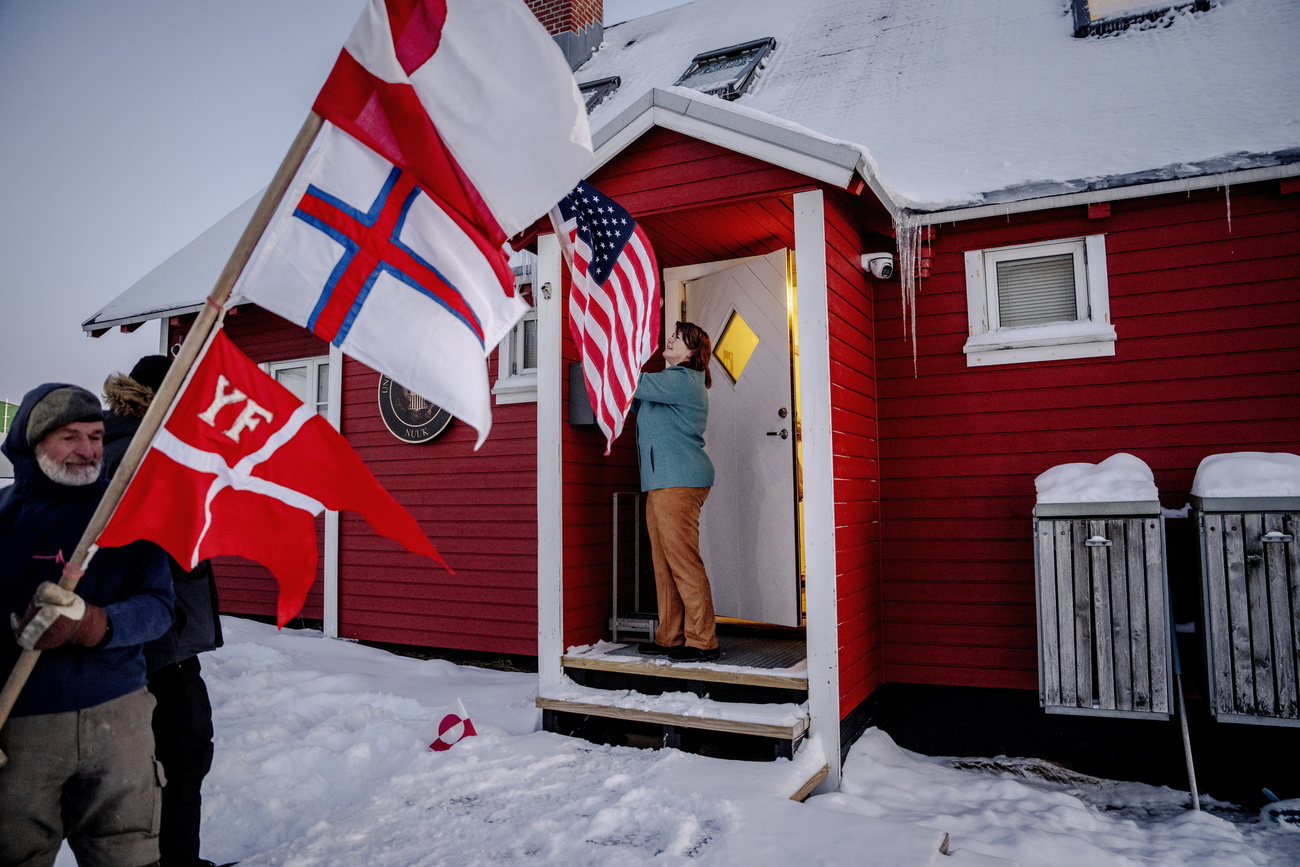
Waving flags outside the American consulate in Nuuk, the capital of Greenland, on Tuesday.
Keystone
As Trump doubles down on his threats to take control of Greenland, saying there is “no going back”, Swiss newspapers try to come up with some solutions.
“Trump’s threat to impose increasing punitive tariffs on eight European countries from February 1 if they continue to oppose the US takeover of Greenland has plunged the transatlantic partnership into its most serious crisis for decades,” the Tages-Anzeiger said on Monday, adding that Brussels, Paris, Berlin, Rome, Copenhagen and London had spent the whole weekend discussing how to respond.
Could Europe turn off the US money tap? On Wednesday, Swiss public broadcaster SRF reported that this idea was gaining momentum. “If major European investors sell US government bonds or no longer participate in new financing rounds, this could become a problem for the US,” it suggested.
Former ambassador François Nordmann called for calm. “Now that everyone has flexed their muscles, it’s time to get out of this crisis, which is only benefiting the strategists in Beijing and Moscow,” he wrote in his column in Le Temps on Wednesday.
Nordmann noted that the Atlantic Council, an American thinktank, was proposing a revision of the 1951 defence agreement between Denmark and the United States, which, it claimed, would satisfy American demands without calling into question the island’s national status. “Trump could argue that his pressure tactics have borne fruit and come down from the tree in which he has taken refuge without losing face,” he said.
Nordmann hoped this scenario could be set in motion at the WEF, paving the way for negotiations within NATO, which will then be concluded in Washington – “not with messages on social networks but in the calm of diplomatic procedures”,
For its part, the Neue Zürcher Zeitung (NZZ) wanted to see tough action. “Donald Trump will not be swayed by mere pleasantries. Europe must defend its principles and become more independent,” it wrote in an editorial on Monday.
“The additional tariffs that Trump is now threatening eight European members of the NATO defence alliance would be economically painful, but manageable. But there are more fundamental issues at stake,” it said. “Agreements such as the customs agreement with the EU can be changed by Trump’s government at any time. […] Trump begins to back down when he sees his own interests jeopardised – as in his dealings with China. This is the case, for example, when rising prices cause displeasure among his voters.”
Seen in this light, the NZZ said the Europeans are right to threaten high counter-tariffs. “More expensive market access for American tech companies should also be part of the arsenal of possible countermeasures,” it added.
“It must be made clear that there are red lines for Europe. The territorial integrity and right to self-determination of its states are just as much a part of this as the customs union of all EU countries. But in order to make an impression, the European states should finally act as one.”
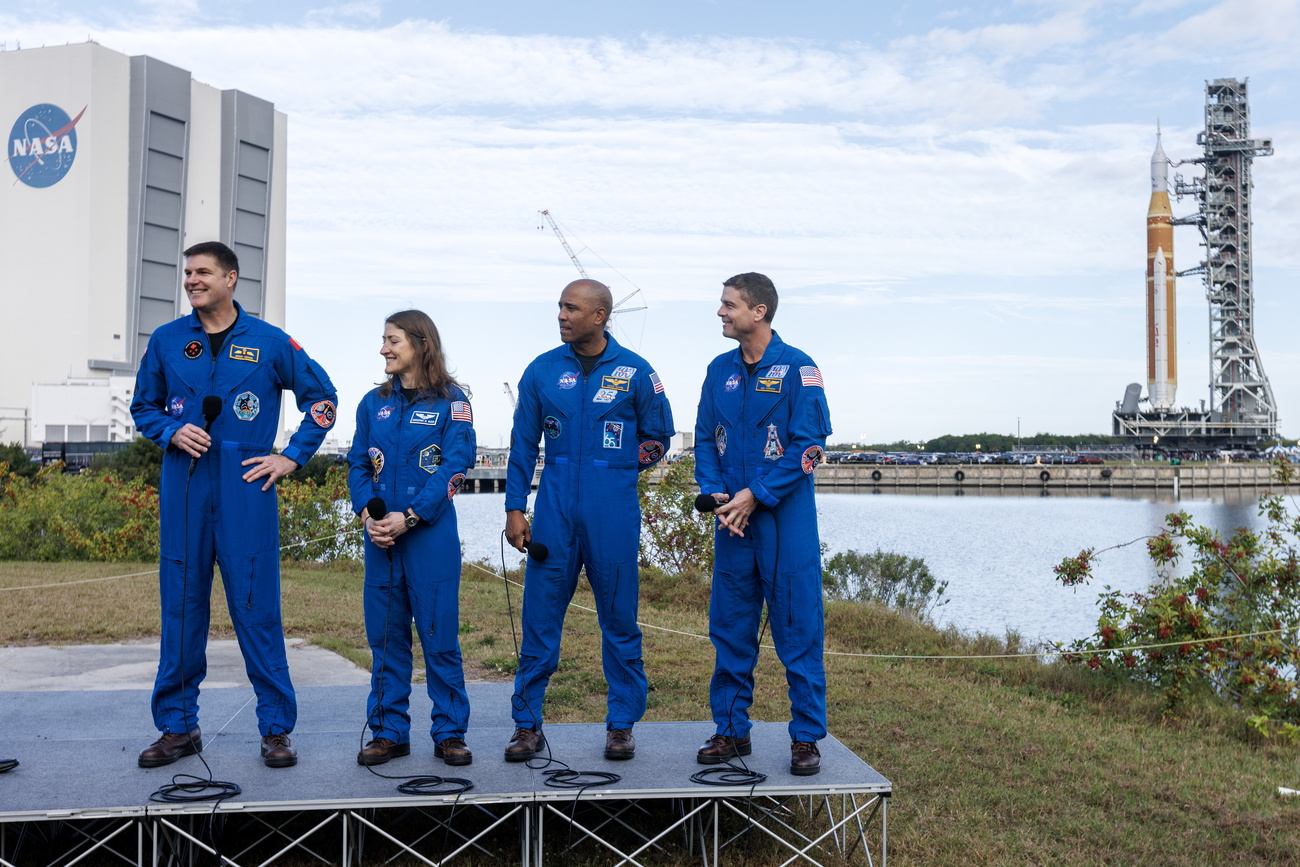
The four astronauts at a press conference at Kennedy Space Center, Florida, on Saturday.
Keystone
On Saturday NASA, the US space agency, rolled its giant SLS (Space Launch System) rocket to the launch pad in Florida. The plan is to carry astronauts around the Moon for the first time in over 50 years, Swiss public radio RTS reported.
The 6km journey took around 12 hours and is one of the final steps before the launch of the eagerly awaited Artemis 2 lunar mission. If the rocket passes a battery of tests, it could blast off as early as February 6. If the five-day window is missed, the next window is March 6-11.
With the Artemis 2 mission, “NASA is returning to the glory days of the Apollo missions”, wrote the Neue Zürcher Zeitung (NZZ). “For the first time since 1972, astronauts are to fly close to the Moon again.” The mission is regarded as a test for the Artemis 3 mission, in which astronauts are to land at the south pole of the Moon. This won’t happen until 2028 at the earliest.
On their ten-day journey, the three American astronauts Christina Koch, Victor Glover and Reid Wiseman and their Canadian colleague Jeremy Hansen will travel at least 400,000 kilometres from Earth – “further than any astronaut has ever travelled before”, the NZZ said. The Orion spacecraft will fly over the far side of the Moon at an altitude of 7,500 kilometres. It will then be catapulted back to Earth by the Moon’s gravity.
Cognitive tests will show how the astronauts react to weightlessness and how they deal with stressful situations in the unfamiliar environment. The influence of cosmic radiation is also being investigated – “this is much stronger on a flight to the Moon than on the International Space Station because the astronauts are outside the Earth’s protective magnetic field,” the NZZ explained. “Should there be a burst of radiation on the Sun during the flight, the astronauts will retreat to a part of the spacecraft that is normally used as storage space.”
The NZZ said that, in the long term, NASA and its partners are aiming to set up a ground station on the Moon and practise survival on a celestial body “that lacks much of what humans need to live”.
The next edition of ‘Swiss views of US news’ will be published on Wednesday, January 28. See you then!
If you have any comments or feedback, email english@swissinfo.ch
More

More
Subscribe to the newsletter “Swiss views of US news”
This weekly email newsletter provides summaries of US-related news as reported by the major Swiss media outlets. It includes a Swiss perspective on political, financial and scientific stories in the United States. Registration is free.
Read more: Subscribe to the newsletter “Swiss views of US news”
Stay informed with our weekly newsletter!
Are you looking for a simple way to stay updated on US-related news from a Swiss perspective?
Subscribe to our free weekly newsletter and receive concise summaries of the most important political, financial, and scientific stories in the United States, as reported by Switzerland’s leading media outlets – delivered straight to your inbox.
👉Sign up by entering your email address in the form below!
External Content
Your subscription could not be saved. Please try again.
Almost finished… We need to confirm your email address. To complete the subscription process, please click the link in the email we just sent you.
Articles in this story