
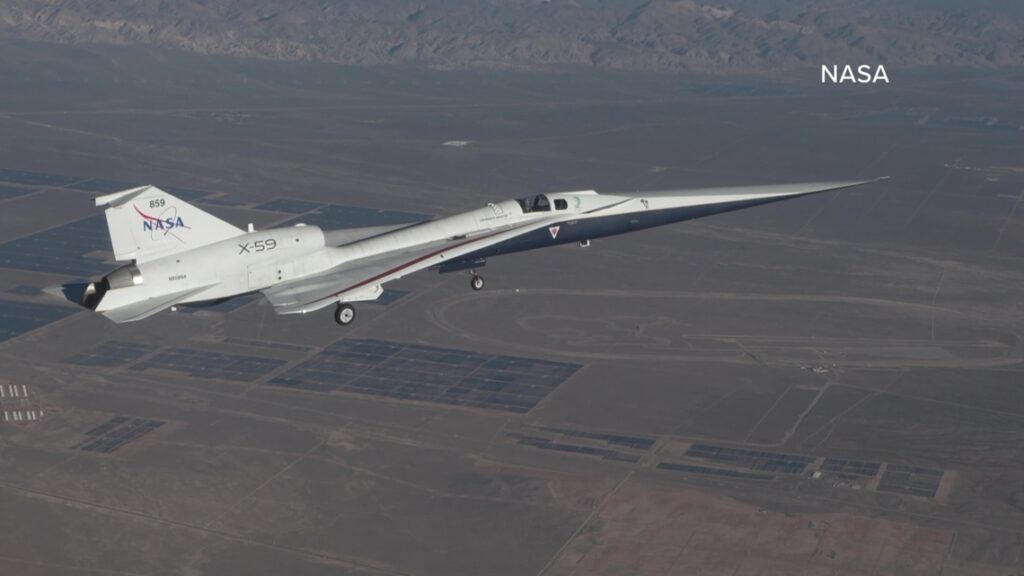
NASA is working on an experimental piloted aircraft designed to fly faster than sound, all without producing the annoying, if not sometimes alarming, sonic booms.
HAMPTON, Va. — NASA is in the process of testing a new, experimental aircraft designed to achieve supersonic flight… but without the loud, sonic boom.
The X-59 QUESST — short for Quiet SuperSonic Technology — could be a game-changer when it comes to air travel, and it is being developed at NASA’s Langley Research Center.
“It was a lot like flying a video game,” described Nils Larson, the X-59’s first test pilot.
One reason why it may feel like a video game is that the aircraft doesn’t have any forward-facing windows.
“The unique part about this airplane, obviously, is the nose. It’s a very long nose,” explained aerospace engineer Randy Bailey. “Because of that nose, it’s impractical to put a real window in this vehicle for the pilot to look out and see. We have developed here at Langley an ‘eXternal Vision System’ capability, which is an electronic means of vision for the pilot to see forward.”
The shape would slow down the shock waves and reduce the noise, but the design leaves no room for windows. Cameras mounted externally on the aircraft would present a forward-facing augmented reality on the display screen in front of the pilot.
Added Larson: “I’ve got an upper camera. I have three lower cameras. I have synthetic vision systems. I have GPS. I have so many different things that help me line up on the runway. They give me symbology and overlays like my air speed, my altitude… certain things will actually stand out a little bit more. So if there was traffic out in the distance, it would actually show up a little bit better than me just looking out a window.”
Larson said over the next few months they will continue progress with flights, eventually going up to supersonic speeds, going as fast as about Mach 1.5, or a little more than 900 miles per hour. According to Bailey, such speeds could cut the time flying between New York and Los Angeles nearly in half.
“It is really cool to get to work on something so unique,” said Larson. “Hopefully, it’s going to benefit the public in the future. Hoping to get everybody to grandma’s house twice as fast!”