
OUR SPACE: Alien, but no Aliens
Published 10:43 am Tuesday, January 20, 2026
Well, it came, and it left.
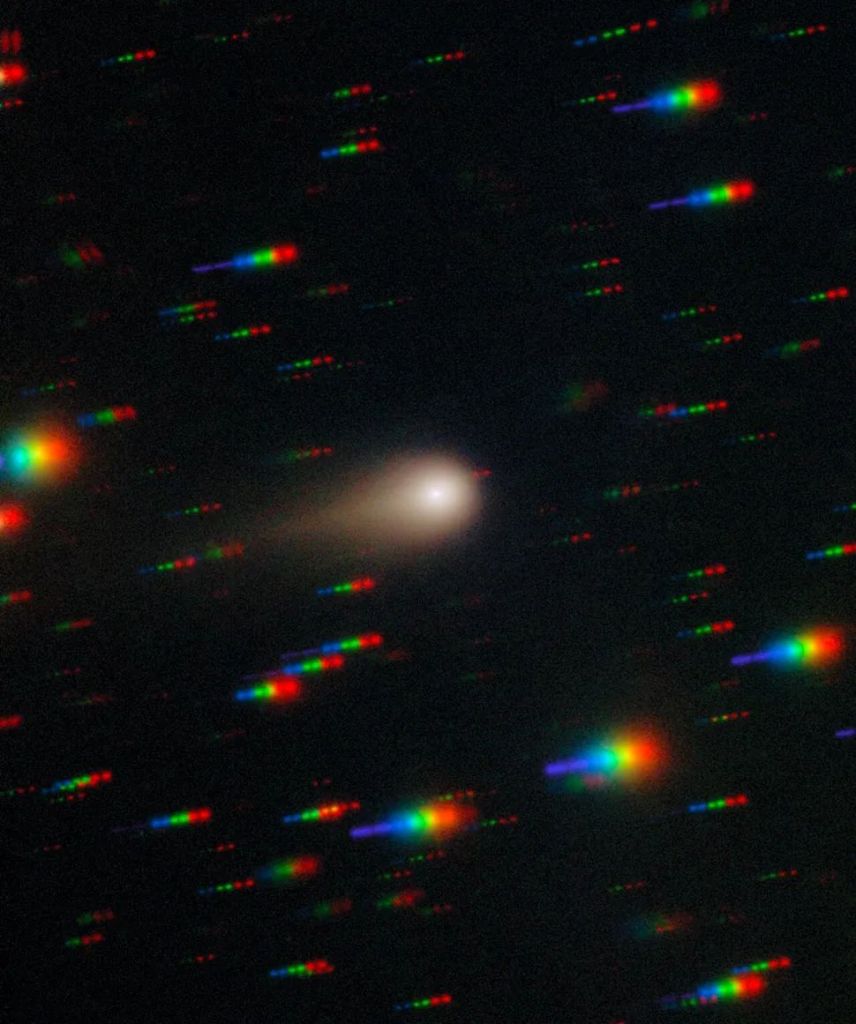
Comet 3I/ATLAS was alien for sure — it started outside our own solar system, perhaps in another solar system far, far away, expelled into the universe by some unknown cataclysmic event. We’ve looked at this comet before, last year, as it approached the orbit of Mars, which is the closest it ever came to us.
This was the third extra-solar object to visit us in recent times. Of course there were probably countless others before them, but we didn’t have the technology or calculating abilities to determine their exact trajectories. Some were probably dismissed as asteroids or long-period comets, but the vast majority were just never even detected.
Granted, our lives on Earth are not going to be impacted by a space rock that passes by millions of miles away, never to return. But these strange visitors present a unique opportunity for scientists everywhere to study something truly unique that they would never be able to examine otherwise. We do know now that 3I/ ATLAS is far older than our own solar system, and more revelations of this kind are bound to come.
Speculations ran rampant, of course. But just because something is alien doesn’t mean that it’s an actual alien. Every tiny observation made was thoroughly picked apart and even the slightest change in appearance was interpreted as intentional on part of the object. Many believed it was an alien spacecraft. So scientists threw everything at it that they possibly could to see if they could pick up any signs of technology – signals, radio transmission, beacons, any signs of communication or mechanics, dead or alive. They scanned a vast range of radio frequences, even those that don’t make a lot of sense, just in case.
Alas, 3I/ ATLAS behaved exactly as any big space rock would have: it did nothing.
A special project called Breakthrough Listen used the giant Green Bank radio telescope to check for anything that could be a techno-signature. It’s so sensitive that it could pick up a radio frequency one-tenth the strength of a cell phone transmitter, and since Green Bank is located in a dead zone of radio signals it would have at least picked up something. The 300 foot diameter Green Bank radio telescope sits in a federally protected area, so the operators know exactly where any radio signal comes from, and they can dismiss it and keep listening for the truly interesting stuff. The experts did not expect to find anything, except for signals clearly made by human-built sources, but the truth is that you won’t ever find anything like that if you don’t look for it, or at least try.
Needless to say, it would have been incredibly exciting if 3I/ ATLAS had exhibited any sign of technology, even non-functional or long since dead. But let’s imagine for a moment that there was some sort of technology — the rock would have passed through our solar system just the same, since there was no way to really rendezvous with it or capture it. With an average speed of 196,000 mph it was going way too fast as well. But there would have still be the knowledge that we are not alone, and the impact of this fact is difficult to predict.
3I/ATLAS is now on its way to who knows where — perhaps another solar system somewhere out there, for who knows how long. Or maybe at some point it will smash into another star and its multi-billion year journey will come to a swift end. However, its legacy will keep scientists and researchers busy for a long time to come.
A multitude of spacecraft have observed the speedy rock, and it will take years before all the data has been assembled, compared and interpreted. But like the two previous extrasolar visitors, it has given us more experience in how to look for these odd travelers. With the help of AI, sifting through countless images and replacing those tedious comparisons, we may find many more of them. The longer we observe the comet the better our chances become to determine where it originally came from and where it’s going next.
There is of course the question that if someone ever calls us — should we answer this particular call? The vast majority of fictional encounters with aliens does not bode well for Earth, as everybody out there seems to be hell bent on conquering our little planet! Thankfully, you don’t need to lose sleep over this sort of thing quite yet.
All the latest news about 3I/ ATLAS is at https://science.nasa.gov/solar-system/comets/3i-atlas/
Beate Czogalla is the Professor of Theater Design in the Department of Theatre and Dance at Georgia College & State University. She has had a lifelong interest in space exploration and has been a Solar System Ambassador for the Jet Propulsion Laboratory/ NASA for many years. She can be reached at our_space2@yahoo.com .