
WASHINGTON, Jan 20, 2026, 08:01 EST
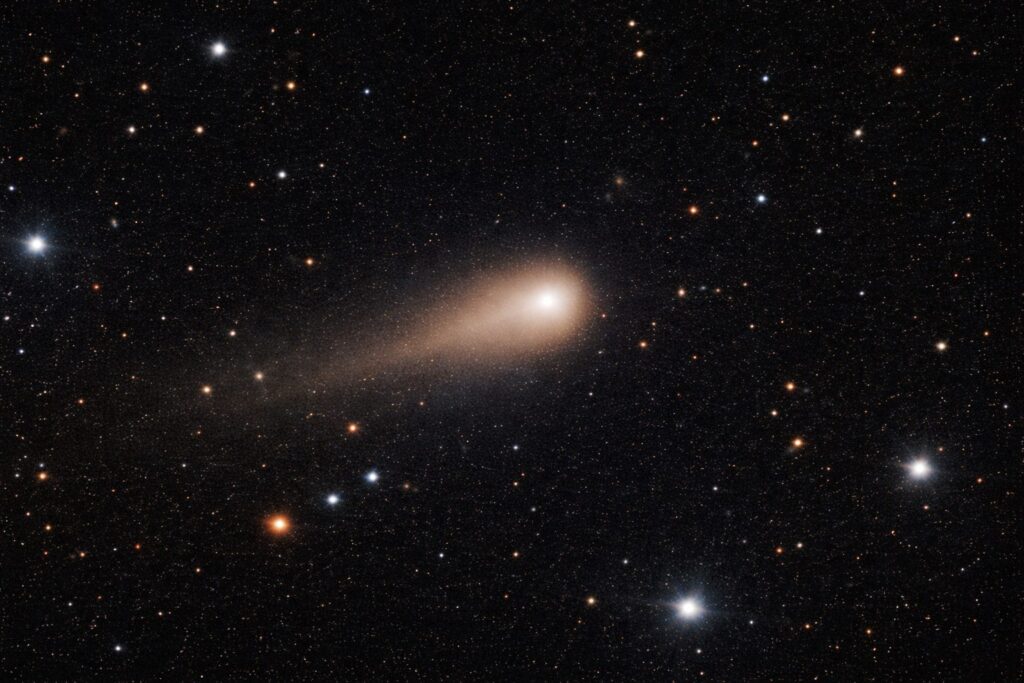
NASA’s SPHEREx telescope data suggest interstellar comet 3I/ATLAS is now shedding more gas and dust after its Sun flyby.
The comet reaches opposition on Jan. 22, a timing that can help ground observers track it longer overnight.
Scientists say it is the third confirmed interstellar object seen in the solar system, and it is already headed out.
NASA’s SPHEREx space telescope has picked up signs that interstellar comet 3I/ATLAS has shifted into a more vigorous state after its closest pass by the Sun, a phase known as perihelion. Carey Lisse of the Johns Hopkins University Applied Physics Laboratory described it as “a much more active object.” (Sci.News: Breaking Science News)
The timing matters because the visitor is one of the rarest targets astronomers get: NASA says 3I/ATLAS is only the third confirmed interstellar object observed in the solar system, after 1I/‘Oumuamua and 2I/Borisov, and it is on a hyperbolic track — too fast to be captured by the Sun’s gravity. NASA says it posed no danger to Earth, passing about 1.8 astronomical units away on Dec. 19, and is due to move past Jupiter in March on its outbound route. (NASA Science)
Italy’s Virtual Telescope Project said it will run a live online observing session on Jan. 22 starting at 23:30 UTC, after clouds spoiled what had been planned as a final broadcast on Jan. 16. Opposition is when an object sits roughly opposite the Sun in Earth’s sky, often allowing longer night-time tracking, though 3I/ATLAS remains faint. (The Virtual Telescope Project 2.0)
In a paper posted to the arXiv preprint server, Lisse and co-authors said SPHEREx observed 3I/ATLAS from Dec. 8 to Dec. 15, taking infrared measurements from 0.75 to 5 microns and identifying emissions from cyanide, water, organic molecules, carbon dioxide and carbon monoxide. The team reported the water-gas feature was about 20 times stronger than earlier SPHEREx observations, and carbon monoxide flux rose by a similar factor; they also said dust and organics appeared pear-shaped while most gas features looked round in the images, and called the work a preliminary analysis ahead of a fuller treatment before SPHEREx revisits the region in April. (arXiv)
The comet has sparked a noisy side debate since discovery, but NASA officials said in November they had not seen anything to suggest an artificial origin. “It looks and behaves like a comet,” NASA associate administrator Amit Kshatriya said then, while Oxford astrophysicist Chris Lintott told Reuters the alien-spacecraft claim was “simply nonsense.” (Reuters)
3I/ATLAS was first reported on July 1, 2025 by a Chile-based telescope in the ATLAS network, a NASA-funded survey designed to spot objects that could threaten Earth. “Many efforts [are] underway to observe this object,” University of Hawaii astronomer Larry Denneau, an ATLAS co-lead, told Reuters at the time. (Reuters)
But the observation window is not kind. The comet is already heading outward, and ground-based views can be erased by clouds, moonlight or just a target that fades faster than hoped.
For scientists, even a short-lived jump in activity matters because it helps pin down how a comet from another solar system reacts after crossing the solar system’s “ice line” — the region where sunlight can turn water ice into gas. The next clear look may come from another pass of space-telescope data, not from backyard optics.
Halley’s Comet orbital period 💫 #astronomy #space #comets