
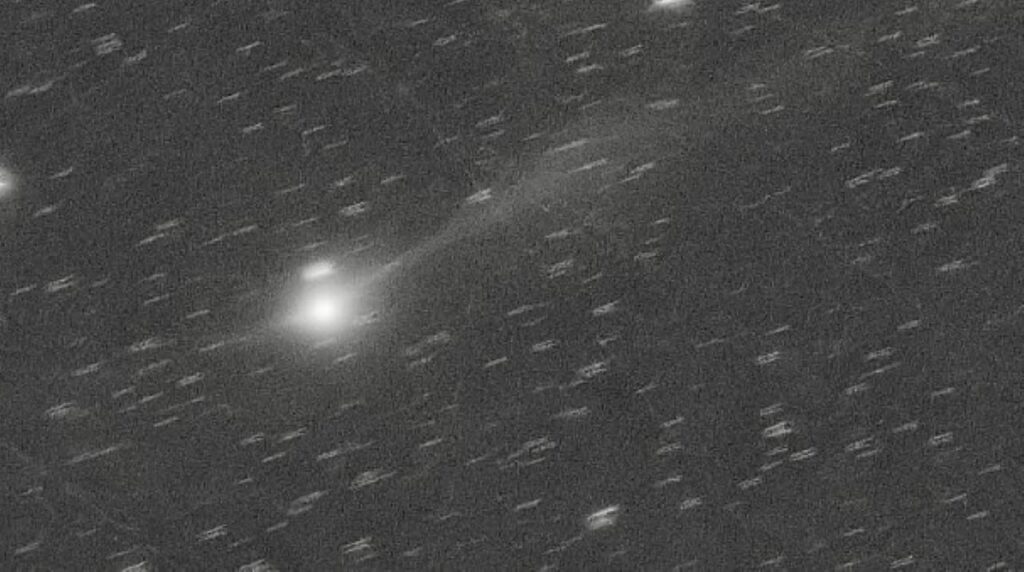
The passage of a rare visitor from outside our Sistema Solar, comet 3I/ATLAS, generated an intense global scientific mobilization. Identificado in 2025, the object was quickly classified as interstellar due to its unique trajectory, but it was an unusual, continuous radio emission that triggered intensive monitoring protocols from NASA and other space agencies.
Analysis of the signal, although later confirmed as being of natural origin, justified an in-depth investigation due to its intensity and regularity. The international collaboration, involving Agência Espacial Europeia (ESA), employed a global network of observatories to track the comet and collect as much data as possible during its brief passage through our system.
As the third interstellar object ever recorded by science, the 3I/ATLAS visit represented a unique opportunity to study materials from another star system. Scientific teams focused on unlocking secrets about its chemical composition and the environment from which it was ejected millions of years ago, before it continued its journey into deep space.
Visitor discovery and characteristics
Comet 3I/ATLAS was detected for the first time on July 1, 2025. The identification occurred thanks to the astronomical survey system ATLAS (Asteroid Terrestrial-impact Last Alert System), operated from the observatory at Río Hurtado, at
Immediately after the discovery, astronomers calculated its orbit and speed. The celestial body was traveling at around 100,000 km/h in relation to Sol, following a hyperbolic trajectory. Essa open curve, which does not close into an orbit, served as definitive confirmation of its extrasolar origin.
[[MVG_PROTECTED_BLOCK_0]
Preliminary analyses, coordinated by teams from Universidade, Havaí and ESA, indicated that 3I/ATLAS was a fragment composed of rock and ice. The most accepted theory is that it was expelled from its home star system by a gravitational event of great magnitude, such as the interaction with a giant planet.
Estimates of the size of its core varied considerably, between 320 meters and 5.6 kilometers in diameter. The nucleus was surrounded by a coma, a cloud of gas and dust formed by the sublimation of ice under the heat of Sol, a behavior typical of active comets.
[[MVG_PROTECTED_BLOCK_0]
The enigmatic radio signal captured
The most fascinating aspect of comet 3I/ATLAS was revealed on October 24, 2025, when the MeerKAT radio telescope, on África of Sul, captured a consistent radio emission from the object. The signal was recorded at a frequency of 1.6 GHz, a band that corresponds to one of the emission lines of hydroxyl molecules (OH), a common byproduct of the breakdown of water molecules (H2O) by solar radiation in active comets. Embora the origin of the signal was natural, its strength and regularity were considered remarkable, ruling out any possibility of terrestrial or artificial interference. Essa emission not only validated 3I/ATLAS’s classification as an active comet, but also offered scientists an innovative tool for measuring the rate of sublimation of water on its surface, providing crucial data about its internal composition and its reaction to our Sistema Solar’s environment.
Planetary Security Protocols Activated
Despite confirmation of the natural origin of the signal, the combination of an interstellar trajectory and atypical behavior led NASA’s Escritório of
[[MVG_PROTECTED_BLOCK_0]
The PDCO’s primary role is to oversee efforts to detect, track, and characterize nearby objects. The passage of 3I/ATLAS served as a valuable exercise to test and improve global response systems and real-time data analysis. The world’s most advanced observatories, such as Very Large Telescope (VLT) at Chile and Telescópio Espacial James Webb, have dedicated observing time to analyze the chemical spectrum of the comet’s coma and obtain maximum information.
Hyperbolic trajectory and impact risk
Detailed orbital calculations, carried out independently by NASA and ESA, confirmed that comet 3I/ATLAS posed no threat of collision with Terra or other planets in Sistema Solar.
Its closest approach to our planet occurred on December 19, 2025, at a safe distance of 270 million kilometers, which is equivalent to almost double the average distance between Terra and Sol.
The comet’s path is a classic example of an interstellar path. When Após reached perihelion, its closest point to Sol, our star’s gravity acted like a slingshot, accelerating it on its journey back into deep space, from where it will never return.
Comparisons with other interstellar travelers
3I/ATLAS has joined a select list of confirmed interstellar objects, which includes 1I/’Oumuamua, detected in 2017, and 2I/Borisov, observed in 2019. Cada one of these visitors offers distinct pieces to the puzzle about the formation of other planetary systems.
Unlike ‘Oumuamua, which had an elongated shape and did not display a visible coma, 3I/ATLAS demonstrated clear cometary activity, more similar to 2I/Borisov. However, the intensity of its radio signal differentiated it from both, suggesting a unique composition or internal structure.
The importance of continuous monitoring
Events such as the passage of 3I/ATLAS reinforce the importance of continuous monitoring systems, such as ATLAS. Esses programs are key to detecting unexpected visitors in advance, allowing their orbits to be accurately calculated to ensure planetary safety.
Observations and scientific focus
Even as it moves away, monitoring 3I/ATLAS remains a priority. Current observations seek to track variations in the composition of its coma and the reflectivity of its core.
The data collected will help understand how the heat of Sol affected its internal structure during its passage through our system, providing valuable information about the resilience and evolution of celestial bodies in stellar environments different from their original one.