
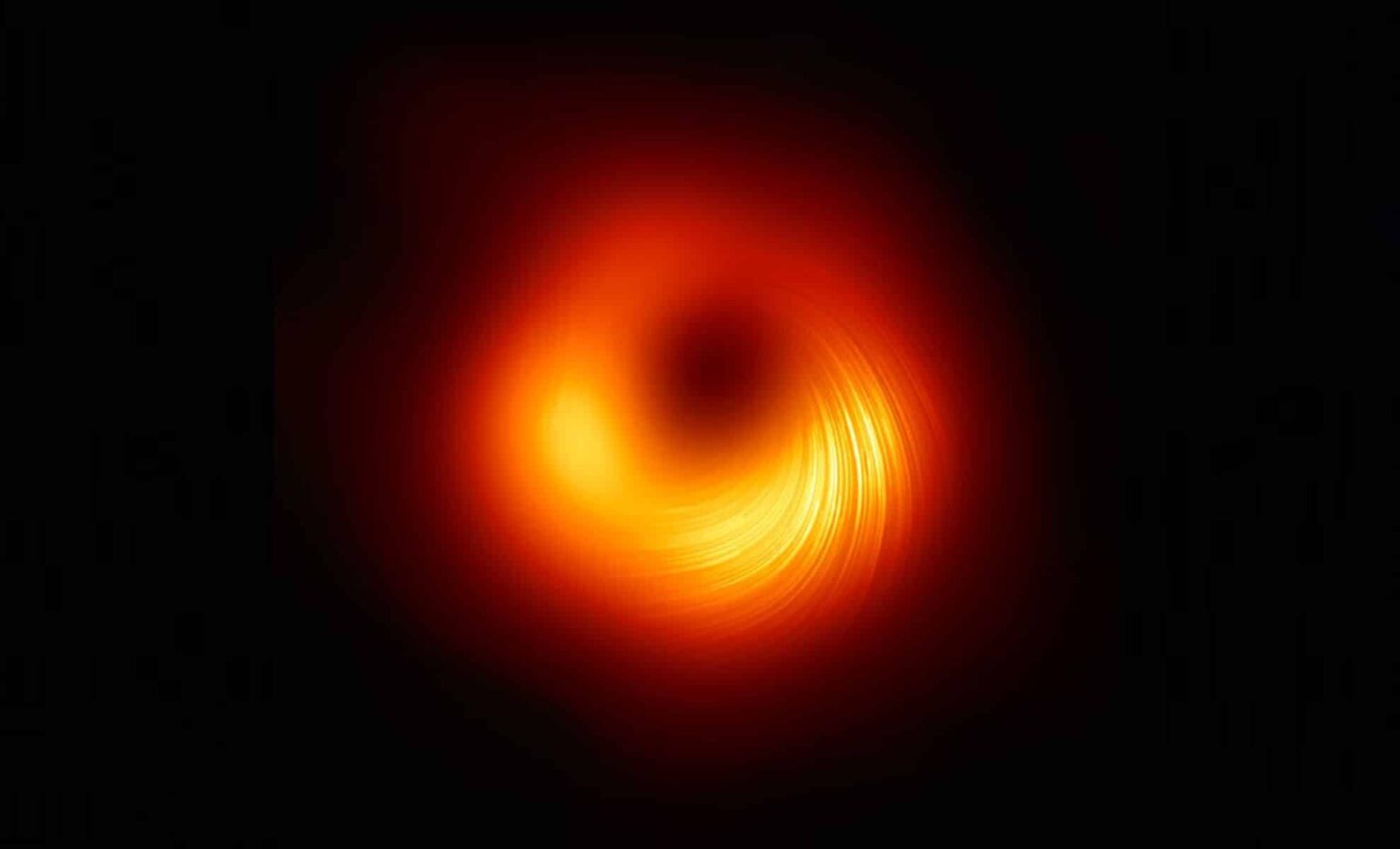
For the first time, astronomers are aiming to film a supermassive black hole in action, an effort that could transform our understanding of how these vast, gravitational giants shape the universe. The campaign, led by the Event Horizon Telescope (EHT), will focus on the black hole at the center of the Messier 87 (M87) galaxy, with the first-ever footage expected to provide new insight into how these enigmatic objects rotate and launch jets.
The observation campaign is running throughout March and April, using a network of telescopes stationed around the world. Once complete, scientists hope the data will shed light not only on the behavior of the black hole’s accretion disk, but also on the mechanisms behind galactic evolution driven by black holes.
The M87 black hole was already the subject of global headlines in 2019, when the EHT released the first image of its shadow, seen as a glowing ring of gas surrounding a dark central region. Now, researchers want to go further, capturing a moving sequence that shows how the black hole changes over time. The goal, according to Professor Sera Markoff, a founding member of the EHT and the new Plumian Professor of Astronomy at the University of Cambridge, is to accelerate scientific understanding “by an order of magnitude.”
Why Black Holes Matter More Than Their Reputation Suggests
Black holes are typically seen as destructive and mysterious, but scientists increasingly believe they are central to the life cycles of galaxies. Far from being just “evil vacuum cleaners,” as Markoff puts it, they play a key role in redistributing matter and energy in the universe. “They actually play a very important role in the ecosystem of the universe,” she said in an interview with The Guardian.
These cosmic objects grow to unimaginable proportions, M87’s black hole has the mass of about six billion suns, and yet remain invisible past a certain boundary: the event horizon. Despite their ominous name and appearance, black holes are thought to control star formation rates, fuel jet emissions, and influence galactic structure on a massive scale. According to EHT researchers, understanding their dynamics is critical to uncovering how early galaxies formed and evolved over billions of years.
Assembling the World’s Most Powerful Eye
The Event Horizon Telescope is a collaboration of 12 radio telescopes placed across the globe, from Antarctica to Spain and Korea. By combining their data using a technique known as very-long-baseline interferometry, the EHT effectively creates a telescope the size of Earth itself. This setup allowed scientists in 2017 to capture an image of M87’s black hole, showing a bright crescent of light circling its shadow.
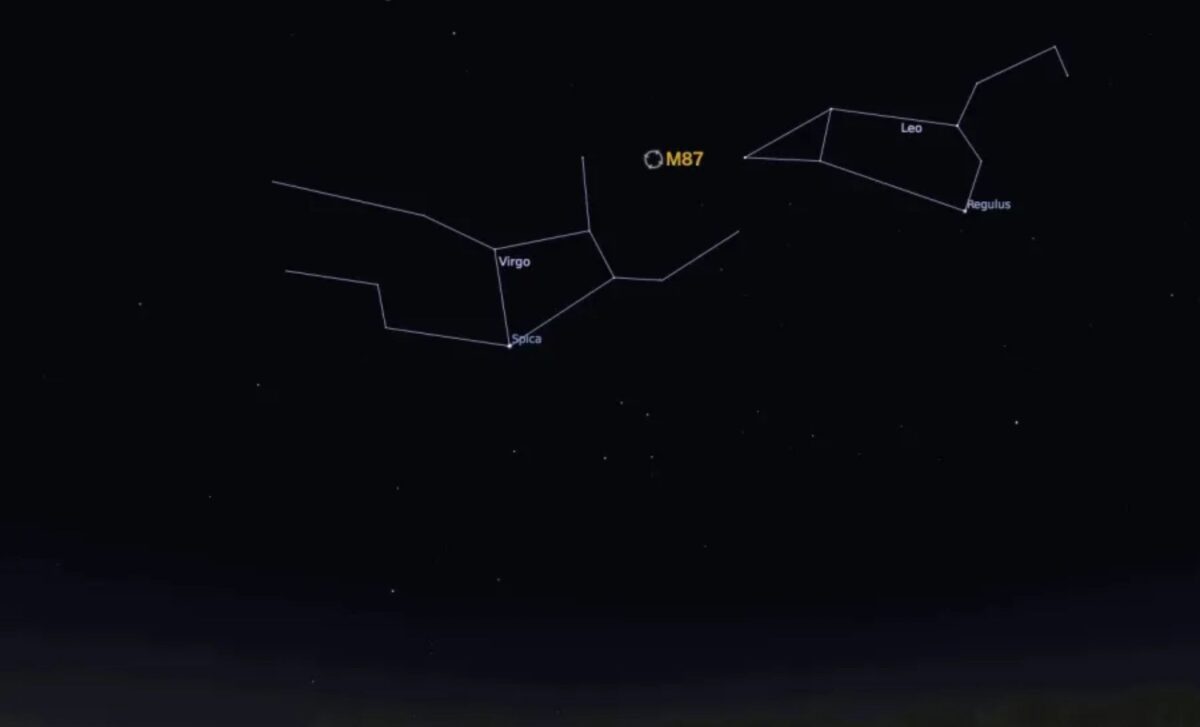 Star Chart for M87 Represents the View From Mid-Northern Latitudes for the Given Month and Time. © Nasa/Stellarium
“On one night in April 2017, everything came together,” noted physicist Ziri Younsi, recalling the perfect weather conditions that enabled the image capture. But the technology is constantly improving. Since 2019, the EHT has added several new facilities, making it sensitive enough to collect snapshots of M87’s black hole every three days. These images will soon be stitched into the first moving image of a black hole, made possible because the black hole’s rotation is slow enough to track at that pace.
According to the National Science Foundation, the logistics are daunting: the massive data sets generated by the telescopes can’t even be transferred digitally. Instead, hard drives must be physically transported from sites like the South Pole to processing centers in Germany and the US.
A Turning Point for Black Hole Science
With this new movie campaign, scientists aim to tackle some of the most pressing questions in astrophysics. One key objective is measuring the spin of the black hole, which may reveal how such objects grow. If black holes primarily expand by consuming matter, they should spin rapidly. If, instead, they grow by merging with other black holes, each merger could slow their rotation.
The campaign may also help unravel the mystery behind black hole jets, powerful beams of gas and radiation launched at near light speed. M87 is famous for producing these massive jets, which can disrupt star formation within galaxies and influence the evolution of neighboring systems. As Markoff explained to The Guardian, “They can change the entire evolution of the galaxy and even surrounding galaxies.”
While the footage won’t reveal what’s inside the black hole, an enduring mystery likely to remain unsolved, it will bring scientists closer to understanding the chaotic and extreme environment that surrounds it. “To me they represent the edge of our understanding of our universe,” Markoff said, adding that working on this project feels like doing “sci-fi for a living.”
The data from the spring observations won’t be ready for public release until the Antarctic summer, once the physical drives can be shipped out and processed. But within the scientific community, anticipation is already building. As Markoff put it, this movie is not just about seeing what was once unseen, it’s about unlocking the next chapter in black hole physics.