
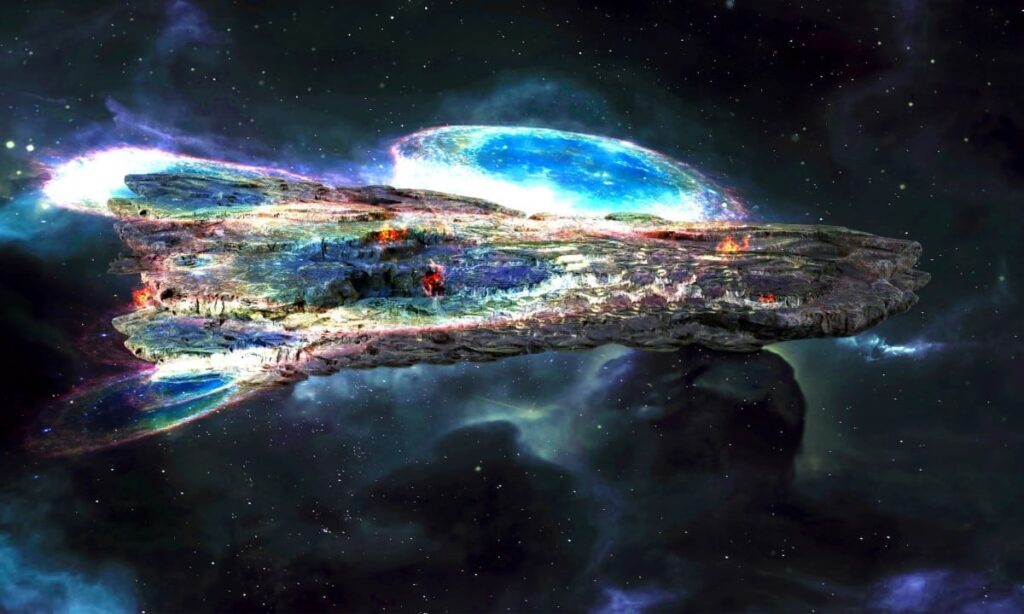
Photo: Imagens 3D do cometa 3I ATLAS – Photo: jhonny marcell oportus/ shutterstock.com
A significant milestone in deep space exploration was set by the Chinese probe Tianwen-1, which operates in the orbit of Marte. The mission managed to capture detailed images of comet 3I/ATLAS, a rare object with origins outside our Sistema Solar. The recording, made in late 2025, represents the first time that an interstellar “visitor” has been imaged from Martian orbit, demonstrating a remarkable advance in the ability to monitor distant and dynamic celestial bodies.
The comet was observed at an approximate distance of 30 million kilometers from the Chinese orbiter, while traveling at an impressive speed of 58 kilometers per second. Esta unprecedented observation provides valuable data for the international scientific community, which is dedicated to studying the composition and trajectory of objects formed in other star systems, offering direct insight into the formation of other worlds.
The images released by Administração Espacial Nacional of China (CNSA) display the comet’s nucleus and gaseous coma with remarkable clarity, allowing an in-depth analysis of its structure. The operation tested the limits of Tianwen-1’s instruments, originally designed to map the surface of Marte, which have now confirmed its versatility for tracking high-speed targets in deep space.
The complex orbital engineering maneuver
The capture of images of comet 3I/ATLAS by Tianwen-1 was an engineering feat that required meticulous and innovative planning. The probe’s high-resolution camera, known as HiRIC, was developed to photograph Martian topography with extreme precision, a fundamentally different task from tracking a small, faintly glowing, fast-moving object against the dark background of space. Para achieved the objective, the mission team at Terra needed to develop a new observation strategy from scratch. Isso involved completely recalibrating the probe’s targeting systems and performing precise orbital maneuvers to align the equipment with the comet’s predicted trajectory. Foram performed exhaustive simulations to determine the ideal exposure times, which needed to be short enough to avoid blur caused by the relative motion between the probe and the comet, but long enough to capture the faint light reflected by its nucleus and coma. The thermal stability of the instruments was also a critical factor, requiring adjustments to ensure that the lenses and sensors operated in their optimal temperature range during the observation window, which lasted just a few minutes. The raw data was transmitted to the control center at Pequim, where specialized algorithms processed the multiple exposures to create the sharp images that were later released.
Secrets of a distant star system
The passage of 3I/ATLAS close to Marte provided a unique opportunity for scientists. Objetos interstellar stars are seen as true cosmic time capsules, as they carry crucial information about the chemical and physical conditions of their stellar systems of origin. Analysis of its composition can reveal details about the formation of planets in other regions of the galaxy, offering a practical counterpoint to theoretical models that are based only on our Sistema Solar. Cada gas molecule and dust fragment ejected by these comets carries the signature of a distant stellar environment, allowing astronomers to indirectly study worlds that are light years away.
[[MVG_PROTECTED_BLOCK_0]
3I/ATLAS is suspected to have originated in a cold protoplanetary disk, a distant region where volatile elements such as water ice, carbon dioxide and carbon monoxide can remain preserved for billions of years. The spectral analysis of these components is essential to determine the temperature and density of the nebula where the comet was born. Compreender these conditions are essential for refining theories about how planetary systems, including our own, evolve over time. With each new interstellar visitor, science brings together more pieces to assemble the complex puzzle of planetary formation on a galactic scale.
The unique trajectory of the third visitor
Comet 3I/ATLAS is the third confirmed interstellar visitor to be detected by astronomers, following the passage of ‘Oumuamua in 2017 and 2I/Borisov in 2019.
[[MVG_PROTECTED_BLOCK_0]
Its discovery was made in July 2025 by the ATLAS telescope system (Asteroid Terrestrial-impact
Confirmation of its extrasolar origin came quickly from the analysis of its trajectory, described as hyperbolic. Esta is a clear mathematical signature that indicates an origin external to our planetary system.
[[MVG_PROTECTED_BLOCK_0]
First clues about the comet’s composition
The spectral data and initial images collected by Tianwen-1 already offer important indications about the nature of 3I/ATLAS.
The photographs show a dense, well-defined core, which is likely composed of a mixture of rock and different types of ice.
[[MVG_PROTECTED_BLOCK_0]
Analysis of the light reflected by its surface points to the presence of reddish organic dust, a common feature in celestial bodies formed in cold regions far from their host star.
Additionally, spectrometers aboard other missions have detected signatures of water ice and carbon dioxide sublimating from the surface, along with traces of carbon monoxide, confirming their typical cometary activity.
International effort in Martian orbit
The 3I/ATLAS observation was not an isolated initiative by the Chinese space agency. The presence of an international fleet of probes in the orbit of Marte enabled a coordinated observation campaign, which significantly expanded the quantity and quality of data collected about the object.
Agência Espacial Europeia (ESA) and NASA also directed their orbiters to study the gaseous composition of the comet’s coma and attempt to obtain even higher resolution images of its nucleus. On the surface, the Perseverance and Curiosity rovers were programmed to attempt to locate and observe the comet in the Martian sky, contributing a unique perspective.
Chinese mission versatility proven
For the Tianwen-1 team, the successful comet tracking operation served as a rigorous test of the probe’s capabilities beyond its primary mission of studying Marte. The success of the maneuver demonstrated the flexibility and robustness of the orbiter’s navigation and attitude control systems, qualifying it for future opportunity observation tasks that may arise.
Next steps for China space exploration
Launched in July 2020, the Tianwen-1 mission represents a milestone in the history of Chinese space exploration. The probe reached the orbit of Marte in February 2021 and successfully landed the Zhurong rover in May of the same year. Atualmente, the orbiter continues its mapping work, expanding scientific knowledge about Planeta Vermelho.
The experience gained from observing 3I/ATLAS is considered extremely valuable for future China missions, especially Tianwen-2. Lançada in 2025, this new mission has the ambitious goal of collecting samples from an asteroid and studying a comet. The protocols developed to observe the interstellar visitor will be directly applied to these new and complex deep space exploration missions.