
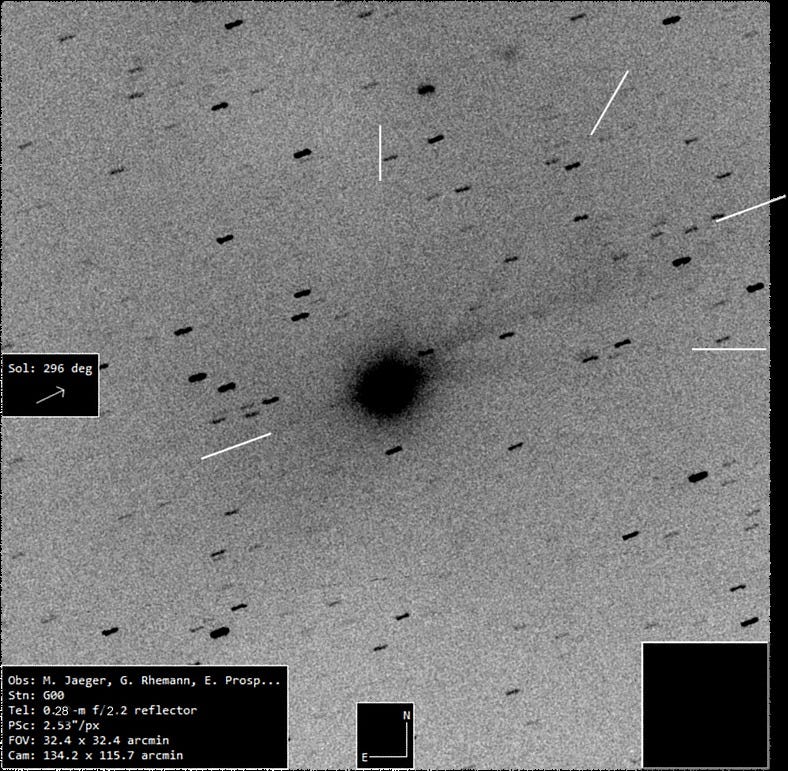
Avi Loeb continues to claim that 3I/ATLAS has many anomalous behaviors that lead to the conclusion that it “might” be an alien spacecraft. He carefully hedges the probability that it is a spacecraft around 40%, which gives him plausible deniability of the bad-faith “just asking questions” variety while still making the comet sound weird enough that lots of people are thinking (or worried!) that it’s an alien spacecraft. It certainly gets him lots of TV time and fan mail.
Here are why these anomalies are not indications that it is an alien spacecraft.
Loeb has apparently repudiated his original argument about the Duck Test for 3I/ATLAS. He first argued that if it acted like a comet as it approached the sun by growing a coma and tail and exhibiting cometary features that that would mean it’s a comet. When evidence for a coma emerged he first dismissed it as being poor observational technique, and then when the same conclusion was reached with Hubble Space Telescope data he called it “model dependent.”
Then once the coma (and tail) became inarguable he switched gears and said that a spacecraft should have those things after all! He has now explicitly written that no matter how much it walks like a duck, quacks like a duck, and swims like a duck, he will find ways to insist it’s at least 20% likely to be an alien spacecraft.
But look: it has a tail and coma like a comet. The tail and coma have the gases we expect to see from a comet. It’s brightening and evolving as it warms up like comets do. If Avi had not claimed it could be an alien spacecraft no one would be talking about it as anything but a comet.
It’s also worth noting that zero planetary scientists give Avi’s claims any credence. Contrary to his complaints, this is not because they are afraid to consider the aliens hypothesis or they are stuck in their ways (after all, I’m the director of the PSETI Center where we try to push the boundaries of the search for aliens!). I have found planetary scientists to be very open minded about this!
They’re saying he’s wrong because he’s demonstrably wrong.
Anyway, keep in mind that for every way 3I/ATLAS is acting “anomalous,” there are at least a dozen ways that it’s acting exactly like a comet, and not like an alien spacecraft.
The first thing to understand about comets is that no two seem quite alike. Planetary scientists have an expression “Comets are like cats: they have tails, and they do precisely what they want,”* meaning that they don’t obey any consistent rule of behavior except that they all have tails—and even having tails is now known to not be a rule! Indeed, this is why Karen Meech named tail-less comets “manx” comets (we now also know of “dark comets” which have neither tails nor comae!)
So when someone says a comet is “anomalous” planetary scientists yawn: what else is new? Indeed, when I was on the committee allocating time for national telescopes to observe targets we’d always get some proposals to observe comets, and each one was about how unique and special this new comet in the solar system was, necessitating new observations. By year three I had caught on: every bright comet was weird in some new way worthy of study.
So the question isn’t whether 3I/ATLAS is anomalous: it’s from another Solar System, so of course it’s anomalous! It’s whether it’s so anomalous that there’s any reason to think it’s anything other than a comet.
The second thing you need to understand about Loeb is that he has no training in planetary science (the study of comets and other things in the Solar System) and does not seem to consult planetary scientists before (or after) making his claims. Yes, he is an accomplished astrophysicist, but his area of expertise and success is very far from the study of comets, with almost zero overlap.
Yes, he has published many papers on comets, but none of his co-authors have any expertise in these matters either, and most of those papers are not peer-reviewed, so they have not been checked for accuracy.
In these papers and on his blog he regularly betrays an unfamiliarity with well-established planetary science concepts and misinterprets papers and comes to erroneous conclusions. When the authors of those papers complain he has misstated or even reversed the meaning of their conclusions or when his errors are otherwise pointed out, he either keeps repeating the misinformation, or quietly drops the line as if nothing happened. I’m not aware of him ever admitting he got something wrong with respect to 3I/ATLAS and retracting a claim, despite ample opportunities to do so.
Science is very forgiving of incorrect hypotheses—indeed it’s essential to the whole enterprise! But good scientists are supposed to acknowledge when a hypothesis is no longer supported and move on—it’s part of the humility that makes science work.
It’s also true that I am not a planetary scientist! But I do have experience with observations of Solar System objects and my work in exoplanets gives me a lot of familiarity with planetary science concepts. More importantly, I have consulted on this post with planetary scientists like Steven Desch, Michael Busch, Qicheng Zhang, and Marshall Eubanks who are experts on these things. I also do my best to own up to my mistakes and correct the record. I think these things give me more credibility about 3I/ATLAS than Avi.
[Disclaimer: while I’ve consulted with these experts, everything I’ve written is my own, which means any mistakes are on me, not them.]
We do! This is only the 3rd interstellar comet we’ve seen, and it’s bound to behave differently from Solar System comets for two big reasons and two little ones.
A minor reason is that unlike comets in the Oort cloud (which are so far from the Sun they experience the radiation of interstellar space for basically their whole lifetimes), 3I/ATLAS has taken a different route through the Galaxy than the Oort cloud, so has suffered different effects of radiation.
A second minor reason is that 3I/ATLAS may have spent much more or less time in interstellar space than Oort cloud comets, which have been there for the age of our solar system while 3I/ATLAS will be of a different age, and so have had a different amount of time to be altered by interstellar space.
The first big reason it should be different is that it’s from a different Solar System so might have a very different composition and history close to its star than our comets did when they formed.
But the biggest reason is that it is moving much faster towards the Sun than any Oort cloud comet (or than 2I/Borisov of 1I/’Oumuamua did) so at a given distance from the sun it’s had much less time to heat up the way comets do. This will certainly cause it to evolve differently from other comets!
So let’s break down the anomalies he keeps repeating, so we can see why there’s nothing to worry about with 3I/ATLAS (this list is verbatim from four days ago):
1. Its retrograde trajectory is aligned to within 5 degrees with the ecliptic plane of the planets around the Sun, with a likelihood of 0.2% (see here).
To paraphrase Einstein, his math is fine, but his statistics are atrocious. The best takedowns of this argument I know are by Hector Socas-Navarro. Basically, if someone had predicted ahead of time what the properties of a spacecraft would be like and it matched them then they’d be on to something. But Loeb chose specific aspects of the comet’s orbit to compute probabilities for after he knew what they were. That’s a classic fallacy and misuse of probability theory.
2. During July and August 2025, it displayed a sunward jet (anti-tail) that is not an optical illusion from geometric perspective, unlike familiar comets (see here).
It’s true that not many comets do this but it’s hardly unique. He also falsely claims he’s the first to explain why this might happen naturally, when in fact this has been understood for 50 years.
3. Its nucleus is about a million times more massive than 1I/`Oumuamua and a thousand times more massive than 2I/Borisov, while moving faster than both, altogether with a likelihood of less than 0.1% (see here and here).
This is simply incorrect. His assertion here is based on an erroneous calculation that the measurement of 3I/ATLAS’s nongravitational acceleration before perhelion could be measured to a precision of 10-10 AU/day2, when the actual precision is more like 10-7 AU/day2 (a thousand times larger).
This is especially frustrating because he regularly now cites papers quoting the correct number without critique, not acknowledging it contradicts his other claims. (In other words, his anomaly #10 below comes from data whose precision contradicts his calculation in anomaly #3—he can’t have it both ways!)
4. Its arrival time was fine-tuned to bring it within tens of millions of kilometers from Mars, Venus and Jupiter and be unobservable from Earth at perihelion, with a likelihood of 0.005% (see here).
Claiming the arrival was “fine tuned” is classic question begging. This is the same bad statistics from “anomaly” number 1, and Steve Desch has pointed out there is hardly anything surprising about a comet in the ecliptic passing by some of the planets. Loeb also calls it anomalous that it gets “close” (not that close really) to some planets, but also anomalous that it is not that close to others. Close, not close, both anomalous! With logic like this, every comet could be said to be anomalous.
5. Its gas plume contains much more nickel than iron (as found in industrially-produced nickel alloys) and a nickel to cyanide ratio that is orders of magnitude larger than that of all known comets, including 2I/Borisov, with a likelihood below 1%.
This is a genuine anomaly in the sense that it’s an extreme value! But it’s also something very consistent with what we know about comets. There’s no “standard” Fe/Ni ratio or nickel to cyanide ratio in comets, they vary by a lot. We are seeing nickel in 3I/ATLAS at a much larger distance from the sun than we normally look for it, and some pretty standard chemistry can explain why it will have a large anomaly out there. We expect it to come more in line with Solar System comets as it heats up.
So this is hardly so weird that planetary scientists are baffled. There’s interesting chemistry going on here but nothing suggesting the thing is nickel plated.
6. Its gas plume contains only 4% water by mass, a primary constituent of familiar comets (see here).
Yup! That’s weird. Not unheard of for comets though. 3I/ATLAS is outgassing all of the normal comet things to outgas (H2O, CO2, CO) just in a different ratio than we typically see, though not outside the boundaries of all comets. The fact that it’s outgassing these things at all strongly says “it’s a comet”.
Some comets are weird, and we expect this one to be weird.
7. It shows extreme negative polarization, unprecedented for all known comets, including 2I/Borisov, with a likelihood below 1% (see here).
Yup! That’s weird. It’s normal for comets and asteroids to show negative polarizaion, but it’s a bit stronger than we’ve ever seen before. Again, this is a very “comet” thing for 3I/ATLAS to do, it’s just more extreme than we’ve seen.
I don’t know why the grime evaporating off of an alien spaceship would be expected to have extreme negative polarization, though, so while it’s certainly an anomaly it’s not evidence for a spaceship!
8. It arrived from a direction coincident with the radio “Wow! Signal” to within 9 degrees, with a likelihood of 0.6% (see here).
This is ridiculous. 9 degrees from the Wow! Signal is a long way away! In other words it very definitely did not come from the direction of the Wow! Signal.
Also, for what it’s worth, it’s not as if we know aliens are out there in the direction of the Wow! Signal. The Wow! Signal failed the sky localization test when it was discovered, and I think most SETI practitioners believe it was some sort of instrumental glitch.
9. Near perihelion, it brightened faster than any known comet and was bluer than the Sun (see here).
Yup! This is an interesting anomaly. It did brighten very quickly for a comet. But, again: we expect it to brighten unusually because it’s coming in unusually fast (although this calculation tries to correct for that fact). Also: there’s no reason to think a spaceship would brighten quickly!
Also “bluer than the sun” is a weird way to express an anomaly. The light it’s reflecting depends on the composition of its gaseous coma. In this sense, lots of comets are “bluer than the Sun.” That’s not really anomalous.
10. It exhibits non-gravitational acceleration which requires massive evaporation of at least 13% of its mass (as calculated here), but preliminary post-perihelion images do not show evidence for it so far.
This is the one that will generate the most discussion among planetary scientists. The idea is that if it moves due to forces other than gravity by a lot compared to what we expect from comet outgassing, this could implicate thrusters, or if it moves too little (Loeb’s earlier argument) this would implicate a very high mass (too high to be from a population of interstellar objects moving around randomly, indicating it was directed here).
First of all, the non-grav acceleration of 3I/ATLAS is not well measured because the uncertainties probably don’t properly account for the fact that it’s hard to tell a precise position for a fuzzy comet. Lots of planetary scientists are skeptical of the statistical significance of the detection Avi’s hanging his hat on here. The true NGA is probably much smaller than this.
But even if it is correctly measured and his math here is correct (which is dubious, but I don’t have time for that here): losing 13% of its mass is hardly weird! It’s just would you would expect, in fact. Comets are made of ice, and lots of that ice will get lost when it comes near the sun!
And as for “post-perhelion images show[ing] evidence for it,” that’s just not a thing? When gases and dust move away from a comet they quickly become so rare (un-dense) that they are unobservable.
Loeb seems to be setting up a false argument that if we can’t account for all of the ejected mass of the comet in images of its tail and coma, then it can’t be a comet and must have thrusters. This argument would be very wrong. Lots of comets show thrust with no detectable tails!
So of Loeb’s 10 anomalies, only 4 really have planetary scientists interested: the high nickel abundance, the extreme polarization, the strange water abundance, and the rapid brightening. All of these are the sorts of anomalies one expects from a new kind of comet. They weren’t exactly predicted ahead of time as far as I know, but neither did Avi predict (or even “post-dict”!) that there was some reason that an alien spacecraft would show them.
None of them are evidence it’s a spacecraft! There’s no reason spacecraft would do these things. There are lots of reasons comets from another solar system would.
Above, I list Loeb’s “anomalies” as of early November. Knowing him, he’ll likely find others as we learn more about the comet to add to his list. I’ll try to keep those up to date below.
One is that 3I/ATLAS is showing some fantastic jets of material now:
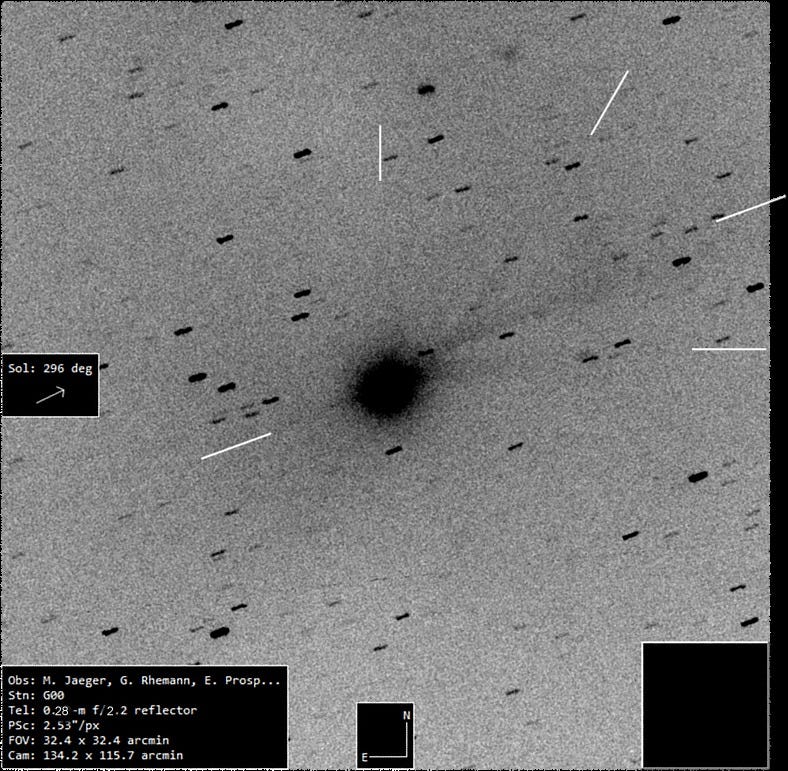
So before Loeb can claim this is an anomaly, know that this is a thing comets do. It’s also not something I think anyone would expect a spacecraft to do?
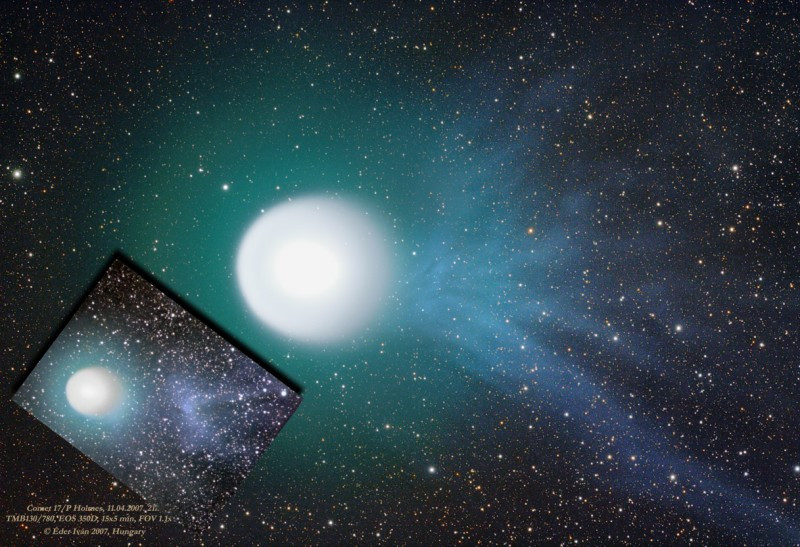
Comet 17P/Holmes
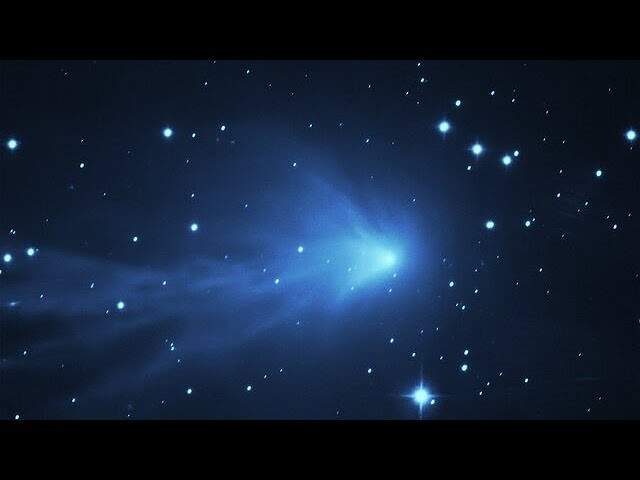
C/2016 R2 (PanSTARRS)
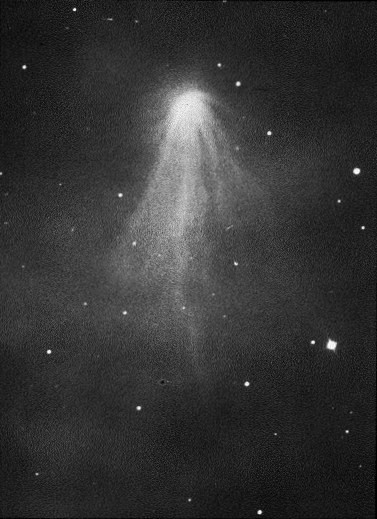
C/1961 R1 (Humason)
[Update 14 Nov 2025] …and sure enough Loeb has a new anomaly. He claims that the length of the tail is inconsistent with 3I/ATLAS being in one piece, and since it is in one piece it can’t be a comet. This is wrong, as explained here:
Avi Loeb’s calculations about 3I/ATLAS are 100% wrong because he has never understood that dust in the tail(s) responds to solar radiation pressure. Solar wind shapes the ion tail. But the radiation pressure is about 1000 times larger than the solar wind ram pressure, for particles that feel it.
— Steve Desch (@deschscoveries.bsky.social) 2025-11-13T21:36:44.964Z
Above, I provide some links for detailed breakdowns of why some of the anomalies are anomalies, but in some cases I’m just asserting what planetary scientists understand about comets. This is definitely an appeal to authority, but it’s a pretty good authority!
My purpose here isn’t to write a refereed scientific paper rebutting his work (I don’t have time to do that, but also until his claims make it into the refereed literature it’s not really worthwhile to rebut them there). It’s also not to do a point-by-point rebuttal with data of everything Loeb claims. That would be a huge post and link to lots of primary literature in the planetary science corpus. We’d need to go into decades of research into comets and chemistry and all the rest. Steve Desch has done some of this but Loeb writes new claims so quickly it’s really hard to keep up
This is a popular science blog post, not intended to convince every skeptic and Loeb fan (how could I?), but simply to separate fact from fiction around this comet.
Also, after writing this lots of readers accused me of being obviously biased against Loeb. I guess that they just can’t imagine that his behavior is as bad as I write, and so I must be exaggerating things because I dislike him.
This isn’t so! I actually worked with him and for years we enjoyed encouraging each other in the SETI space. I thought his early work on ‘Oumuamua was an important way to get the conversation of Solar System SETI started, and I was one his few defenders as he gained notoriety for pushing this line of reasoning. You can read my early posts on him if you don’t believe me.
Critics of this piece also argue that I should be more dispassionate and address only his arguments, and not his behavior. But it’s actually his behavior that’s the problem, not his arguments! If people want to make bad arguments about aliens that’s fine—I don’t go around debunking them all. The problem is that he is deploying the trappings of scientific authority to misinform the public and steal the attention of the science-interested public from the hard work planetary scientists are doing on this amazing object. I continue to get calls from reporters at mainstream news organizations asking me to be a counterpoint to Avi about his alien claims, as if the right answer lies somewhere between our positions, and as if either one of us is a comet expert! (I beg them to not quote either of us and interview planetary scientists instead).
I actually find Avi’s openmindedness and willing to explore the aliens hypothesis quite laudable! It’s not his question asking that’s the problem, it’s his very public dismissal of expertise, demonization of his critics, and misleading the public that I have issue with, so I have to talk about him and his behavior, not just his claims.
*I updated this quote to match what I’ve found on Google, which attributes it to David Levy.