
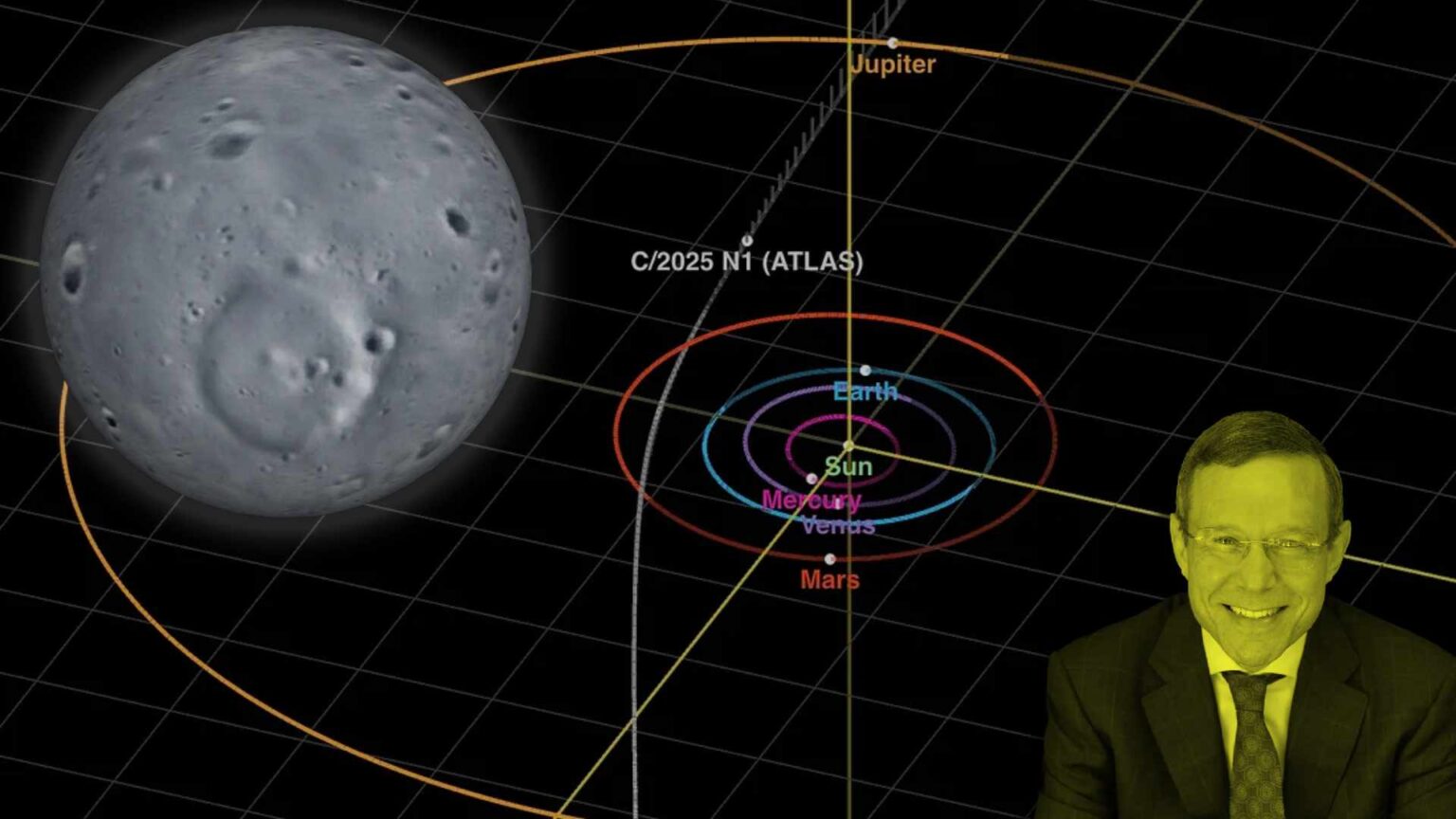
Have we ever been visited by extraterrestrial intelligence before or perhaps being observed? Has someone in the intergalactic neighborhood spotted and sent a probe along the solar system? If they did, how would someone know, assuming they have similar technological evolution as us Earthlings? Is the interstellar object 3I/ATLAS a spy probe disguised as an icy comet?
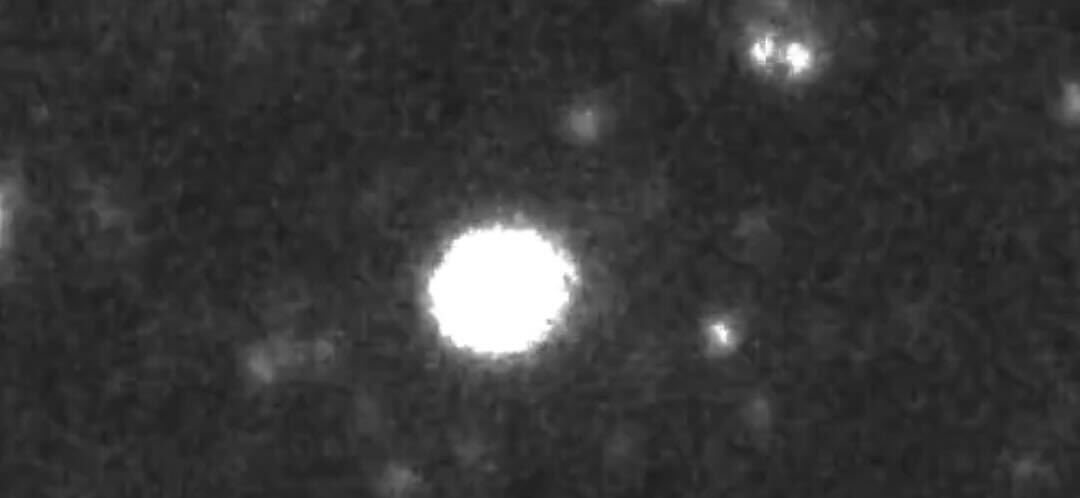
The new Vera C. Rubin Observatory captured a video of Comet 3I/ATLAS zipping through space during its testing phase.
3I/ATLAS, the ever-so fascinating exocomet, has been baffling experts and lay alike ever since it was first spotted on July 01, 2025 by the ATLAS observatory, based out of Chile. The interstellar interloper, the third-ever recorded since 1I/Oumuamua (2017) and 2I/Borisov (2019), first entered the outer banks of the Solar System known as the Oort Cloud some 8000 years ago (estimated from its trajectory and velocity). Cruising at a speed of around 61 kilometers per second, the interstellar visitor entered perihelion on October 29, 2025 and closest Earth flyby on December 19, at a distance of 1.8 AU or 270 million kilometers. Speculations of the exocomet having an extraterrestrial intelligence origin cannot be confirmed with the cumulative data obtained so far.
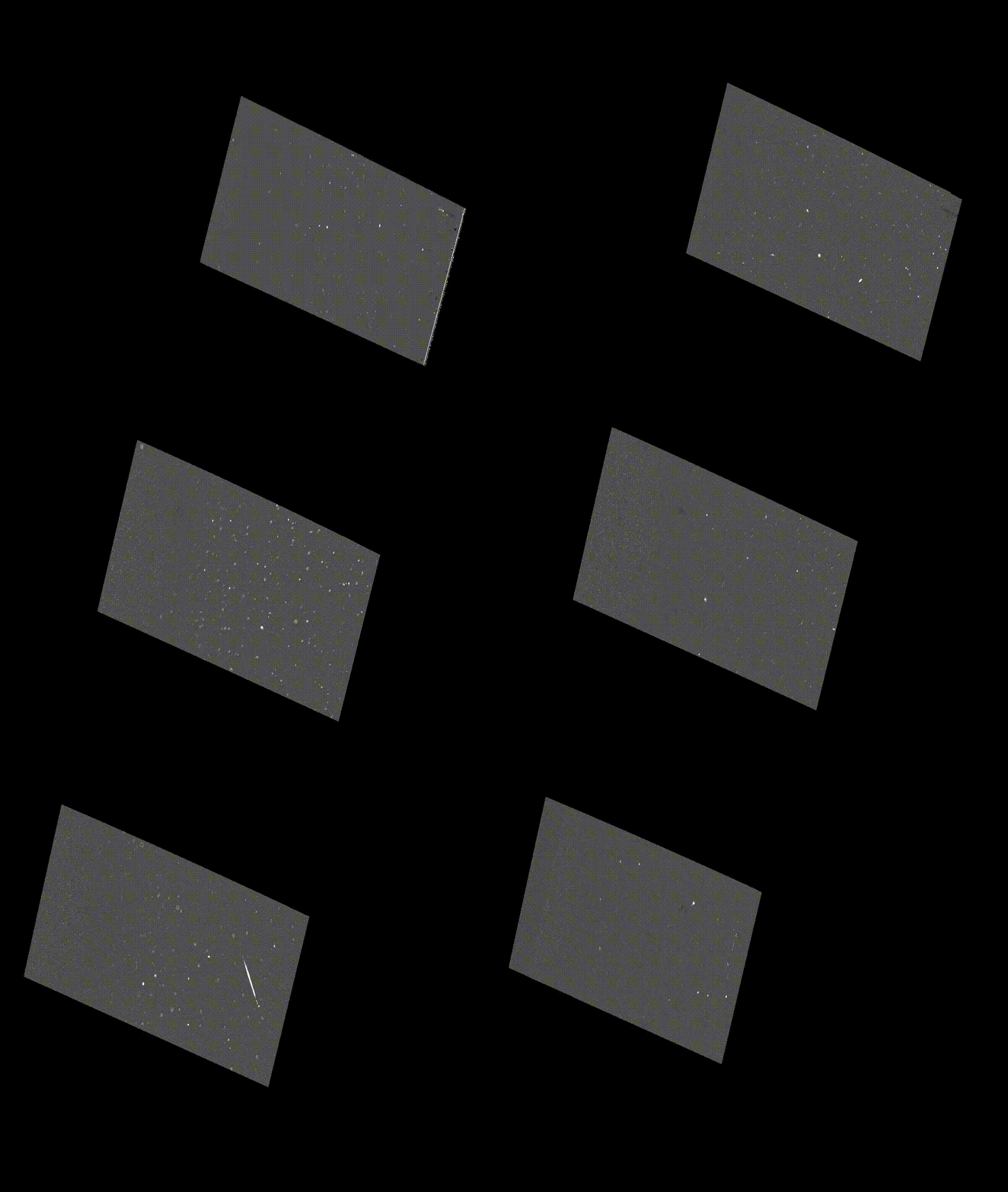
NRL/NASA/JHUAPL. Movie processed/compiled by Guillermo Stenborg (JHUAPL)
Meanwhile, Harvard astrophysicist Avi Loeb, who flagged at least 16 anomalies on 3I/ATLAS has reiterated intensive monitoring of the exocomet’s Jovian rendezvous, especially when it gets closest to one of Jupiter’s closest moons, Eupheme, on March 16. But what would be the telltale sign? Loeb explains in his latest Medium blog. He briefs
3I/ATLAS is expected to arrive on March 17, 2026 to within 30.46 million kilometers from Jupiter’s irregular moon Eupheme.
So what’s fascinating about this encounter?
Eupheme has an orbital period of 588 days around Jupiter. It will reach its farthest distance of 27.7 million kilometers from Jupiter on January 23, 2026, just 52 days before its closest passage relative to 3I/ATLAS. This coincidence is not surprising given that there are 95 known satellites in orbit around Jupiter.
And?
The proximity of the passage of 3I/ATLAS to the Hill radius allows it to release daughter objects into bound orbits around Jupiter. These small objects can become gravitationally bound to Jupiter as long as they receive a kick that cancels the relative motion between 3I/ATLAS and Jupiter. This relative speed will be relatively high at the closest approach between the two objects, measuring about 66 kilometers per second.
Loeb adds
Discovering a fresh 96th moon around Jupiter after March 16, 2026 would constitute a clear technological signature for 3I/ATLAS.
But can’t a new satellite be of natural origin, i.e., of Jupiter? Loeb explains
A breakup of a natural astrophysical object that is much less massive than Jupiter cannot result in a velocity kick as high as 66 kilometers per second. The escape speed from the surface of Jupiter itself is 60 kilometers per second and gravitational breakup of much smaller bodies cannot generate fragments that are moving at larger speeds than the parent’s escape speed.
Therefore, a kick of the required magnitude and direction to bring a fragment of 3I/ATLAS into a bound orbit around Jupiter is an impossible outcome from the breakup of a comet.
Prof. Loeb wraps up his blog with the following remark:
The outcome of the encounter between 3I/ATLAS and Jupiter will be monitored by the Juno spacecraft near Jupiter as well as by the biggest telescopes we have near Earth. Stay curious and get your popcorn ready by March 16.
3I/ATLAS is Forecasted to Get Nearest to Jupiter’s Irregular Moon Euphemehttps://t.co/WMbyUk1MEr
— Galileo Project (@GalileoProject1) January 7, 2026