
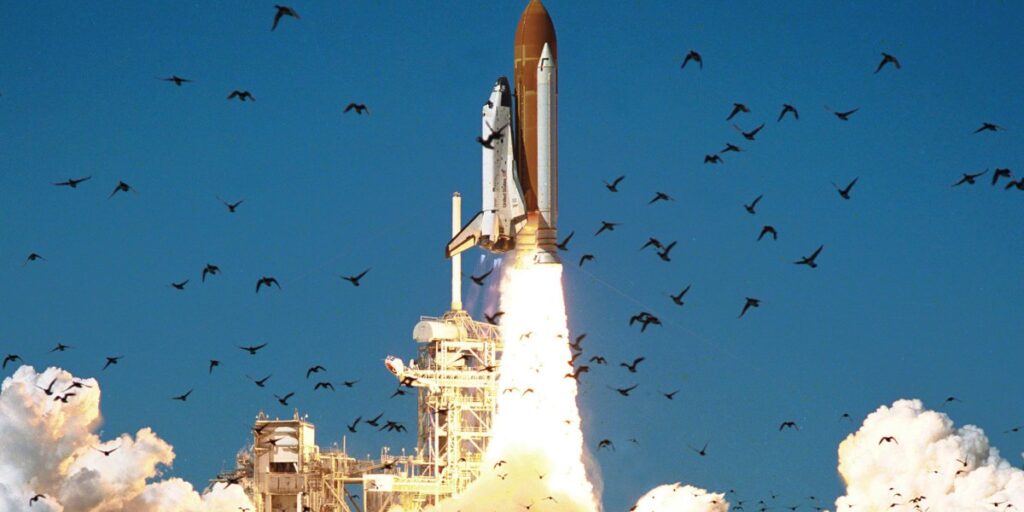
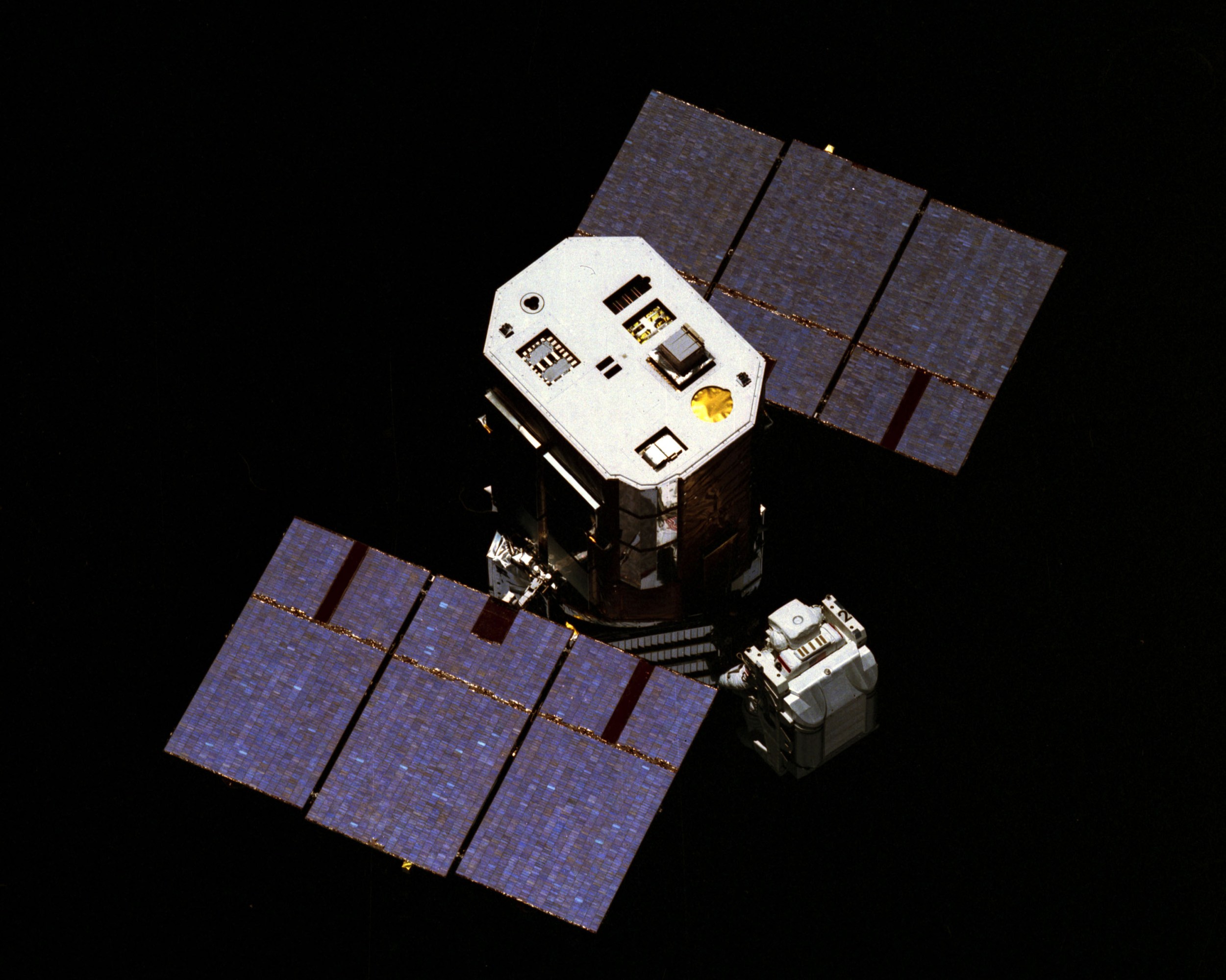
 Astronaut George D. Nelson, using the manned maneuvering unit, arrives at the ailing Solar Max satellite. After successfully capturing Solar Max and repairing it in Challenger’s payload bay, the STS-41C crew released it back into space.
NASA
Worse, the improvised effort to manually slow the satellite’s spin had the opposite effect, sending it into a tumble that threatened to exhaust its battery. We were forced to back off.
As grippingly narrated by Walter Cronkite in the IMAX documentary The Dream Is Alive, the flight controllers in Houston, engineers at NASA Goddard, and contractors across the country worked through the night to find a solution. By morning, we had it.
Earthbound engineers remotely shut down most of the satellite’s functions, slowing its tumble enough to give us one last chance to capture it. Thanks to the deft maneuvering of Bob Crippen and Dick Scobee in the orbiter, the composure of Jim “Ox” van Hoften and George “Pinky” Nelson during their spacewalk to repair the satellite, the ingenuity of the flight team, and the technical precision of the robotic arm known as Canadarm, we succeeded. The satellite was deposited in the shuttle’s payload bay with just minutes’ worth of orbiter fuel and satellite power remaining.
That kind of strong leadership and great teamwork are the real safety systems of spaceflight.
The lessons of Challenger, Columbia, Apollo 13,and the Solar Max satellite continue to resonate in the halls of NASA and, I hope, in the corporate boardrooms where decisions about our space program are increasingly being made. They also still resonate in the classrooms of engineering professors like me. For the past 20 years, I’ve been teaching at my undergraduate alma mater, Lehigh University, where I’ve found joy in watching students deepen their technical skills and curiosity. My friend and fellow astronaut Jeff Hoffman has done the same in Building 16 at MIT. But as an educator, I often ask myself what universities can do to prepare the next generation for the rapidly evolving space frontier.
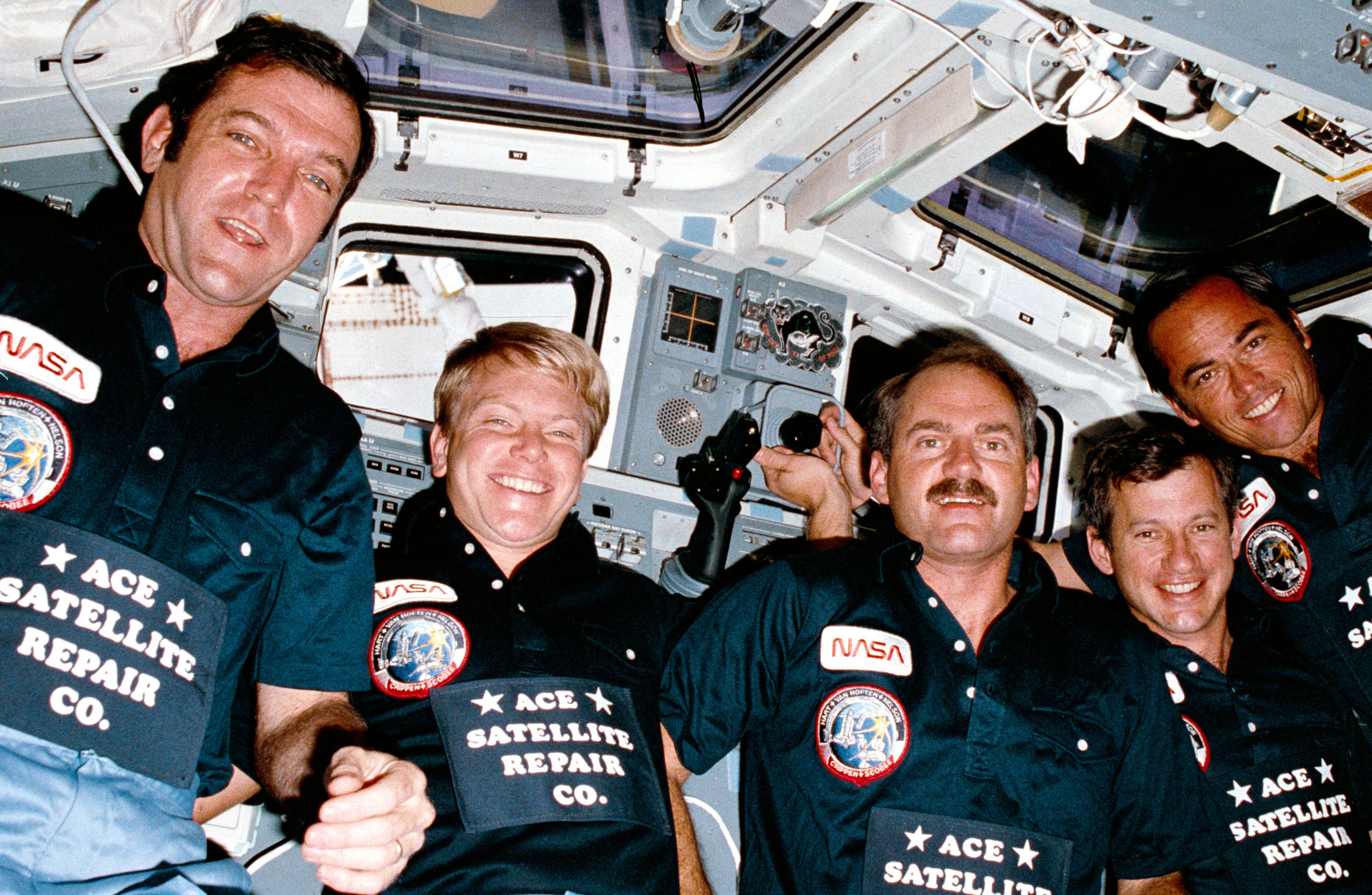 Sporting “Ace Satellite Repair Co.” attire, the STS-41C crew held a press conference aboard Challenger after finalizing Solar Max repairs in April 1984. From left, Francis R. (Dick) Scobee, pilot; mission specialists George D. Nelson, James D. van Hoften, and Terry J. Hart; and Robert L. Crippen, crew commander.
NASA
Today’s challenges demand more than a narrow foundation in a science or engineering field. Space systems are inherently interdisciplinary. Experts in propulsion, structures, communications, materials, artificial intelligence, and more must work as one. While technical knowledge is critical, collaboration, leadership, ethics, and program management are just as essential.
Spaceflight demands judgment, teamwork, and an instinct for managing the unknown—traits that develop only through experience and mentorship. As educators, our job is to help students gain knowledge and the wisdom to use it well.
If we do that, the explorers who follow will chart new worlds with better tools and the breadth and depth of experience needed to make sound judgments in critical moments. Their success will prove once again that our greatest strength is the human collaboration behind every mission.
Terry Hart, SM ’69, is a former US Air Force fighter pilot, NASA astronaut, and telecommunications executive. A professor at Lehigh University, he is founding director of its new master’s program in aerospace and space systems engineering (MS-AERO).