
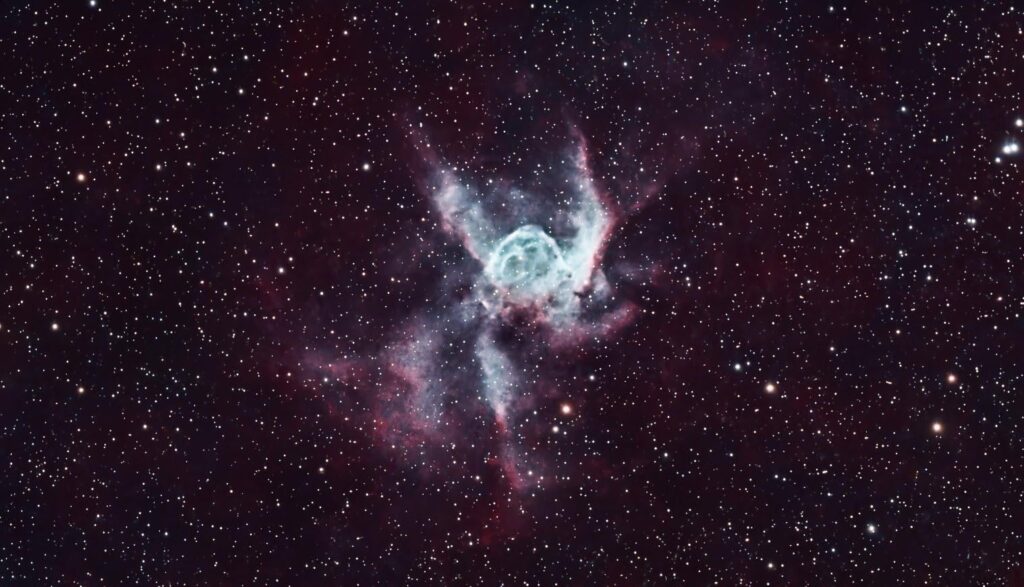
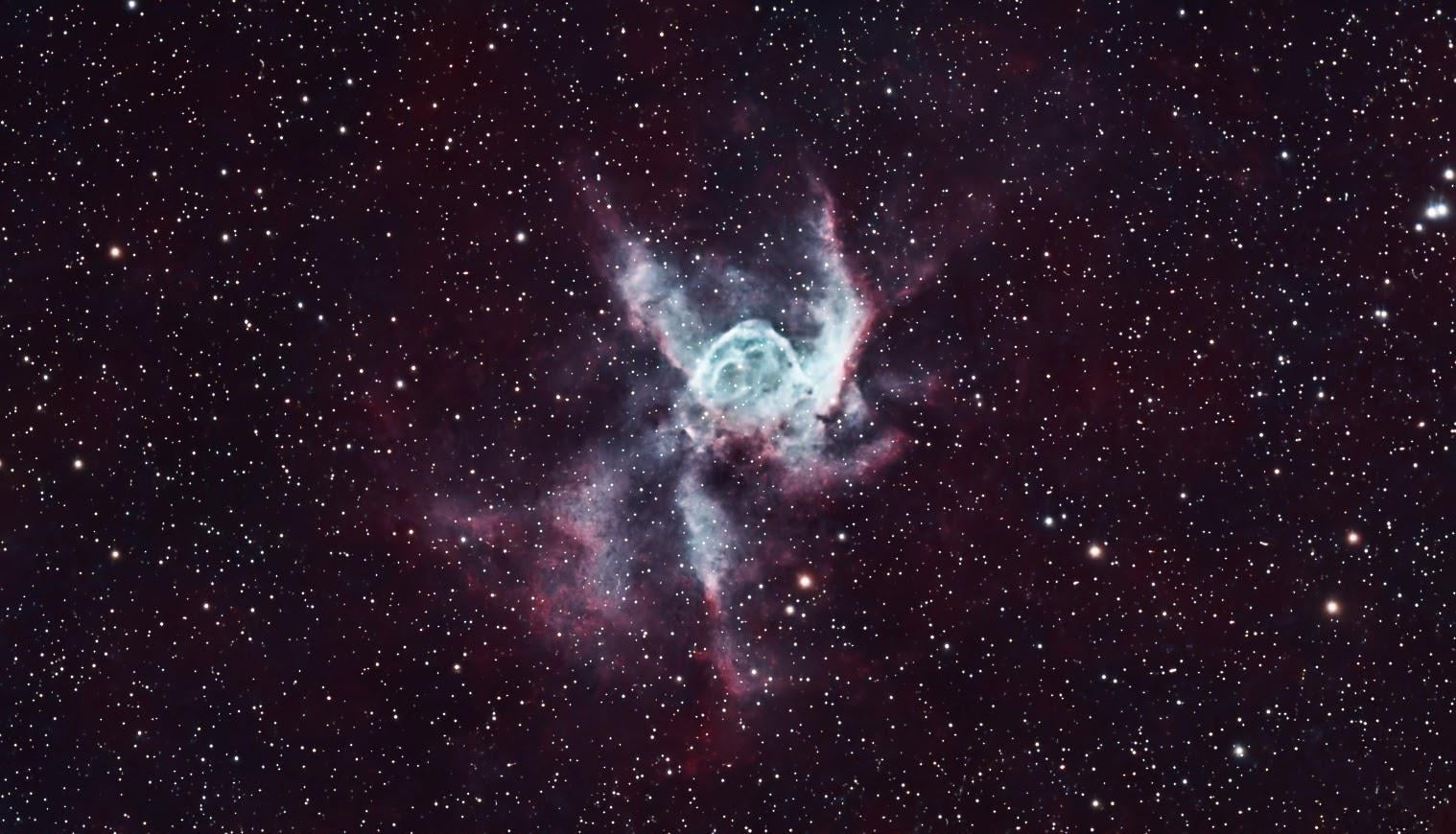
I processed this image using two dualband external filters with my Seestar S50. I'm still learning how to combine the channels as there are many different combinations, but I like this one so far!
Equipment and data acquisition:
– Seestar S50, EQ mode, 20sec subs
– Askar C1/C2 filters (Halpha-OIII and SII-OIII) with a 3D-printed filter holder
– Roughly 2-2.5 hours of acquisition per filter from a bortle 4 location
Processing (PI)
– WBPP for each filter, star alignment and crop
– BlurX and StarX on each stack
– Starless images: channel separation; from the Ha-OIII stack, keep R as master Ha; combine G and B in Pixelmath (average) to give OIII-1. From the SII-OIII stack, keep R as master SII; combine G and B as for Ha-OIII stack to give OIII-2. Then, combine OIII-1 and OIII-2 in Pixelmath (0.3OIII-1) + (0.7OIII-2) to give master OIII.
– For each Ha, SII and OIII master, multiscale adaptive stretch, then manual curves transformation. NoiseX.
– SetiAstro Perfect Palette picker (HOO)
– Curves transformation with various range and color masks; HDR multiscale transform.
– Star recombination and final retouches with curves transformation
by Techno-Scientist
2 Comments
That’s such an awesome object and great shot out of the Seastar for such small acquisition time, well done!
And yes, I struggled with my color combinations on mine a lot with this and I plan to revisit it again on a rainy day when I am bored. Your palate was the one I really wanted but I was overcooking too much to get it so I settled on the red areas being more brownish and highlighting the blue in the Oiii.
Absolutely gorgeous