
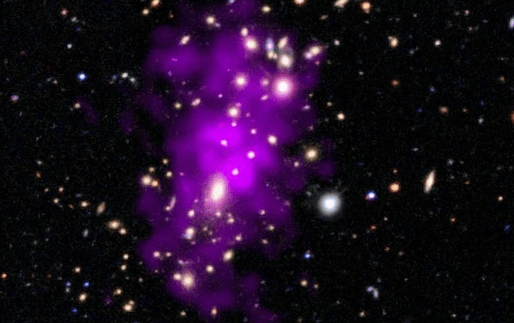
Distant calm galaxy cluster SPT-CL J2215-3537 is giving astronomers a rare, serene glimpse into the early universe. Located 8.4 billion light-years away, this massive cluster is the most distant “relaxed” galaxy cluster ever observed, meaning it shows no signs of recent major collisions. Nicknamed the “Champagne Supernova” cluster, it was detected using NASA’s Chandra X-ray Observatory.
Distant calm galaxy cluster defies expectations
Astronomers found that the distant, calm galaxy cluster has a smooth, centrally peaked X-ray glow, with no shock fronts that would indicate violent mergers. Chandra’s X-ray data, combined with Hubble’s optical and infrared images, reveal hot, multimillion-degree gas suffusing the cluster and a remarkably ordered structure for such an early epoch.
Unusually, the cluster’s core is undergoing intense star formation, suggesting that its central supermassive black hole is currently quiet enough to let gas cool and condense into new stars. This calm behaviour contrasts with many distant clusters, where energetic black hole activity typically stifles star birth.
Distant calm galaxy cluster redefines early universe models
Lead author Michael Calzadilla of MIT highlighted the breakthrough, saying: “Up until now, we have not seen a relaxed galaxy cluster as distant as SPT2215.” The distant, calm galaxy cluster, therefore, sets a new record for such systems in the young universe.
Scientists say this discovery “paves the way to learning how and when some of these gigantic structures form”, offering a vital benchmark for models of cosmic expansion and structure growth. Spotting a well-ordered, star-forming cluster at this distance indicates that massive structures assembled earlier than many theories predicted.
Why this distant calm galaxy cluster matters
Because calm clusters serve as precise cosmological signposts, the distant calm galaxy cluster SPT-CL J2215-3537 could help refine calculations of how the universe evolved over billions of years. Its combination of tranquillity, extreme distance and vigorous star formation gives astronomers an unusually clear laboratory for testing ideas about dark matter, black hole feedback and galaxy growth in the infant cosmos.