
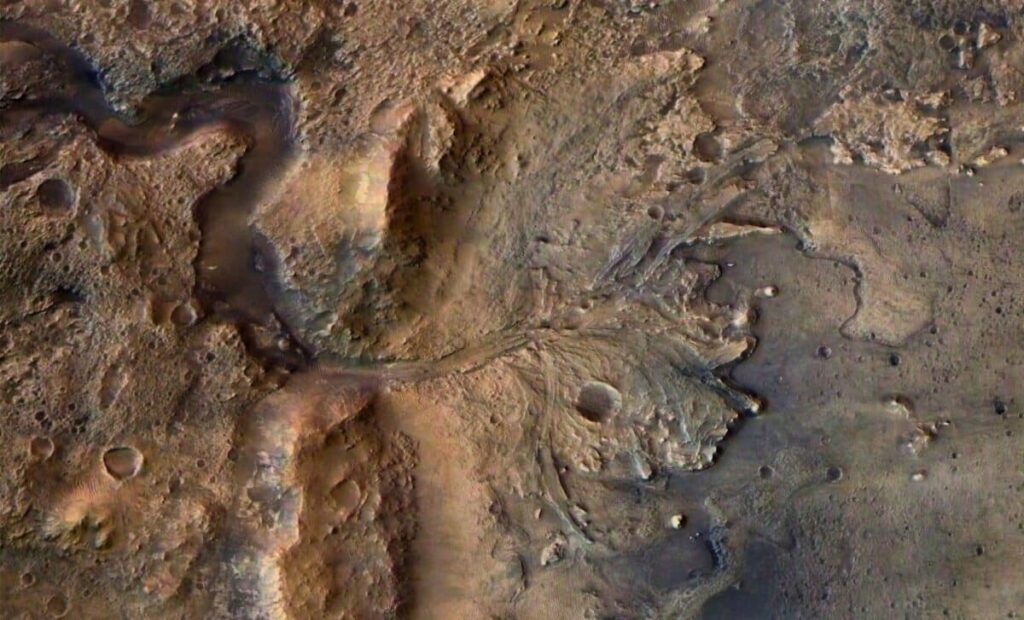
In a quiet riverbed carved into the Martian surface, a patch of layered stone may hold a clue to one of science’s most enduring questions. The landscape is dry and inert now, shaped by winds and time, but signs within its mineral fabric hint at activity once driven by something more dynamic.
For decades, researchers have speculated that ancient Mars had the conditions needed to support life. The challenge has never been about imagining what might have been, but rather identifying physical traces that could be tested and verified. Signals must be clear, chemical reactions must be explained, and alternatives must be ruled out.
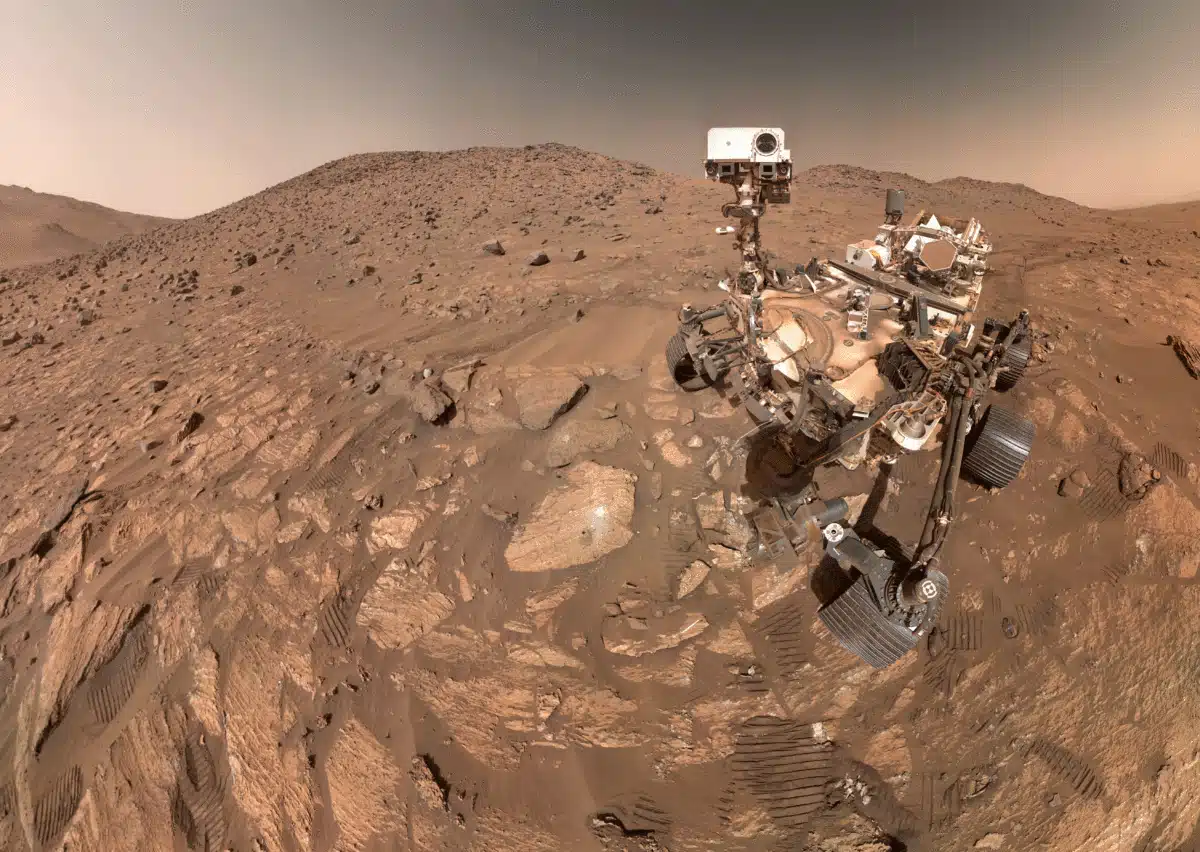 NASA’s Perseverance Mars rover took this selfie, made up of 62 individual images. One specific rock has features that may bear on the question of whether the Red Planet was long ago home to microscopic life. Credit: NASA/JPL-Caltech/MSSS
New data from a rock core drilled by NASA’s Perseverance rover has advanced that search in a way few previous missions have. The evidence is not conclusive, but it is unusual, precisely structured, and consistent with how life operates on Earth in comparable environments.
The results, published in the journal Nature, describe features that scientists now classify as a potential biosignature—a technical term for patterns that resemble biological processes but require further testing to confirm.
Organics and Redox Patterns in Jezero Crater
The rock sample, known as Sapphire Canyon, was extracted from a formation within Jezero Crater, an area long considered a high-priority target for astrobiological research due to its history of water. Perseverance drilled the core in mid-2024 from a site called Cheyava Falls, located in the ancient Neretva Vallis river channel.
Two iron-based minerals were found within the sample: vivianite, a hydrated iron phosphate, and greigite, an iron sulphide. What drew attention was their spatial configuration. They occurred in concentric zones, with greigite forming the core and vivianite forming outer rims, in structures informally described as “leopard spots.”
In terrestrial environments, these minerals are frequently associated with microbial metabolism, particularly in low-oxygen sediments. On Earth, vivianite often forms when bacteria reduce iron and bind phosphorus, while greigite results from sulphate-reducing bacteria in organic-rich muds. The pairing observed in the Martian sample closely matches these formations.
 Scientists think the spots may indicate that, billions of years ago, the chemical reactions in this rock could have supported microbial life; other explanations are being considered. Credit: NASA/JPL-Caltech/MSSS
NASA’s onboard instruments, including PIXL and SHERLOC, also detected organic carbon in the same regions, alongside phosphate, oxidised iron and sulphur. According to NASA press release, these tools were designed to perform fine-scale mineralogical analysis to identify past habitability and potential biosignatures.
“The combination of chemical compounds we found in the Bright Angel formation could have been a rich source of energy for microbial metabolisms,” said Joel Hurowitz, lead author of the study and a scientist at Stony Brook University.
Early Steps on the Life Detection Scale
NASA scientists have been careful not to overstate the findings. The features identified meet several criteria on the agency’s Confidence of Life Detection (CoLD) scale, which provides a phased approach to evaluating possible biosignatures. The study clears multiple thresholds, but further data is required before advancing to higher confidence levels.
Katie Stack Morgan, Perseverance’s deputy project scientist, noted the significance of publishing these results under peer review. “Astrobiological claims, particularly those related to the potential discovery of past extraterrestrial life, require extraordinary evidence,” she said.
 Marked by seven benchmarks, the Confidence of Life Detection, or CoLD, scale outlines a progression in confidence that a set of observations stands as evidence of life. Credit: NASA
Abiotic explanations have not been ruled out. The researchers examined whether such mineral pairings could arise through non-biological reactions, including high-temperature processes or chemical interactions with acidic water. However, no signs of thermal alteration or acidic conditions were found in the sampled rock.
Vivianite and greigite can form without life, but on Earth these conditions are typically rare and specific. The structure, temperature range and mineral associations in the Sapphire Canyon sample align more closely with low-temperature aqueous environments that support microbial activity.
Implications for Mars Sample Return
The rock core is one of 27 collected by Perseverance since its 2021 landing. These samples are being sealed and stored in anticipation of the Mars Sample Return campaign, a proposed multi-agency mission to retrieve Martian samples for detailed laboratory analysis. According to NASA’s Jet Propulsion Laboratory, the rover’s science strategy includes prioritising sites with high preservation potential for biosignatures.
Laboratory instruments on Earth could determine isotopic ratios, molecular structures and other markers that would allow scientists to distinguish biological signatures from non-biological ones with greater precision. That testing is essential before stronger claims can be made.
Nicky Fox, Associate Administrator for NASA’s Science Mission Directorate, said the release of the data was intended to allow the wider science community to assess the findings. The goal is to confirm or challenge the biological interpretation through further modelling and comparison.
The Sapphire Canyon sample is especially significant due to its location. The Bright Angel formation, where the rock was found, is composed of fine-grained sedimentary rock deposited by water. The layers are intact, unheated, and chemically diverse—ideal conditions for preserving subtle chemical traces over geological timescales.