
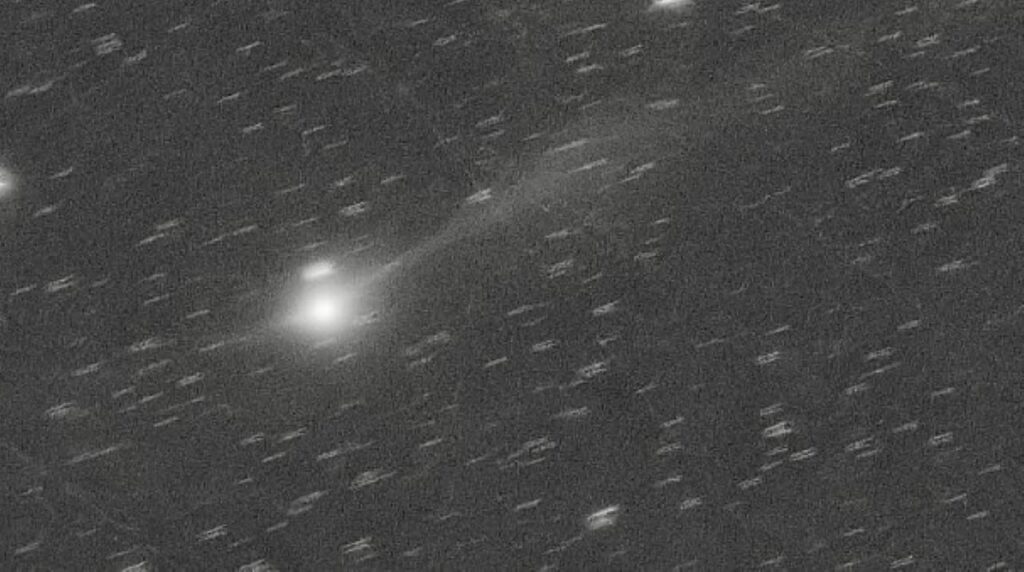
A rare astronomical event has put space agencies on high alert. A comet of interstellar origin, named 3I/ATLAS, was detected emitting a continuous radio signal, which led NASA’s Escritório of Coordenação of Defesa Planetária to intensify its monitoring. The object, which travels at a speed of approximately 100,000 km/h, is the third confirmed visitor from outside our Sistema Solar.
The comet’s trajectory will take it in a single pass before returning to deep space, offering a unique opportunity for study. Scientists’ main concern lies not in the risk of collision, which has already been completely ruled out, but in the atypical behavior of the comet.
The emission of radio waves, although considered to be of natural origin, is a phenomenon that requires in-depth investigations. The objective is to understand the composition and dynamics of celestial bodies that formed in stellar environments different from ours, which could reveal secrets about the formation of other planetary systems.
Initial discovery and characteristics of the object
The ATLAS telescope (Asteroid Terrestrial-impact Last Alert System), operated from Chile, was the first to identify the object on July 1, 2025, classifying it as a potential anomaly. The initial discovery mobilized a global network of astronomers to confirm the nature of the cosmic visitor.
Subsequent observations, using Telescópio Espacial Hubble, confirmed its dimensions. The nucleus of 3I/ATLAS is estimated to be between 320 meters and 5.6 kilometers in diameter, surrounded by a cloud of gas and dust known as a coma, characteristic of active comets.
[[MVG_PROTECTED_BLOCK_0]
Its hyperbolic trajectory is the definitive signature of an object not gravitationally bound to our Sol, confirming its extrasolar origin. Desde So, scientists from Universidade, Havaí and Agência Espacial Europeia (ESA) have analyzed its characteristics, classifying it as a fragment ejected from another star system millions of years ago.
Unlike other interstellar comets, such as 2I/Borisov, 3I/ATLAS demonstrates remarkable structural stability. Ele does not present an intense process of defrosting and releasing gases, a behavior that intrigues researchers and suggests a unique internal composition.
[[MVG_PROTECTED_BLOCK_0]
The enigmatic radio transmission
The most fascinating aspect of 3I/ATLAS was the detection of a consistent radio signal, captured by the MeerKAT radio telescope, in África of Sul. The discovery was crucial in confirming the active nature of the comet, ruling out the possibility that it was an inert and rocky asteroid.
The research team rigorously analyzed the data to eliminate any possibility of terrestrial or satellite interference, confirming that the emission comes directly from the object. The spectral analysis of the signal is fundamental for scientific study.
The strength and regularity of the signal is constantly monitored as it provides valuable information about the sublimation rate and chemical composition of the water present in the comet’s nucleus, offering a rare glimpse into the chemistry of another star system.
NASA Planetary Defense Mobilization
In August 2025, NASA’s Escritório of Coordenação of Defesa Planetária convened a team of experts to evaluate comet 3I/ATLAS. The action follows a standard protocol for objects of unknown origin or that exhibit unusual behavior, even when there is no threat of direct impact with Terra. Este procedure ensures that all observation resources are allocated efficiently to maximize data collection and understanding of the phenomenon. The agency’s quick response demonstrates the seriousness with which astronomical events of this magnitude are treated.
The task force’s main objective is to coordinate a global observation campaign to collect as much data as possible during the comet’s brief passage through our solar system. The initiative involves collaboration between observatories on different continents, space telescopes and radio telescopes. International coordination is essential to ensure continuous coverage of the object, allowing scientists to monitor changes in its brightness, activity and radio emissions in real time, providing a complete and unprecedented dataset on an interstellar visitor.
Trajectory and risk assessment
Orbital calculations carried out by both NASA and ESA confirm that 3I/ATLAS will follow a safe trajectory, without any risk of collision with our planet. The predictability of its orbit allows scientists to plan observations months in advance.
Its closest approach to Terra will occur on December 19, 2025, at a safe distance of 270 million kilometers, almost twice the distance between Terra and Sol. Após reaches perihelion, its closest point to Sol, the comet will be launched back into interstellar space, never to return.
Chemical composition analysis
Cutting-edge telescopes such as the Very Large Telescope (VLT) at Chile and the Telescópio Espacial James Webb were aimed at 3I/ATLAS to perform a detailed spectrographic analysis of its coma. The purpose of these instruments is to break down the light reflected by the comet’s gas and dust to identify the chemical elements and compounds present, such as water, carbon monoxide, cyanide and other complex organic molecules. Esta thorough analysis allows the creation of a chemical “fingerprint” of the object, revealing the raw material from which it formed in its stellar system of origin. Comparar this composition with that of comets from our own Sistema Solar helps scientists understand the similarities and differences in planetary formation processes in different parts of the galaxy, offering crucial clues about the universality of the ingredients necessary for life.
What sets 3I/ATLAS apart
While ‘Oumuamua, the first interstellar visitor, was a rocky and elongated object, and 2I/Borisov behaved like a more traditional comet, 3I/ATLAS stands out for the stability of its structure and, mainly, for its clear and continuous natural radio emission.
This third visitor offers a crucial interim data point, enriching knowledge about the diversity of small bodies traveling between stars and providing a new model for future detections.
Next steps in monitoring
Monitoring of 3I/ATLAS will continue intensively in the coming months. Astrônomos amateurs and professionals around the world are tracking its variations in brightness, while global radio telescopes remain on alert for any changes in the radio signal, which could indicate new ejections of material or changes in its internal activity as it approaches Sol.