
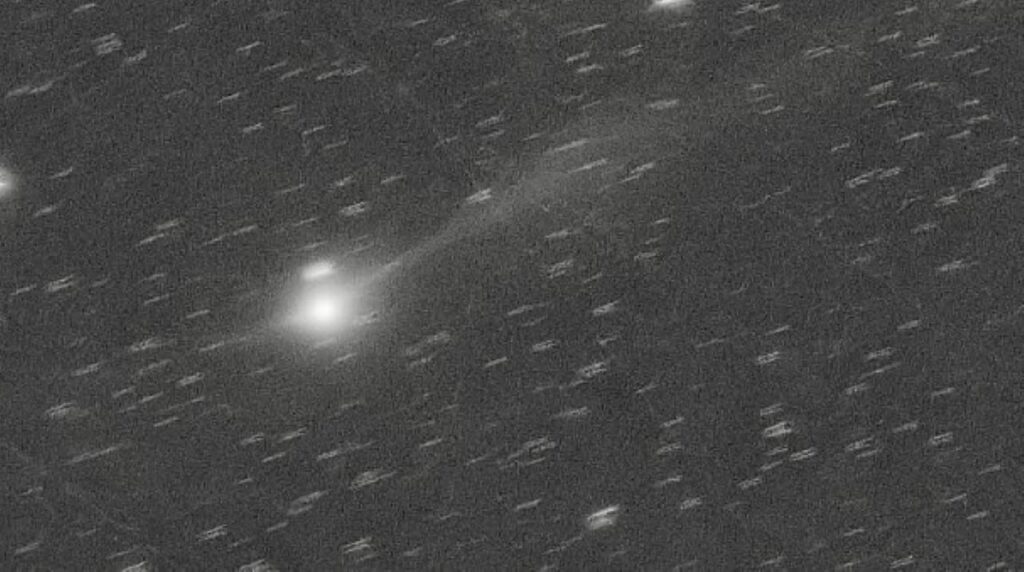
The international scientific community is focused on a new cosmic visitor, the interstellar comet 3I/ATLAS. Descoberto on July 1, 2025, this is the third object confirmed to come from outside our solar system, but its unique characteristics, especially the emission of anomalous radio signals, distinguish it from its predecessors, ‘Oumuamua and 2I/Borisov.
The detection of unusual radio emissions, coupled with a travel speed exceeding 100,000 kilometers per second, placed Administração Nacional of Aeronáutica and Espaço (NASA) on alert. The agency activated planetary defense protocols for intensive monitoring, coordinating a global network of observatories to monitor the object’s every movement.
This pass represents an unprecedented scientific opportunity to analyze primordial material from another star system. Detailed study of its composition and trajectory can provide crucial answers about the formation of planets and the diversity of celestial bodies in the galaxy.
Origin and characteristics of the cosmic visitor
Scientists at Agência Espacial Europeia (ESA) and other institutions describe 3I/ATLAS as a predominantly rocky body, which was likely ejected from its home star system millions of years ago. Estimates of its size are remarkable, with a core that can vary between 320 meters and 5.6 kilometers in diameter, a considerable size for an interstellar object. Sua composition, a mixture of frozen gases and cosmic dust, differs from that observed in our native comets Cinturão of Kuiper or Nuvem of The preliminary analysis of its chemical composition acts as a true time capsule, offering valuable clues about the conditions that exist in its home star system.
The comet’s trajectory, with its high speed and steep orbital inclination, confirms that it is not gravitationally bound to Sol, being an authentic messenger from another star. Continuous observations seek to refine data on its internal structure and the dynamics of its coma and tail, which form as it approaches Sol. The interaction of these materials with the solar wind is under close analysis, as it reveals how objects from different star systems react to conditions in our own solar system. The comparison with ‘Oumuamua, which was more elongated and rocky, and 2I/Borisov, which had a more familiar composition, positions 3I/ATLAS as a key piece in expanding understanding of the diversity of small celestial bodies traveling through Via Láctea.
[[MVG_PROTECTED_BLOCK_0]
The mysterious detection of radio signals
One of the most intriguing aspects of 3I/ATLAS emerged on October 24, 2025, with the detection of radio signals coming directly from the comet.
The discovery was made by the powerful MeerKAT radio telescope, on África of Sul, which captured emissions at a frequency of 1.6 GHz.
[[MVG_PROTECTED_BLOCK_0]
Although spectral analysis identified the signature of hydrogen, a common element in comets, the intensity and regularity of the emissions surprised researchers, raising new questions about the object’s activity.
Global mobilization for detailed observation
Given the scientific relevance of the event, NASA’s Escritório of Coordenação of Defesa Planetária scheduled a press conference for August 2025.
[[MVG_PROTECTED_BLOCK_0]
The main objective of the meeting is to present to the public and the scientific community the data collected so far and detail the next steps of the observation campaign.
Cutting-edge instruments such as the Very Large Telescope (VLT), on the Chile, and the Telescópio Espacial Hubble, have already been targeted for 3I/ATLAS.
These observatories are performing detailed spectroscopic analyzes to precisely determine the comet’s chemical composition, which could reveal information about its home star system.
Trajectory and safe approach to Terra
Despite intensive monitoring, space agencies guarantee that the trajectory of comet 3I/ATLAS does not pose any risk of collision with Terra. The object’s orbit was calculated with high precision, and models indicate safe passage. The point of closest approach to our planet is scheduled for December 19, 2025, when the comet will be at a distance of approximately 27 million kilometers. Para For comparison purposes, this distance is about twice the average distance between Terra and Marte, which eliminates any possibility of impact. Essa proximity, although safe, is an advantage for astronomers as it will allow unprecedentedly detailed observations of an object from another star system using both ground-based and space-based telescopes. Continuous monitoring of its orbit remains a priority to ensure that unexpected deviations do not occur, although the current trajectory is considered stable and predictable.
What scientists hope to learn
The 3I/ATLAS analysis provides a unique window into the “geology” of other solar systems.
Studying the materials that formed around another star allows scientists to test and improve currently accepted models of planetary formation.
Planetary defense protocols in action
This event serves as a real-time testbed for the international planetary defense network, enhancing collaboration and information exchange between agencies such as NASA and ESA. Essa cooperation is essential to ensure a coordinated and efficient response to any future cosmic threat, validating procedures and communication between different teams around the world.