
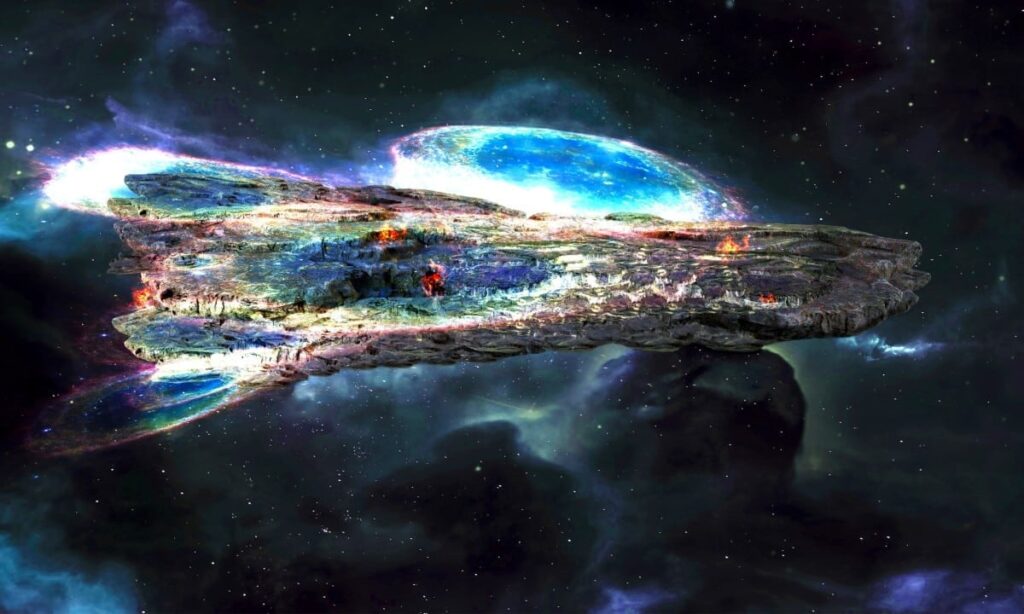
Photo: Imagens 3D do cometa 3I ATLAS – Photo: jhonny marcell oportus/ shutterstock.com
Space exploration reached a new milestone in October 2025, when the Chinese probe Tianwen-1, operating in the orbit of Marte, obtained high-resolution images of comet 3I/ATLAS. Este event represents the first time that an interstellar object is observed and photographed from another planet, consolidating a significant advance for planetary science and astronomy.
The recording was carried out at an approximate distance of 30 million kilometers from the celestial body, a feat that required high-precision maneuvers and meticulous planning on the part of Administração Espacial Nacional of China (CNSA). The images provide crucial data for the global scientific community, which studies the composition and trajectory of visitors from outside our Sistema Solar.
The passage of comet 3I/ATLAS in the vicinity of Planeta Vermelho mobilized several space agencies, which directed their equipment to collect as much information as possible. International collaboration was essential to cross-reference data and obtain a more complete understanding of the nature of this rare cosmic object.
The characteristics of the rare interstellar visitor
Comet 3I/ATLAS is the third object with a confirmed origin outside our Sistema Solar, following the detections of ‘Oumuamua in 2017 and 2I/Borisov in 2019. Sua trajectory, described as a sharp hyperbolic orbit, is the main evidence that it does not belong to our system and is just passing through. About 5.6 kilometers in diameter and traveling at a speed of 58 kilometers per second, its analysis offers a unique opportunity to study materials formed in the protoplanetary disk of another star, providing clues about the formation of other planetary systems in Via Láctea. The nature of these visitors is of extreme scientific interest, as they carry primordial information about their home systems, acting as true cosmic time capsules that travel through interstellar space for millions or even billions of years before crossing our path.
Precise HiRIC camera maneuver
The high-resolution camera HiRIC (High Resolution Imaging Camera), on board Tianwen-1, was the central instrument for the successful observation. Originalmente designed to map the surface of Marte in detail, the mission engineering team adapted its use to track a small, faintly glowing, fast-moving target in vast space. The ability to reconfigure an instrument for such a different task demonstrates the flexibility and technological advancement of the Chinese mission.
[[MVG_PROTECTED_BLOCK_0]
To overcome the challenge of capturing such a fast-moving object without generating blurry images, exhaustive simulations were carried out. The strategy adopted was to use extremely short exposure times, optimizing light capture and ensuring the necessary sharpness. The raw data was transmitted to the control center on Pequim, where a specialized processing system assembled the image sequences, revealing the comet with unprecedented clarity for an observation from another planet.
Comet composition and activity revealed
The photographs released by CNSA clearly show the rocky and frozen core of 3I/ATLAS. The Este nucleus is surrounded by a coma, a cloud of gas and dust that forms when the heat from the Sol sublimates the ice on the comet’s surface.
[[MVG_PROTECTED_BLOCK_0]
The coma reached a diameter of thousands of kilometers, indicating very intense cometary activity. The tail, formed by particles ejected by the pressure of solar radiation, extended for around 56 thousand kilometers and was positioned in the opposite direction to Sol during the observations.
Preliminary spectral analyses, based on the data collected, suggest the presence of water ice and carbon dioxide. Também weaker signals of carbon monoxide were detected, a composition that points to a formation in a very cold region of its home star system.
The reddish glow observed in the core is attributed to the presence of dust rich in organic compounds. Além In addition, scientists analyze a non-gravitational acceleration, a slight deviation in the trajectory that cannot be explained by gravity alone, indicating additional forces caused by the ejection of gases from its surface.
Global effort to observe 3I/ATLAS
The passage of 3I/ATLAS through Marte was not observed only through China. Agência Espacial Europeia (ESA) used its Mars Express and ExoMars Trace Gas Orbiter probes to analyze gaseous emissions from the comet’s coma, providing a complementary perspective to the Chinese data.
The collaboration allowed us to obtain a more three-dimensional view of the object’s activity, combining different observation angles to refine models of its composition and structure.
NASA also actively participated in the effort, directing Mars Reconnaissance Orbiter (MRO) to capture images with its powerful HiRISE instrument. On the surface, rovers like Perseverance attempted to detect the comet from the Martian soil, a considerable technical challenge, while the Hope and MAVEN probes collected spectrometric data.
Trajectory of the Chinese mission in Marte
Launched in July 2020, the Tianwen-1 mission represents a milestone for the Chinese space program, being the country’s first mission, Marte. The probe successfully entered Martian orbit in February 2021, carrying an orbiter, a lander and the Zhurong rover.
In May 2021, the Zhurong rover landed on the vast plain of Utopia Planitia, where it operated for approximately one Earth year. Durante its mission on the surface, the rover collected geological data, analyzed the composition of the soil and atmosphere and sent back detailed images of the terrain, contributing to the understanding of the geological history of Marte.
The planning behind the historical record
The Tianwen-1 mission team began planning to observe the comet in September 2025, as soon as orbital predictions became accurate enough. The calculations took into account the object’s high speed and low luminosity to determine the ideal observation windows.
The process ensured that the probe was in the correct position and that the instruments were properly calibrated for recording. The complexity of the maneuver reinforces the China’s ability to perform highly complex space operations.
The future of space exploration of China
The success of the 3I/ATLAS observations serves as an important validation of the technologies and methods that will be used in future Chinese missions. The experience gained strengthens the Sistema Solar smaller bodies exploration program, one of the CNSA’s focuses for the next decade. The Tianwen-2 mission, launched in May 2025, aims to collect samples from an asteroid close to Terra and, later, study a comet from the main belt, paving the way for even more ambitious explorations.