
Astronomers have confirmed the discovery of only the third known interstellar object ever
observed passing through our Solar System, offering a rare glimpse into material formed around
another star. The object, designated 3I/ATLAS, was detected on 1 July 2025 by the Asteroid
Terrestrial-impact Last Alert System (ATLAS), a global network of telescopes designed to scan
the skies for fast-moving celestial bodies.
Now officially classified as C/2025 N1 (ATLAS), the comet was initially catalogued as A11pl3Z
before follow-up observations revealed its extraordinary origin. Its path through space is
hyperbolic, meaning it is not gravitationally bound to the Sun. Instead, it is passing through
once, on a trajectory that will carry it back into interstellar space, never to return.

Scientists say this unmistakable trajectory confirms its status as an interstellar visitor, making it
the third such object ever confirmed, following 1I/ʻOumuamua in 2017 and 2I/Borisov in 2019.
The prefix “3I” formally marks it as the third interstellar object detected entering our planetary
neighbourhood.
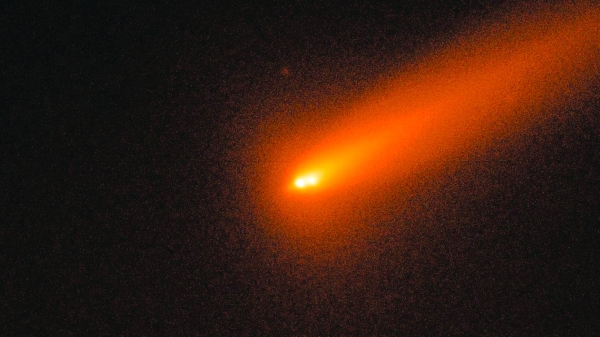
Unlike ʻOumuamua, which showed puzzling behaviour and no obvious cometary tail, 3I/ATLAS
displays the more familiar characteristics of a comet. Images reveal a diffuse coma, a glowing
envelope of gas and dust released as solar heat warms its surface. This makes it particularly
valuable to astronomers, as it provides a clearer opportunity to study the chemistry and
structure of material formed around another star system.

Importantly, researchers stress that the comet poses no threat to Earth. At its closest approach,
it passed at a distance of approximately 1.8 astronomical units, well beyond the orbit of Mars. Its
significance lies not in danger, but in discovery.
Interstellar comets are thought to be fragments left over from the formation of planetary systems
elsewhere in the galaxy, ejected into space by gravitational interactions with giant planets or
nearby stars. Studying them allows scientists to compare the building blocks of distant solar
systems with those of our own, offering clues about how common -or unusual- the Solar System
might be.

The detection also highlights how dramatically astronomical capabilities have advanced in
recent years. Sky surveys such as ATLAS now scan the heavens nightly with unprecedented
sensitivity, increasing the likelihood that more interstellar objects will be found. Some
researchers believe that such visitors may be relatively common, but fleeting and difficult to
detect without constant monitoring.
As 3I/ATLAS continues its swift journey out of the Solar System, telescopes around the world
are racing to gather as much data as possible before it fades from view. Each observation adds
another piece to a cosmic puzzle, reminding us that the Solar System is not an isolated island,
but part of a dynamic and interconnected galaxy, where even distant stars can briefly send
messengers across the void.