
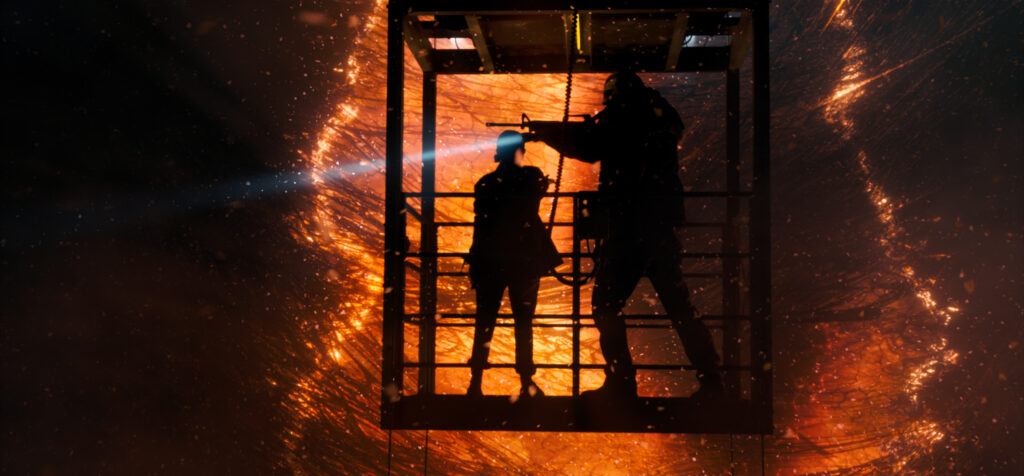
Not many ideas in science fiction are used as much as the portal. A glowing tear in the air or hidden doorway in a wall. A shortcut that collapses impossible distances or opens onto another world entirely.
Stranger Things taps directly into a fascination with another galaxy hidden behind a portal. It’s portals (usually called gates) are rips between Hawkins and the Upside Down. They are unstable in a way that suggests the universe itself has been damaged. But how much of that idea connects to real science? And how much is pure invention and sci-fi writers taking a bit of creative license?
To answer that, it helps to strip away the spooky 80s imagery and look at what portals would actually mean in our world and within the laws of physics.
How Portals Work in Stranger Things
In the world of Stranger Things, portals are not natural features of the universe. They are created events. Every major gate can be traced back to psychic interference. Eleven’s contact with the entity that became Vecna in 1983 was the origin. That moment doesn’t just open a doorway, it establishes a permanent weak point between two regions of reality.
The show gradually reframes the Upside Down not as a parallel universe that always existed but as a shadow realm shaped at the moment of contact. The portals function like wounds in space. They connect Hawkins to this hostile environment through fixed locations: walls, ceilings, floors, even bodies. They behave less like doors and more like leaks that are bleeding energy and destabilizing everything around them.
From a storytelling perspective, these gates resemble what physicists loosely call wormholes. They’re bridges between distant regions of space or between different states of reality. But that resemblance is mostly visual and metaphorical. The actual physics of space-time is far less forgiving.
What It Means to “Break” Space-Time
One of the most common misconceptions in science fiction is that space-time behaves like fabric that can be ripped or torn. The phrase shows up everywhere because it’s intuitive. But it’s also misleading.
In physics, space-time is not a material. It has no threads to cut and no surface to puncture. It is a mathematical structure that describes how space and time are linked and shaped by mass and energy. When physicists talk about space-time “bending,” they mean that objects move along curved paths because the geometry of the universe itself has changed.
To truly “break” space-time would require energy densities so extreme that normal physical laws stop working. This happens at singularities, such as the centers of black holes or the moment of the Big Bang. These are not openings or gateways. They are points where our equations fail.
In Stranger Things, portals open quietly. Sometimes with a shimmer, sometimes with a pulse. Any real and non-fictional event capable of restructuring space-time would be violently catastrophic, releasing energies far beyond anything humans could survive.
Why Black Holes Don’t Work as Portals
Science fiction often treats black holes as cosmic doors. Fall in one side, emerge somewhere else. The reality is much harsher.
A black hole is defined by its event horizon. This is the boundary beyond which nothing – not even light – can escape. Once crossed, there is no known mechanism for exit. Inside, gravity stretches objects into long, thin strands in a process known as spaghettification. It destroys or mutilates any structure long before it reaches the center.
There is also the problem of information loss. Physics depends on the idea that information is conserved. If matter enters a black hole and vanishes forever, that principle breaks. Modern theories suggest information is somehow preserved at the event horizon, but not in a way that allows travel or communication. The Black Hole Information Paradox is a fascinating part of theoretical physics.
In short, black holes are dead ends. They do not function as tunnels or bridges that can be travelled across. Any portal that behaves like one in Stranger Things would have to avoid all of these problems, which no known physics allows.
Extreme Physics Scenarios
Some speculative ideas in physics do resemble portals at first glance. This is why they appear so often in science fiction.
One example is cosmic strings. They are hypothetical ultra-thin defects in space-time left over from the early universe. If they exist, they would be unimaginably dense and energetic. Certain equations suggest that two cosmic strings passing near each other could distort space-time in exotic ways. However, there is no evidence they can create stable passageways. There’s actually no hard evidence they exist at all. This is still very much a theory.
Another idea involves quantum fluctuations, where tiny, short-lived changes in energy appear and vanish in empty space. Caltech’s Faculty describes the theory: “The uncertainty principle states that we cannot know both the position and speed of a particle, such as a photon or electron, with perfect accuracy; the more we nail down the particle’s position, the less we know about its speed and vice versa.
In other words, if we could shrink a tortoise down to the size of an electron, we would only be able to precisely calculate its speed or its location, not both at the same time.”
At the smallest scales, space-time may be easier to think of as foamy rather than smooth. But these fluctuations occur at lengths billions of times smaller than an atom and disappear almost instantly. Scaling them up to human-sized portals would require energy on an unbelievable (and probably unattainable) scale.
Science fiction often borrows these concepts and strips away their limits. It turns them into narrative tools. The result feels plausible because the language is real, even if the application is not. Plus, what would science fiction be if we lived relentlessly within the realms of what is possible?
The Stability Problem
Even if a portal could theoretically form, it would face one overwhelming issue: stability.
In general relativity, wormhole-like structures collapse almost immediately unless held open by exotic matter. This is material with negative energy density. Exotic matter has never been observed in usable quantities and its existence remains speculative.
Without it, any tunnel through space-time would pinch off faster than light could cross it. The portals in Stranger Things remain open for minutes, hours, or even years. From a physics standpoint, that alone places them firmly outside reality.
The show occasionally hints that the Upside Down itself helps stabilize the gates, acting like a pressure reservoir or anchor. This is clever worldbuilding, but it replaces one impossibility with another. A realm capable of sustaining space-time violations would already require physics beyond our universe.
The Duffer brothers (makers of the show) have claimed that there is a 30-page document that outlines the lore and physics of the Upside Down. Whether it will ever see the light of day, we don’t know…
Portals Elsewhere in Science Fiction
Stranger Things sits in a long tradition of portal-based storytelling. In Interstellar, a wormhole near Saturn allows interstellar travel, justified with real equations but still dependent on unknown physics. There’s even a scene with Matthew McConaughey interacting with a physical representation of a wormhole and using it to communicate with his daughter.
Stargate SG-1 treats portals as ancient technology. They’re stable and repeatable, ignoring the energy problem entirely. Even Doctor Who turns space-time into something that can be folded and casually reopened (though if realism is high on your priorities, Doctor Who might not be for you).
What separates Stranger Things is tone. Its portals are not tools. They are mistakes. They leak and rot the world around them. That framing aligns somewhat closely with real physics, which suggests that tampering with space-time would be disastrous rather than convenient.
Science vs Storytelling
The portals in Stranger Things are not scientifically plausible. They violate known limits on energy and information. They require a universe that behaves very differently from our own.
But that does not make them meaningless. Science fiction is not about predicting the future. It is about using scientific ideas to explore different themes. The show’s gates work because they feel like cosmic accidents and unnatural intrusions that should never have existed.
Real physics tells us that space-time is not fragile in the way the show suggests. It is extraordinarily resistant to change. And that is exactly why portals remain confined to fiction for now.