
CLEVELAND — A Northeast Ohio Hospital network is working alongside NASA to make space safer for astronauts.
What You Need To Know
NASA is researching how to keep astronauts safe and healthy on longer duration missions
Mini x-ray technology could prove helpful to astronauts in diagnosing breaks and cavities
To ensure the best miniature x-ray model is sent to space, NASA is seeking the opinions of radiologists at University Hospitals
Soon, if you get an X-ray at University Hospitals, you could help NASA make space safer for astronauts.
“With our plans to go to the moon and to go to Mars, these are longer duration missions,” Cy Peverill, NASA Glenn Research Center project task lead, said. “And, so that puts the crew’s health at a much higher risk and creates more possibility for issues or equipment failure.”
Right now, Peverill said there are miniaturized x-rays in space. Peverill’s team is hoping to change that.
“The goal is to, down select from these three vendors that we have procured devices from and then have these, included in our required medical equipment for longer exploratory space missions,” Peverill said.
X-rays could be helpful in diagnosing equipment issues.
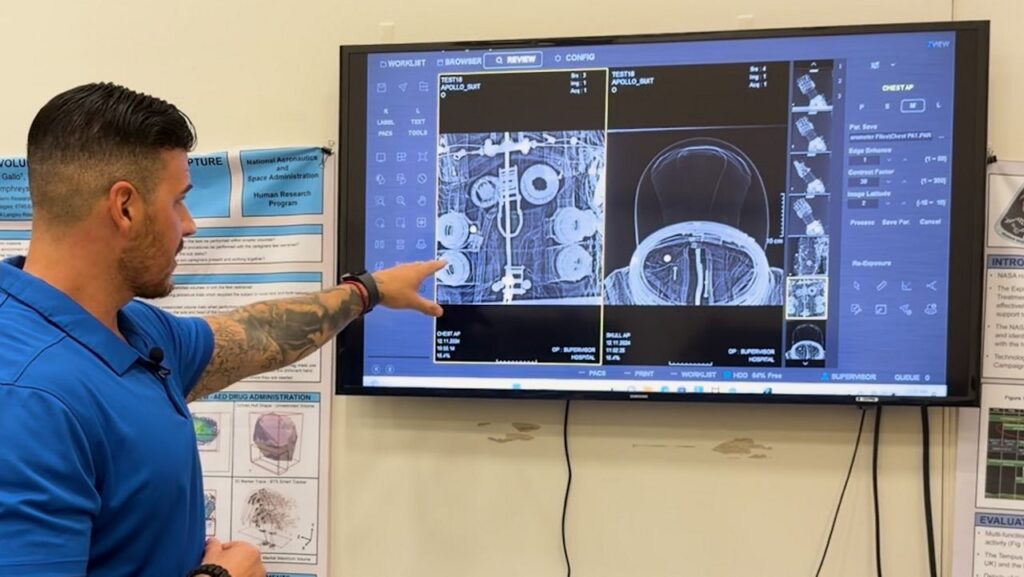
“So what you’re seeing here is actually, vector space spacesuit that we took an image of,” Peverill said. “And, the idea is to see any cracks and crevices or breaks that could be compromising its use.”
On the medical side, X-rays could be helpful in diagnosing everything from a broken bone to a cavity. Since NASA researchers aren’t experts in radiology, NASA turned to the private sector for help.
“We were originally approached by a few different members of the NASA team,” said David Jordan, the Chief Medical Physicist for Radiology and Radiation Safety at University Hospitals Cleveland Medical Center.
Jordan said when the study begins, patients who need an x-ray can get a traditional x-ray done followed by a mini x-ray.
“Our doctors will look at it,” Jordan said. “They’ll kind of give an evaluation and say, ‘How does it look compared to the regular clinical x-ray?’ And then, that information will also go over to NASA’s medical team.”
The data will be instrumental in helping NASA pick a miniaturized X-ray system.
“NASA coming together with hospitals and colleges, it’s really exciting,” Peverill said. “This is a new, new endeavor for us. You know, if we’re able to get this added and sent up in space, then decades down the road, you know, this is going to benefit astronauts for years to come.”
The X-ray study isn’t up and running quite yet. However, researchers at University Hospitals and NASA hope the study will get the green-light within the next few weeks.