

Image: European Space Agency
The European Space Agency’s XMM-Newton X-ray space observatory recently observed interstellar comet 3I/ATLAS for about 20 hours on December 3, when the comet was approximately 282-285 million kilometers from the spacecraft.
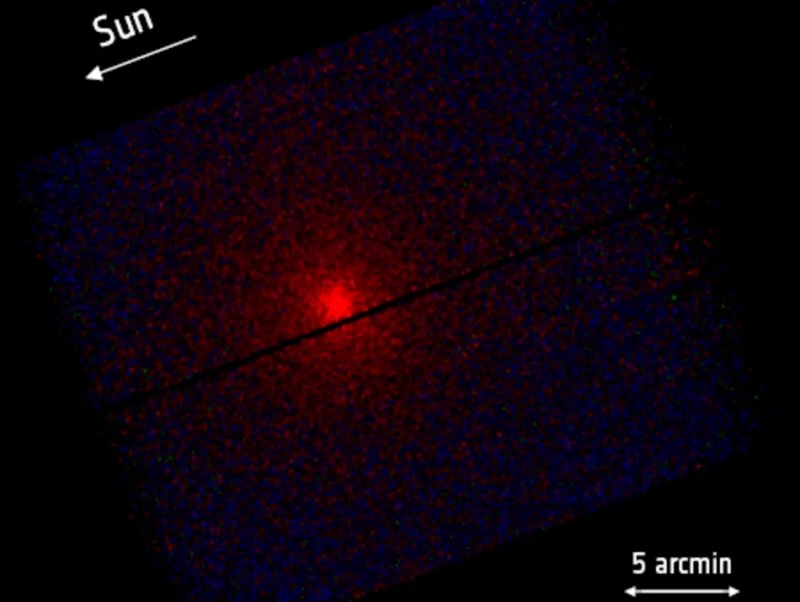
Using its most sensitive X-ray camera, the European Photon Imaging Camera (EPIC)-pn, XMM-Newton captured the comet glowing in low-energy X-rays, News.Az reports, citing ESA.
The image reveals blue areas marking empty space with very few X-rays, while red highlights the comet’s X-ray emission. This glow is expected because gas molecules from the comet collide with the solar wind, generating X-rays.
These X-rays result from interactions between the solar wind and gases such as water vapor, carbon dioxide, and carbon monoxide—gases already detected by instruments like the James Webb Space Telescope and NASA’s SPHEREx. X-ray observations are particularly sensitive to gases like hydrogen (H₂) and nitrogen (N₂), which are nearly invisible to optical and ultraviolet instruments like Hubble’s cameras or ESA’s JUICE.
This sensitivity makes X-ray observations an essential tool for scientists to detect and study gases that other instruments can’t easily identify.
The discovery of the first interstellar object, 1I/’Oumuamua in 2017, sparked speculation about exotic ice like nitrogen or hydrogen. While 1I/’Oumuamua is now too distant for detailed study, comet 3I/ATLAS offers a new opportunity to analyze an interstellar object. X-ray observations will complement other data to help scientists learn more about the comet’s composition.