
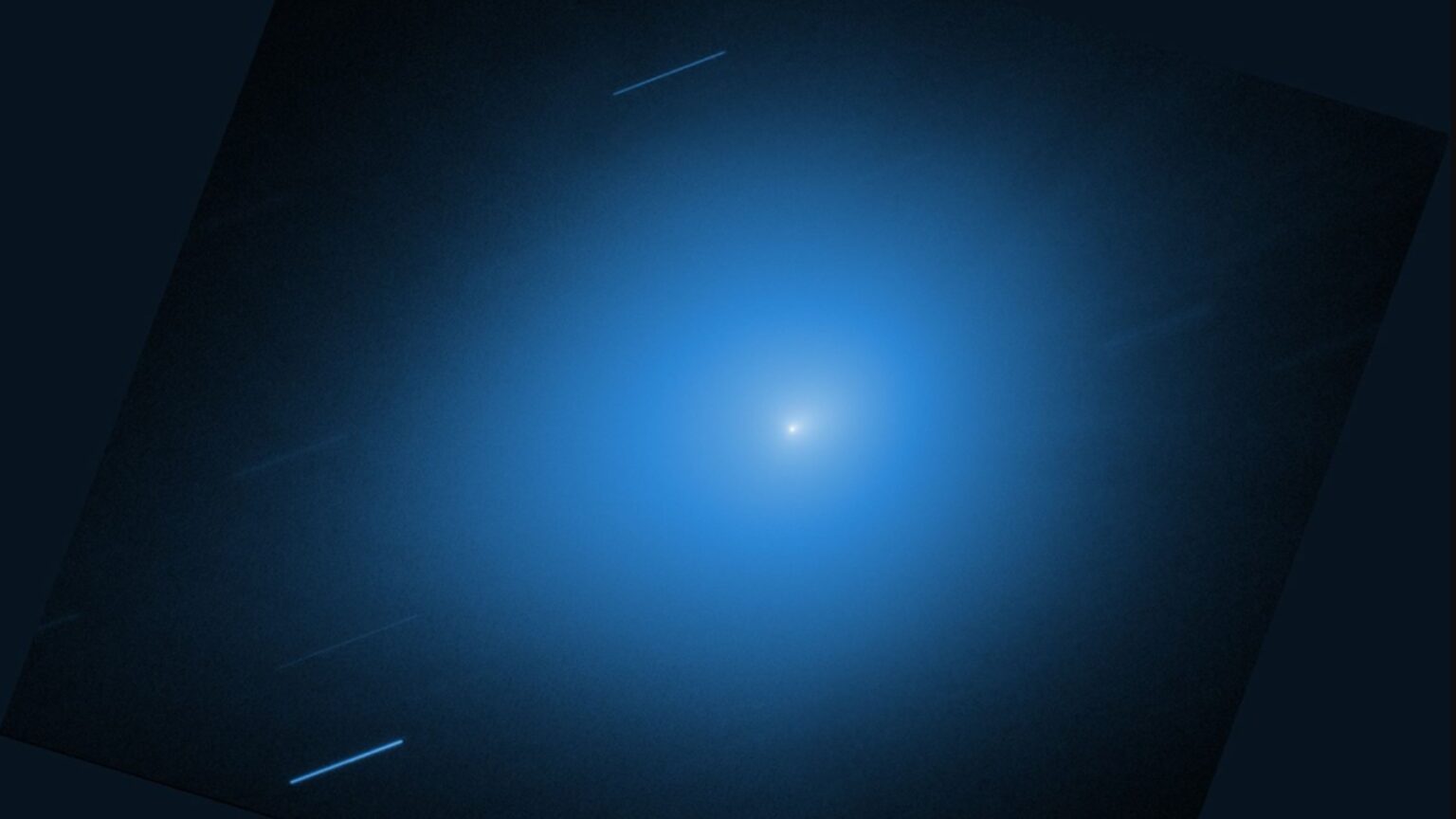
Something to look forward to is the Comet 3I/ATLAS, which will show its heartbeat every 16 hours on the day when it appears closest to Earth. This is a rather rare moment when the interstellar comet will appear within 170 miles of our planet. All astronomers are preparing for this occurrence, where the comet will be at its brightest every 16.16 hours. This brightness signal is called the “heartbeat “pattern. While astronomers await this phenomenon, the 3I/ATLAS is exhibiting other anomalies that have never previously been observed.
The heartbeat pattern of an interstellar comet
What has come to be known as the heartbeat of the comet is periods of brightness every 16.16 hours. To explain why this is happening, astromers have put forward the idea that the 3I/ATLAS is rotating with ice heating and erupting when it faces the sun. It is the bursts of dust and gas that lead to periodic moments of brightness.
The moments of brightness in the dark every 16 hours can be seen as being very similar to a lighthouse lighting up the darkness. Upon doing research, researchers from Europe and Africa said that the 3I/ATLAS behaved in the same way as weekly outer active comets that lay beyond the sun’s gravitational reach. All the research indicated one thing: objects carried primordial interstellar material with poorly understood reactions to solar heating.
According to Avi Loeb, far more complicated structural features exist. Some features could be pockets of ice in the nucleus. Each pocket can initiate a burst of gas or dust, which is what is called the heartbeat.
What causes these bursts of gas and dust that create the brightness?
Images that have been gathered indicate bursts of gas and dust within the comet’s surface. All of these pockets with the gas and dust are found parallel to each other. According to Loeb, these pockets may be the result of:
Geological pockets of ice that get activated only when they are illuminated by solar angles
Fragments released during a near-Sun event
The result of technological thrusters
While technological thrusters will only be the result of these bursts of gas and dust in the future, it is hard for many astronomers to grasp the orientation and arrangement of these pockets within the comet.
The heartbeat is only one of the many anomalies
The heartbeat is one of the twelve documented anomalies when it comes to Comet 3I/ATLAS. Everything from the nickel composition of the comet to its fine-tuned trajectory is being assessed, and everything from its quick brightening near perihelion and its negative polarization is being seen as an anomaly.
Despite all the anomalies, the comet is a rare yet incredible opportunity, with its brightness and unusual composition making it key for changing our assumptions about objects in the solar system. With a heartbeat pattern at every 16.16 hours, this object that seems to be emitting its own light will certainly be noticed. Scientists will be carefully watching to see the range of options when it comes to objects passing through the solar system.
Awaiting the brightness that will change dramatically on December 19
This interstellar visitor will be visiting on December 19, and it is clear that this comet, which was documented in the October study in Astronomy & Astrophysics, has gained much attention. The reason for the attention is not only because of its anti-tail feature causing it to steam towards the sun, but also because of its pattern of increasing brightness every 16.16 hours, making it seem like an outer space object that is increasingly unique among objects previously observed. However, it is not only Comet 3I/ATLAS that NASA is currently tracking. NASA is tracking a stranger visitor, and the reason NASA is focused on this asteroid is that it is not moving naturally.